Results by title
9 books match the query 'Charter schools'
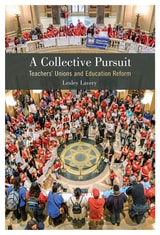
A Collective Pursuit
Teachers' Unions and Education ReformLesley Lavery
Temple University Press, 2020
Teachers’ unions are the organizations responsible for safeguarding the conditions of teachers’ employment. Union supporters claim strong synergies between teachers’ interests and students’ interests, but critics of unions insist that the stance of teachers in collective bargaining may disadvantage students as unions reduce the power of administrators to manage, remove, reward or retain excellent teachers.
In A Collective Pursuit, Lesley Laveryunpacks how teachers’ unions today are fighting for contracts that allow them to earn a decent living and build “schools all students deserve.” She explains the form and function of the nation’s largest teachers’ unions. Lavery then explores unionization campaigns in the Twin Cities charter schools. A Collective Pursuit also examines teacher strikes and contract negotiations, school finance and finance reform, and district and union attempts to address racial achievement gaps, to provide a context for understanding the economic, political, and demographic forces that inspire teachers to improve conditions for students.
A Collective Pursuit emphasizes that while teachers’ unions serve a traditional, economic role, they also provide a vast array of valuable services to students, educators, parents, and community members.
Charter School City
What the End of Traditional Public Schools in New Orleans Means for American EducationDouglas N. Harris
University of Chicago Press, 2020
New Orleans became the first US city ever to adopt a school system based on the principles of markets and economics. When the state took over all of the city’s public schools, it turned them over to non-profit charter school managers accountable under performance-based contracts. Students were no longer obligated to attend a specific school based upon their address, allowing families to act like consumers and choose schools in any neighborhood. The teacher union contract, tenure, and certification rules were eliminated, giving schools autonomy and control to hire and fire as they pleased.
In Charter School City, Douglas N. Harris provides an inside look at how and why these reform decisions were made and offers many surprising findings from one of the most extensive and rigorous evaluations of a district school reform ever conducted. Through close examination of the results, Harris finds that this unprecedented experiment was a noteworthy success on almost every measurable student outcome. But, as Harris shows, New Orleans was uniquely situated for these reforms to work well and that this market-based reform still required some specific and active roles for government. Letting free markets rule on their own without government involvement will not generate the kinds of changes their advocates suggest.
Combining the evidence from New Orleans with that from other cities, Harris draws out the broader lessons of this unprecedented reform effort. At a time when charter school debates are more based on ideology than data, this book is a powerful, evidence-based, and in-depth look at how we can rethink the roles for governments, markets, and nonprofit organizations in education to ensure that America’s schools fulfill their potential for all students.
Lost Classroom, Lost Community
Catholic Schools' Importance in Urban AmericaMargaret F. Brinig and Nicole Stelle Garnett
University of Chicago Press, 2014
More than just educational institutions, Catholic schools promote the development of social capital—the social networks and mutual trust that form the foundation of safe and cohesive communities. Drawing on data from the Project on Human Development in Chicago Neighborhoods and crime reports collected at the police beat or census tract level in Chicago, Philadelphia, and Los Angeles, Margaret F. Brinig and Nicole Stelle Garnett demonstrate that the loss of Catholic schools triggers disorder, crime, and an overall decline in community cohesiveness, and suggest that new charter schools fail to fill the gaps left behind.
This book shows that the closing of Catholic schools harms the very communities they were created to bring together and serve, and it will have vital implications for both education and policing policy debates.
Organizing Locally
How the New Decentralists Improve Education, Health Care, and TradeBruce Fuller
University of Chicago Press, 2015
Fuller first untangles the economic and cultural currents that have eroded the efficacy of—and our trust in—large institutions over the past half century. From there we meet intrepid leaders who have been doing things differently. Traveling from a charter school in San Francisco to a veterans service network in Iowa, from a Pennsylvania health-care firm to the Manhattan branch of a Swedish bank, he explores how creative managers have turned local staff loose to craft inventive practices, untethered from central rules and plain-vanilla routines. By holding their successes and failures up to the same analytical light, he vividly reveals the key cornerstones of social organization on which motivating and effective decentralization depends. Ultimately, he brings order and evidence to the often strident debates about who has the power—and on what scale—to structure how we work and live locally.
Written for managers, policy makers, and reform activists, Organizing Locally details the profound decentering of work and life inside firms, unfolding across postindustrial societies. Its fresh theoretical framework explains resurging faith in decentralized organizations and the ingredients that deliver vibrant meaning and efficacy for residents inside. Ultimately, it is a synthesizing study, a courageous and radical new way of conceiving of American vitality, creativity, and ambition.
Public Schools, Private Governance
Education Reform and Democracy in New OrleansJ. Celeste Lay
Temple University Press, 2022
Two months after Hurricane Katrina, Louisiana took control of nearly all the public schools in New Orleans. Today, all of the city’s public schools are charter schools. Although many analyses mark the beginning of education reform in New Orleans with Katrina, in Public Schools, Private Governance, J. Celeste Layargues that the storm merely accelerated the timeline for reforms that had inched along incrementally over the previous decade. Both before and after Katrina, white reformers purposely excluded Black educators, community members, and parents.
Public Schools, Private Governance traces the slow, deliberate dismantling of New Orleans’ public schools, and the processes that have maintained the reforms made in Katrina’s immediate aftermath, showing how Black parents and residents were left without a voice and the officials charged with school governance, most of whom are white, with little accountability. Lay cogently explains how political minorities disrupted systems to create change and keep reforms in place, and the predictable political effects—exclusion, frustration, and resignation—on the part of those most directly affected.
School Choice and the Future of American Democracy
Scott Franklin Abernathy
University of Michigan Press, 2005
"Scott Abernathy takes up big questions and provides answers grounded in the complex reality of policy and politics. School Choice and the Future of American Democracy is a book written for those who understand that the world does not fit the simple explanations too often put forward."
--Clarence Stone, Professor Emeritus, University of Maryland, and Research Professor, George Washington University
"Will school choice revive or eviscerate democratic processes and institutions? Will it narrow or exacerbate the range of educational inequities? This book takes several differently angled slices into these questions and draws intriguing answers."
--Jeffrey R. Henig, Teachers College, Columbia University, and author of Rethinking School Choice: Limits of the Market Metaphor
"Through extensive research and refreshingly impartial analysis, Scott Abernathy probes how the use of market principles to reform public schools affects democratic citizenship. Treating citizens first and foremost as customers, he finds, threatens civic engagement and the well-being of schools, especially in the nation's neediest communities. This thoughtful and balanced appraisal is must-reading for those concerned about the future of American education and democracy."
--Suzanne Mettler, Alumni Associate Professor, Syracuse University, and author of Soldiers to Citizens: The G.I. Bill and the Making of the Greatest Generation
Scott Franklin Abernathy is Assistant Professor of Political Science, University of Minnesota
Spin Cycle
How Research Gets Used in Policy Debates--The Case of Charter SchoolsJeffrey R. Henig
Russell Sage Foundation, 2008

Struggle For Control Of Public Education
Michael Engel
Temple University Press, 2000
Seduced by the language of the market economy, those making decisions about education today argue that market strategies promote democratic educational reform, when really they promote market reform of education. Michael Engel argues against this tendency, siding with democratic values -- which encourage openness, creativity, social awareness, and idealism, whereas market values uphold individual achievement, competition, economic growth, and national security.
Behind the facade of progressive rhetoric, advocates of these corporate models have succeeded in imposing their definition of school reform through federal and state policy makers. As a result, communities lose control of their schools, teachers lose control of their work, and students lose control of their schools, teachers lose control of their work, and students lose control of their futures. Engel attacks the increasing dominance of market ideology in educational policy and extends his critique beyond such trends in school reform as vouchers, charter schools, and "contracting out" to include issues such as decentralization, computer technology, and standards.
The debate over privatization amounts to ideological warfare between democratic and market values. The question is not so much about "school choice" as it is about the values Americans want at the root of their society. Unprecedented in its value-based challenge to the threat of market ideology to educational policy, The Struggle for Control of Public Education is a sophisticated call for a return to community-controlled schools and democratic values. This argument offers theoretical and practical models crafted in the contemporary feminist and social reconstructionist tradition. Readers interested in the study of educational policies, philosophy, and policy will find this book engaging.

The Seeds We Planted
Portraits of a Native Hawaiian Charter SchoolNoelani Goodyear-Ka'opua
University of Minnesota Press, 2013
In 1999, Noelani Goodyear-Ka‘ōpua was among a group of young educators and parents who founded Hālau Kū Māna, a secondary school that remains one of the only Hawaiian culture-based charter schools in urban Honolulu. The Seeds We Planted tells the story of Hālau Kū Māna against the backdrop of the Hawaiian struggle for self-determination and the U.S. charter school movement, revealing a critical tension: the successes of a school celebrating indigenous culture are measured by the standards of settler colonialism.
How, Goodyear-Ka‘ōpua asks, does an indigenous people use schooling to maintain and transform a common sense of purpose and interconnection of nationhood in the face of forces of imperialism and colonialism? What roles do race, gender, and place play in these processes? Her book, with its richly descriptive portrait of indigenous education in one community, offers practical answers steeped in the remarkable—and largely suppressed—history of Hawaiian popular learning and literacy.
This uniquely Hawaiian experience addresses broader concerns about what it means to enact indigenous cultural–political resurgence while working within and against settler colonial structures. Ultimately, The Seeds We Planted shows that indigenous education can foster collective renewal and continuity.