Results by title
3 books match the query 'Chechni͡a (Russia)'
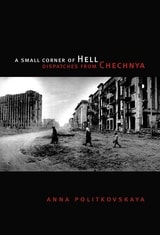
A Small Corner of Hell
Dispatches from ChechnyaAnna Politkovskaya
University of Chicago Press, 2003
An unflinching account of Russia's brutal war in Chechnya by a reporter who was assassinated because of her work
Chechnya, a 6,000-square-mile corner of the northern Caucasus, has struggled under Russian domination for centuries. The region declared its independence in 1991, leading to a brutal war, Russian withdrawal, and subsequent "governance" by bandits and warlords. A series of apartment building attacks in Moscow in 1999, allegedly orchestrated by a rebel faction, reignited the war, which continues to rage today. Russia has gone to great lengths to keep journalists from reporting on the conflict; consequently, few people outside the region understand its scale and the atrocities—described by eyewitnesses as comparable to those discovered in Bosnia—committed there.
Anna Politkovskaya, a correspondent for the liberal Moscow newspaper Novaya gazeta, was the only journalist to have constant access to the region. Her international stature and reputation for honesty among the Chechens allowed her to continue to report to the world the brutal tactics of Russia's leaders used to quell the uprisings. A Small Corner of Hell: Dispatches from Chechnya is her second book on this bloody and prolonged war. More than a collection of articles and columns, A Small Corner of Hell offers a rare insider's view of life in Chechnya over the past years. Centered on stories of those caught-literally-in the crossfire of the conflict, her book recounts the horrors of living in the midst of the war, examines how the war has affected Russian society, and takes a hard look at how people on both sides are profiting from it, from the guards who accept bribes from Chechens out after curfew to the United Nations. Politkovskaya's unflinching honesty and her courage in speaking truth to power combine here to produce a powerful account of what is acknowledged as one of the most dangerous and least understood conflicts on the planet.
Anna Politkovskaya was assassinated in Moscow on October 7, 2006.
"The murder of the journalist Anna Politkovskaya leaves a terrible silence in Russia and an information void about a dark realm that we need to know more about. No one else reported as she did on the Russian north Caucasus and the abuse of human rights there. Her reports made for difficult reading—and Politkovskaya only got where she did by being one of life's difficult people."—Thomas de Waal, Guardian
[more]
Bourdieu's Secret Admirer in the Caucasus
A World-System BiographyGeorgi M. Derluguian
University of Chicago Press, 2005
Bourdieu's Secret Admirer in the Caucasus is a gripping account of the developmental dynamics involved in the collapse of Soviet socialism. Fusing a narrative of human agency to his critical discussion of structural forces, Georgi M. Derluguian reconstructs from firsthand accounts the life story of Musa Shanib—who from a small town in the Caucasus grew to be a prominent leader in the Chechen revolution. In his examination of Shanib and his keen interest in the sociology of Pierre Bourdieu, Derluguian discerns how and why this dissident intellectual became a nationalist warlord.
Exploring globalization, democratization, ethnic identity, and international terrorism, Derluguian contextualizes Shanib's personal trajectory from de-Stalinization through the nationalist rebellions of the 1990s, to the recent rise in Islamic militancy. He masterfully reveals not only how external economic and political forces affect the former Soviet republics but how those forces are in turn shaped by the individuals, institutions, ethnicities, and social networks that make up those societies. Drawing on the work of Charles Tilly, Immanuel Wallerstein, and, of course, Bourdieu, Derluguian's explanation of the recent ethnic wars and terrorist acts in Russia succeeds in illuminating the role of human agency in shaping history.
Exploring globalization, democratization, ethnic identity, and international terrorism, Derluguian contextualizes Shanib's personal trajectory from de-Stalinization through the nationalist rebellions of the 1990s, to the recent rise in Islamic militancy. He masterfully reveals not only how external economic and political forces affect the former Soviet republics but how those forces are in turn shaped by the individuals, institutions, ethnicities, and social networks that make up those societies. Drawing on the work of Charles Tilly, Immanuel Wallerstein, and, of course, Bourdieu, Derluguian's explanation of the recent ethnic wars and terrorist acts in Russia succeeds in illuminating the role of human agency in shaping history.
[more]
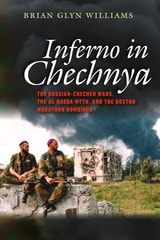
Inferno in Chechnya
The Russian-Chechen Wars, the Al Qaeda Myth, and the Boston Marathon BombingsBrian Glyn Williams
University Press of New England, 2015
In 2013, the United States suffered its worst terrorist bombing since 9/11 at the annual running of the Boston Marathon. When the culprits turned out to be U.S. residents of Chechen descent, Americans were shocked and confused. Why would members of an obscure Russian minority group consider America their enemy? Inferno in Chechnya is the first book to answer this riddle by tracing the roots of the Boston attack to the Caucasus Mountains of southern Russia. Brian Glyn Williams describes the tragic history of the bombers’ war-devastated homeland—including tsarist conquest and two bloody wars with post-Soviet Russia that would lead to the rise of Vladimir Putin—showing how the conflict there influenced the rise of Europe’s deadliest homegrown terrorist network. He provides a historical account of the Chechens’ terror campaign in Russia, documents their growing links to Al Qaeda and radical Islam, and describes the plight of the Chechen diaspora that ultimately sent two Chechens to Boston. Inferno in Chechnya delivers a fascinating and deeply tragic story that has much to say about the historical and ethnic roots of modern terrorism.
[more]