Results by title
2 books match the query 'Chemehuevi Indians'

Heritage and Change
Southern Paiute and Chemehuevi Nuwuvi Basketry, 1870 to 2026Catherine S. Fowler
Museum of New Mexico Press, 2026
The Southern Paiute and Chemehuevi people have lived for countless generations in the southern Great Basin of western North America in a homeland that extends to parts of Utah, Nevada, California, and northern Arizona. Referred to by a variety of names and spellings in the EuroAmerican literature, they are the people whose name for themselves is “Nuwu”—or collectively, “Nuwuvi.” Nuwuvi basket weaving is a traditional and evolving art form that connects weavers to their ancestors and to the natural world.
This publication, years in the making, includes chapters by Catherine S. Fowler, Judith W. Finger, John J. Kania, and Larry Dalrymple that explore the cultural history of the Nuwuvi people, the work of known weavers, and the characteristics and development of Nuwuvi basketry from the 1870s to 2022. It focuses particularly on the fine-coiled work produced during the American Arts and Crafts Movement period of the 1890s to 1930s. Working separately and together, the authors analyzed over 1,200 baskets in museum collections across the United States, from the Smithsonian Institution in Washington, D.C., to the Lost City Museum in Henderson, Nevada. They researched the baskets’ collectors—from John Wesley Powell to Helen J. Stewart and Isabel T. Kelly—and conducted interviews with contemporary weavers. In order to give the reader as broad a visual understanding of Nuwuvi coiled baskets as possible, images of baskets from the collection of Judith and Andrew Finger are included. The book is lavishly illustrated with archival and contemporary photographs.
This publication, years in the making, includes chapters by Catherine S. Fowler, Judith W. Finger, John J. Kania, and Larry Dalrymple that explore the cultural history of the Nuwuvi people, the work of known weavers, and the characteristics and development of Nuwuvi basketry from the 1870s to 2022. It focuses particularly on the fine-coiled work produced during the American Arts and Crafts Movement period of the 1890s to 1930s. Working separately and together, the authors analyzed over 1,200 baskets in museum collections across the United States, from the Smithsonian Institution in Washington, D.C., to the Lost City Museum in Henderson, Nevada. They researched the baskets’ collectors—from John Wesley Powell to Helen J. Stewart and Isabel T. Kelly—and conducted interviews with contemporary weavers. In order to give the reader as broad a visual understanding of Nuwuvi coiled baskets as possible, images of baskets from the collection of Judith and Andrew Finger are included. The book is lavishly illustrated with archival and contemporary photographs.
[more]
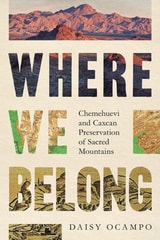
Where We Belong
Chemehuevi and Caxcan Preservation of Sacred MountainsDaisy Ocampo
University of Arizona Press, 2023
This comparative work dispels the harmful myth that Native people are unfit stewards of their sacred places. This work establishes Indigenous preservation practices as sustaining approaches to the caretaking of the land that embody ecological sustainability, spiritual landscapes, and community well-being.
The author brings together the history and experiences of the Chemehuevi people and their ties with Mamapukaib, or the Old Woman Mountains in the East Mojave Desert, and the Caxcan people and their relationship with Tlachialoyantepec, or Cerro de las Ventanas, in Zacatecas, Mexico. Through a trans-Indigenous approach, Daisy Ocampo weaves historical methodologies (oral histories, archival research, ethnography) with Native studies and historic preservation to reveal why Native communities are the most knowledgeable and transformational caretakers of their sacred places.
This work transcends national borders to reveal how settler structures are sustained through time and space in the Americas. Challenging these structures, traditions such as the Chemehuevi Salt Songs and Caxcan Xuchitl Dance provide both an old and a fresh look at how Indigenous people are reimagining worlds that promote Indigenous-to-Indigenous futures through preservation.
Ultimately, the stories of these two peoples and places in North America illuminate Indigenous sovereignty within the field of public history, which is closely tied to governmental policies, museums, archives, and agencies involved in historic preservation.
[more]