Results by title
2 books match the query 'Chemistry, Physical and theoretical'
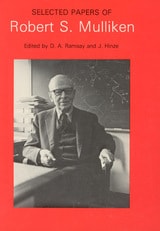
Selected Papers of Robert S. Mulliken
Robert S. Mulliken
University of Chicago Press, 1975
Included in the volume are essays of general as well as scientific interest; they are grouped under thematic headings. Part I contains those papers which are of historical significance. An autobiographical piece by Dr. Mulliken offers a glimpse of the many famous people whom he has known. Also reprinted is the text of his Nobel Prize acceptance speech. At the end is a list of his students and other co-workers, and a complete bibliography of his papers.
Part II includes Mulliken's work on band spectra and chemistry as well as his research on the assignment of quantum numbers for electrons in molecules. Part III surveys the author's early work on the bonding power of electrons and the method of molecular orbitals. Included is a discussion of the structure and spectra of a number of important types of molecules. The papers in part IV focus on the intensities of electronic transitions in molecular spectra. This incorporates Mulliken's work on charge transfer and the halogen molecule spectra.
The problems addressed in part V center on the spectra and structure of polyatomic molecules. Reprinted here is a report which Mulliken prepared on notation for polyatomic molecules. Part VI is devoted to the problem of hyperconjugation. These papers develop and apply the concept of hyperconjugation and explore its relation to the concept of conjugation. The last part offers some of the most important papers from the author's postwar publications. The central focus is on molecular orbital theory, the area in which Mulliken's Nobel-winning discoveries were made.
Self-Organization and Dissipative Structures
Applications in the Physical and Social SciencesEdited by William C. Schieve and Peter M. Allen
University of Texas Press, 1982
The contributions to this volume attempt to apply different aspects of Ilya Prigogine's Nobel-prize-winning work on dissipative structures to nonchemical systems as a way of linking the natural and social sciences. They address both the mathematical methods for description of pattern and form as they evolve in biological systems and the mechanisms of the evolution of social systems, containing many variables responding to subjective, qualitative stimuli.
The mathematical modeling of human systems, especially those far from thermodynamic equilibrium, must involve both chance and determinism, aspects both quantitative and qualitative. Such systems (and the physical states of matter which they resemble) are referred to as self-organized or dissipative structures in order to emphasize their dependence on the flows of matter and energy to and from their surroundings. Some such systems evolve along lines of inevitable change, but there occur instances of choice, or bifurcation, when chance is an important factor in the qualitative modification of structure. Such systems suggest that evolution is not a system moving toward equilibrium but instead is one which most aptly evokes the patterns of the living world.
The volume is truly interdisciplinary and should appeal to researchers in both the physical and social sciences. Based on a workshop on dissipative structures held in 1978 at the University of Texas, contributors include Prigogine, A. G. Wilson, Andre de Palma, D. Kahn, J. L. Deneubourgh, J. W. Stucki, Richard N. Adams, and Erick Jantsch.
The papers presented include Allen, "Self-Organization in the Urban System"; Robert Herman, "Remarks on Traffic Flow Theories and the Characterization of Traffic in Cities"; W. H. Zurek and Schieve, "Nucleation Paradigm: Survival Threshold in Population Dynamics"; De Palma et al., "Boolean Equations with Temporal Delays"; Nicholas Georgescu-Roegin, "Energy Analysis and Technology Assessment"; Magoroh Maruyama, "Four Different Causal Meta-types in Biological and Social Sciences"; and Jantsch, "From Self-Reference to Self-Transcendence: The Evolution of Self-Organization Dynamics."