Results by title
2 books match the query 'Chew, Geoffrey'

Beyond the World of Men
Women’s Fiction at the Czech Fin de SiècleEdited by Geoffrey Chew
Karolinum Press, 2024
Bringing together Czech fiction published by women between 1890 and 1910, Beyond the World of Men presents works that confront pivotal issues of the time, including the “woman question” and women’s rights, class conflict, lesbian love, and the relationship between the aristocracy and the Czech peasantry (as in two stories originally written in German by the aristocrat Marie von Ebner-Eschenbach). The collection contains stories that are of literary merit, but also hold historical value. In these works, the authors offer trenchant social commentary while injecting both comic and sentimental elements into their writing, employing humanity and subtlety.
As a whole, the collection suggests a revision of the critical understanding of Czech literary modernism; these writers represent voices that were not usually heard in the male writing of the period. They also demand evaluation in their differing (but constant) reactions to earlier women’s writing in Czech and in other European languages, but particularly that of the central figure of Božena Nemcová, to whose canonic novel Babicka they constantly return.
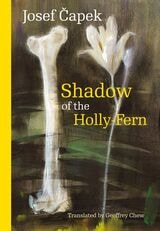
Shadow of the Holly-Fern
Josef Capek
Karolinum Press, 2026
The first English translation of Josef Capek’s classic novella explores what happens when a single violent act changes everything.
Two young poachers are caught by a gamekeeper and, in a moment of panic, shoot him. What began as a reckless adventure in pursuit of a deer becomes a desperate and increasingly hopeless flight through the forest.
Shadow of the Holly-Fern stands among the finest literary achievements of Josef Capek, the Czech painter and illustrator who died in a Nazi concentration camp in 1945 for his democratic convictions. The balladic novella is distinguished by its powerful portrayal of the fugitives’ inner lives; initially intoxicated by the beauty of the forest and a sense of freedom, they gradually succumb to mounting despair. Its intense focus on guilt and conscience recalls Crime and Punishment by Fyodor Dostoevsky, while its language remains intensely lyrical and evocative. First published in 1930, the book remains one of the enduring masterpieces of Czech literature and is presented here in English for the first time in a lucid translation by Geoffrey Chew.