Results by title
5 books match the query 'Chicago Region'
A Natural History of the Chicago Region
Joel Greenberg
University of Chicago Press, 2002
Chicago Neighborhoods and Suburbs
A Historical GuideEdited by Ann Durkin Keating
University of Chicago Press, 2008
Many of us, in fact, know little of the neighborhoods beyond those where we work, play, and live. This is especially true in Chicagoland, a region that spans over 4,400 square miles and is home to more than 9.5 million residents. In Chicago Neighborhoods and Suburbs, historian Ann Durkin Keating sheds new light on twenty-first-century Chicago by providing a captivating yet compact guide to the Midwest’s largest city. Keating charts Chicago’s evolution with comprehensive, cross-referenced entries on all seventy-seven community areas, along with many suburbs and neighborhoods both extant and long forgotten, from Albany Park to Zion. Thoughtful interpretive essays by urban historians Michael Ebner, Henry Binford, Janice Reiff, Susan Hirsch, and Robert Bruegmann explore how the city’s communities have changed and grown throughout the years, and sixty historic and contemporary photographs and additional maps add depth to each entry.
From the South Side to the West Side to the North Side, just about every local knows how distinctive Chicago’s neighborhoods are. Few of us, however, know exactly how they came to be. Chicago Neighborhoods and Suburbs brings the city—its inimitable neighborhoods, industries, and individuals—to life, making it the perfect guidebook for anyone with an interest in Chicago and its history.
Chicagoland
City and Suburbs in the Railroad AgeAnn Durkin Keating
University of Chicago Press, 2005
Historian and coeditor of the acclaimed Encyclopedia of Chicago, Ann Durkin Keating resurrects for us here the bustling network that defined greater Chicagoland. Taking a new approach to the history of the city, Keating shifts the focus to the landscapes and built environments of the metropolitan region. Organized by four categories of settlements-farm centers, industrial towns, commuter suburbs, and recreational and institutional centers-that framed the city, Chicagoland offers the collective history of 230 neighborhoods and communities, the people who built them, and the structures they left behind that still stand today.
Keating reanimates nineteenth-century Chicagoland with more than a hundred photographs and maps; we find here the taverns, depots, and way stations that were the hubs of the region's vibrant, mobile life. Keating also includes an appendix of driving tours so readers can see this history for themselves. Chicagoland takes us into the buildings and sites that are still part of our landscape and repopulates them with the stories and characters behind their creation. The result is a wide-angle historical view of Chicago, an entirely new way to understand the region.
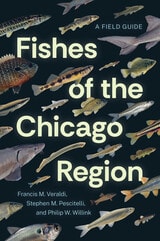
Fishes of the Chicago Region
A Field GuideFrancis M. Veraldi, Stephen M. Pescitelli, and Philip W. Willink
University of Chicago Press, 2025
“A must-have field guide for fans of Second City area fish.”—Robert Ito, The New York Times Book Review • “A treasure of hardcore fish intelligence and delightful tidbits of fish history.”—Dale Bowman, Chicago Sun-Times
Fish don’t heed state boundaries, and neither does this comprehensive, photo-filled guide to the diverse species of Chicago and beyond.
Encompassing southern Lake Michigan, northeastern Illinois, and adjacent areas of Indiana, Michigan, and Wisconsin, the Chicago Region is home to rare habitats supporting diverse fish populations. From small creeks to large rivers and from small ponds to one of the world’s largest freshwater ecosystems, Lake Michigan, these systems are home to some 164 fish species representing 31 families. In this essential field guide, the most complete and up-to-date reference for fishes in the Chicago Region, we meet them all—lampreys, sturgeon, paddlefish, gars, drum, darters, perches, sticklebacks, sculpins, and more. Written by leading local ecologists and featuring a pictorial family key, color photographs, detailed species distribution maps, and natural history observations unique to the region, this go-to guide belongs on the shelf—and in the boat—of every angler, naturalist, fisheries manager, and biologist.
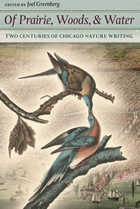
Of Prairie, Woods, and Water
Two Centuries of Chicago Nature WritingEdited by Joel Greenberg
University of Chicago Press, 2008
These writings tell the tale of a land in transition—one with abundant, unique, and incredibly lush flora and fauna, a natural history quite elusive today. Drawing on archives he uncovered while writing his acclaimed A Natural History of the Chicago Region, Greenberg hand-selected these first-person narratives, all written between 1721 and 1959. Not every author is familiar, but every contribution is distinctive. From a pioneer’s hilarious notes on life in the Kankakee marsh to Theodore Drieser’s poignant plea for conservation of the Tippecanoe River to infamous murderer Nathan Leopold’s charming description of a pet robin he kept in prison, the sources included are as diverse as the nature they describe.