Results by title
10 books match the query 'Child & Adolescent'
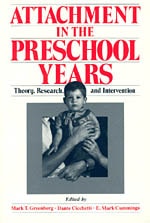
Attachment in the Preschool Years
Theory, Research, and InterventionEdited by Mark T. Greenberg, Dante Cicchetti, and E. Mark Cummings
University of Chicago Press, 1993
"There is a wealth of information and thought in this book; it does not have a weak or uninteresting chapter, starting with the Preface by Emde, and as a whole, it forms a sort of seminar."—John E. Bates, Contemporary Psychology
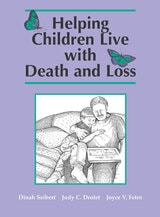
Helping Children Live With Death and Loss
Dinah Seibert, Judy C. Drolet, and Joyce V. Fetro. Illustrations by Christine I. Stetter
Southern Illinois University Press, 2003
Helping Children Live with Death and Loss is a practical guide for parents, caregivers, teachers, clergy, funeral directors, and other adults who may interact with young children between the ages of two and ten. Utilizing a developmental approach that is critical for understanding the unique characteristics and needs among children under ten, the volume is enhanced by an accessible style and format, numerous illustrations, and the positive attitude that make it possible for any reader to comprehend and apply the concepts when discussing death and loss with young children.
The scope of concepts ranges from adult self-assessment to knowledge of children’s developmental stages in learning. Building on that foundation, the book provides four basic content areas for teaching, supplies sample questions and answers, and suggests strategies for teaching general death education as well as strategies for responding to a current death or loss. The resource concludes with print and internet sources for adults and children. Helping Children Live with Death and Loss also aids adults and children in improving their communication and coping skills, which are critical for managing loss and preparing for a healthier future.
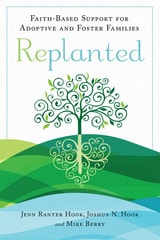
Replanted
Faith-Based Support for Adoptive and Foster FamiliesJenn Ranter Hook
Templeton Press, 2019
Many people embark on the journey of adoption and foster care but are unprepared for the challenges that await them along the way. Replanted takes an honest look at the joys and hardships that come with choosing this journey and provides a model of faith-based support made up of three parts to help families thrive: Soil, Sunlight, and Water.
- Soil, or emotional support, addresses the need for grace-filled settings where families can connect with other families who understand their experience.
- Sunlight, or informational support, focuses on obtaining helpful training to raise children who may have unique needs or challenges.
- Water, or tangible support, deals with concrete resources such as medical care, child care, and financial support.
Throughout the book, the Replanted model is brought to life by stories and examples based on the clinical work and personal experiences of the authors. Their candid insight will serve families who are actively involved in adoption or foster care, as well as people who are eager to help support those families.
Replanted affirms that with the right support system in place, parents can answer this sacred call not only with open hearts but also with their eyes wide open.

Selected Writings of Selma Fraiberg
Edited by Louis Fraiberg with a Foreword by Robert N. Emde, M.D.
The Ohio State University Press, 1987
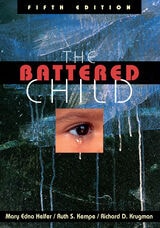
The Battered Child
Edited by Mary Edna Helfer, Ruth S. Kempe, and Richard D. Krugman
University of Chicago Press, 1999
The new edition of this classic text continues the legacy. While updating and significantly adding to previous editions, the fifth edition retains the multidisciplinary and comprehensive approach that initially set the work apart. This new edition contains chapters from professionals in such diverse fields as pediatrics, psychiatry, legal studies, and social work that reflect the past decade's extraordinary advances in research and techniques. Twenty of the book's 30 chapters are entirely new, while the remaining material has been extensively revised.
Part I provides a historical overview of child abuse and neglect as well as background material on the cultural, psychiatric, social, economic, and legal contexts of child maltreatment. Part II discusses the processes of assessing cases of physical, emotional, and sexual abuse and neglect from the unique perspectives of all the professionals involved, including teachers, pediatricians, and social workers. Part III describes intervention and treatment, focusing on legal issues, investigative procedures, and therapeutic processes, while Part IV addresses prevention and policy issues.
Previous editions of The Battered Child have earned the labels of "a classic" and a "Bible." With its up-to-date information, unequaled scope, and contributions from experts on every aspect of child abuse, the fifth edition of this cornerstone text is even more essential to the field than its predecessors.
"Comprehensive and up-to-date."—David Cottrell, British Journal of Psychiatry
"A valuable contribution to the field of abuse and neglect"—Prasanna Nair, Journal of the American Medical Association

The Development of Behavioral States and the Expression of Emotions in Early Infancy
New Proposals for InvestigationPeter H. Wolff
University of Chicago Press, 1987
Wolff argues that a coherent psychobiological theory of early human development must begin with knowledge about the infant's behavioral repertory under free field conditions. Many current theories of human development begin instead with assumptions about the organization of behavior derived from studies of psychological function in the adult; moreover, they appeal to instincts, maturational programs, or genomes to explain the apparent lawfulness in the development of these behavioral categories. Such a priori explanations, Wolff contends, beg the whole question of development. As an alternative to theoretical metaphors that portray the infant as a closed system and suggests that development is controlled by prescient programs that anticipate the mature steady state, Wolff proposes a metaphor of the infant as an open, self-organizing system with partial, mutative mechanisms of development. Applying this metaphor, he addresses the essentially unsolved problem of how novel behavioral forms are induced during ontogenesis.
Wolff presents a study of twenty-two infants who were observed for thirty hours each week in their homes during the first months after birth. He builds a week-by-week description of changes in behavioral states of wakefulness and examines how reversible state changes influence developmental transformations in social-affective behavior and sensori-motor intelligence. The observations and informal experiments emphasize expressions of emotion and the infant's changing relations to persons and things. Pointing out that movements are our only clue to what infants "feel" or "think," Wolff gives special emphasis to the systematic variations in spontaneous and environmentally evoked patterns of motor coordination as a function of behavioral state transitions.
Of great importance to psychologists, psychiatrists, pediatricians, and students of development in general, The Development of Behavioral States and the Expression of Emotions in Early Infancy offers a major empirical, methodological, and theoretical rethinking of the subject to which Wolff has made outstanding contributions.
The Development of Future-Oriented Processes
Edited by Marshall M. Haith, Janette B. Benson, Ralph J. Roberts Jr., and Bruce
University of Chicago Press, 1994
Following Marshall Haith's seminal studies on early infant anticipation, this collection begins with a survey of current knowledge about the early development of expectations. Addressing both the state of neural research in this field and the role of language and social context in the development of future orientation, the authors discuss the nature of planning in action, future orientation in humans and in nonhuman primates, and the development of intermediate and long-term expectations with regard to cognitive skills and scientific activity.
Combining developmental and cognitive perspectives, this volume will interest professionals in developmental psychology, child development, and neuropsychology.
The Emergence of Morality in Young Children
Edited by Jerome Kagan and Sharon Lamb
University of Chicago Press, 1987
"This is a welcome and immensely provocative book. For those of us who favor ethical theorizing done in close proximity to psychology and anthropology, it provides new and illuminating theory and research relevant to perennial debates about the origins of moral sense, its psychological organization, and the objectivity and unity of the moral."—Owen Flanagan, Ethics
The contributors are Augusto Blasi, Lawrence Blum, Judy Dunn, M. Ann Easterbrooks, Carolyn Pope Edwards, Robert Emde, Carol Gilligan, Charles C. Helwig, William F. Johnson, Jerome Kagan, Melanie Killen, Sharon Lamb, Manamohan Mahapatra, Joan G. Miller, Edward Mueller, Richard A. Shweder, Catherine Snow, Elliot Turiel, and Grant Wiggins.
The Five to Seven Year Shift
The Age of Reason and ResponsibilityEdited by Arnold J. Sameroff and Marshall M. Haith
University of Chicago Press, 1996
Leading researchers in neurology, sociology, anthropology, education, and psychology assess what is now commonly known as the five to seven year shift. They consider how development is influenced by changes in neurobiological subsystems; cognition, emotion, and self-concept; concerns with peers and families; and school and cultural practices. They find that important transitions in behavior and environment do take place in this period, and are best described in terms of the qualitative increase in complexity due to interactions among ecological systems.
This volume increases our understanding of both child development and the study and treatment of children at home and at school. It will interest researchers, clinicians, and students of psychology and education.
The Self in Transition
Infancy to ChildhoodEdited by Dante Cicchetti and Marjorie Beeghly
University of Chicago Press, 1990
Contributors are Elizabeth Bates, Marjorie Beeghly, Barbara Belmont, Leslie Bottomly, Helen K. Buchsbaum, George Butterworth, Vicki Carlson, Dante Cicchetti, James P. Connell, Robert N. Emde, Jerome Kagan, Robert A. LeVine, Andrew N. Meltzoff, Editha Nottelmann, Sandra Pipp, Marian Radke-Yarrow, Catherine E. Snow, L. Alan Sroufe, Gerald Stechler, Sheree L. Toth, Malcolm Watson, and Dennie Palmer Wolf.