Results by title
4 books match the query 'Child Health'
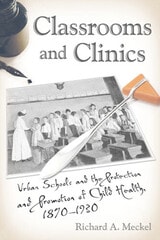
Classrooms and Clinics
Urban Schools and the Protection and Promotion of Child Health, 1870-1930Meckel, Richard A
Rutgers University Press, 2013
Classrooms and Clinics is the first book-length assessment of the development of public school health policies from the late nineteenth century through the early years of the Great Depression. Richard A. Meckel examines the efforts of early twentieth-century child health care advocates and reformers to utilize urban schools to deliver health care services to socioeconomically disadvantaged and medically underserved children in the primary grades. Their goal, Meckel shows, was to improve the children’s health and thereby improve their academic performance.
Meckel situates these efforts within a larger late nineteenth- and early twentieth-century public discourse relating schools and schooling, especially in cities and towns, to child health. He describes and explains how that discourse and the school hygiene movement it inspired served as critical sites for the constructive negotiation of the nature and extent of the public school’s—and by extension the state’s—responsibility for protecting and promoting the physical and mental health of the children for whom it was providing a compulsory education.
Tracing the evolution of that negotiation through four overlapping stages, Meckel shows how, why, and by whom the health of schoolchildren was discursively constructed as a sociomedical problem and charts and explains the changes that construction underwent over time. He also connects the changes in problem construction to the design and implementation of various interventions and services and evaluates how that design and implementation were affected by the response of the civic, parental, professional, educational, public health, and social welfare groups that considered themselves stakeholders and took part in the discourse. And, most significantly, he examines the responses called forth by the question at the heart of the negotiations: what services are necessitated by the state’s and school’s taking responsibility for protecting and promoting the health and physical and mental development of schoolchildren. He concludes that the negotiations resulted both in the partial medicalization of American primary education and in the articulation and adoption of a school health policy that accepted the school’s responsibility for protecting and promoting the health of its students while largely limiting the services called for to the preventive and educational.

Parent Education
The Northwest Conference on Child Health and Parent EducationRichard Beard
University of Minnesota Press, 1927
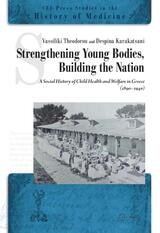
Strengthening Young Bodies, Building the Nation
A Social History of the Child Health and Welfare in Greece (1890–1940)Vassiliki Theodorou
Central European University Press, 2019
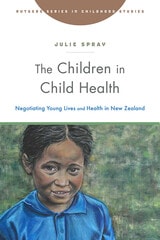
The Children in Child Health
Negotiating Young Lives and Health in New ZealandJulie Spray
Rutgers University Press, 2020
In the unique context of indigenous Māori and migrant Pacific children in postcolonial New Zealand, Julie Spray explores the intertwining issues of epidemic disease, malnutrition, stress, violence, self-harm, and death to address the problem of how scholars and policy-makers alike can recognize and respond to children as social actors in their health. The Children in Child Health innovatively combines perspectives from childhood studies, medical anthropology, and public health and policy together with evocative ethnography to show how a deep understanding of children’s worlds can change our approach to their care.