Results by title
3 books match the query 'Childfree choice'
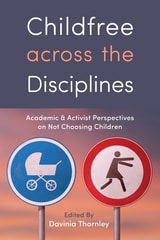
Childfree across the Disciplines
Academic and Activist Perspectives on Not Choosing ChildrenDavinia Thornley
Rutgers University Press, 2022
Recently, childfree people have been foregrounded in mainstream media. More than seven percent of Western women choose to remain childfree and this figure is increasing. Being childfree challenges the ‘procreation imperative’ residing at the center of our hetero-normative understandings, occupying an uneasy position in relation to—simultaneously—traditional academic ideologies and prevalent social norms. After all, as Adi Avivi recognizes, "if a woman is not a mother, the patriarchal social order is in danger." This collection engages with these (mis)perceptions about childfree people: in media representations, demographics, historical documents, and both psychological and philosophical models. Foundational pieces from established experts on the childfree choice--Rhonny Dam, Laurie Lisle, Christopher Clausen, and Berenice Fisher--appear alongside both activist manifestos and original scholarly work, comprehensively brought together. Academics and activists in various disciplines and movements also riff on the childfree life: its implications, its challenges, its conversations, and its agency—all in relation to its inevitability in the 21st century. Childfree across the Disciplines unequivocally takes a stance supporting the subversive potential of the childfree choice, allowing readers to understand childfreedom as a sense of continuing potential in who—or what—a person can become.
Childfree and Happy
Transforming the Rhetoric of Women's Reproductive ChoicesCourtney Adams Wooten
Utah State University Press, 2023
Through interviews with thirty-four childfree women and analysis of childfree rhetorics circulating in historical and contemporary texts and events, this book demonstrates how childfree women individually and collectively try to speak back to common beliefs about their reproductive experiences, even as they struggle to make their identities legible in a sociocultural context that centers motherhood. Childfree and Happy theorizes how affect and rhetoric work together to circulate reproductive doxa by using Sara Ahmed’s theories of gendered happiness scripts to analyze what reproductive doxa is embedded in those scripts and how they influence rhetoric by, about, and around childfree women.
Delving into how childfree women position their decision not to have children and the different types of interactions they have with others about this choice, including family members, friends, colleagues, and medical professionals, Childfree and Happy also explores how communities that make space for alternative happiness scripts form between childfree women and those who support them. It will be of interest to scholars in the fields of the rhetoric of motherhood/mothering, as well as feminist rhetorical studies.
Not Trying
Infertility, Childlessness, and AmbivalenceKristin J. Wilson
Vanderbilt University Press, 2014
But the majority of women who struggle with fertility avoid treatment. The women whose interviews appear in Not Trying belong to this majority. Their attitudes vary and may change as their life circumstances evolve. Some support the prevailing cultural narrative that women are meant to be mothers and refuse to see themselves as childfree by choice. Most of these women, who come from a wider range of social backgrounds than most researchers have studied, experience deep ambivalence about motherhood and non-motherhood, never actually choosing either path. They prefer to let life unfold, an attitude that seems to reduce anxiety about not conforming to social expectations.