Results by title
3 books match the query 'Children and sex'
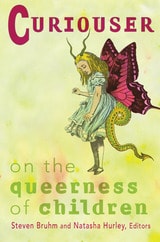
Curiouser
On The Queerness Of ChildrenSteven Bruhm
University of Minnesota Press, 2004
Classic essays and new work on the issue of childhood sexuality and its “queer resonances”
Our culture has a dominant narrative about children: they are (and should stay) innocent of sexual desires and intentions. At the same time, children are officially, tacitly, assumed to be heterosexual. Curiouser is a book about this narrative and what happens when it takes an unexpected, or queer, turn—when the stories of childhood must confront a child whose play does not conform to the ideal of child (a)sexuality.
The contributors to Curiouser examine the ostensibly simple representations of children that circulate through visual images, life narrative, children’s literature, film, and novels. At issue in these essays are the stories we tell to children, the stories we tell about children, and the stories we tell ourselves as children—stories that ultimately frame what is normative and what is queer. From the fiction of Horatio Alger, Henry James, Djuna Barnes, and Guy Davenport to the spectacles of Michael Jackson, Calvin Klein, and The Exorcist; from the narrative structure of pedophilia to evangelical Christianity; from punk tomboyism to queer girl-scouting: these scholars of childhood and sexuality scrutinize queer childhood energies in an impressive range of cultural forms. Contributors: Lauren Berlant, U of Chicago; Andre Furlani, Concordia U; Judith Halberstam, U of California, San Diego; Ellis Hanson, Cornell U; Paul Kelleher; Kathryn R. Kent, Williams College; James R. Kincaid, U of Southern California; Richard D. Mohr, U of Illinois, Urbana; Michael Moon, Johns Hopkins U; Kevin Ohi, Boston College; Eric Savoy, U of Montreal; Eve Kosofsky Sedgwick, CUNY Graduate Center; Kathryn Bond Stockton, U of Utah; Michael Warner, Rutgers U.[more]
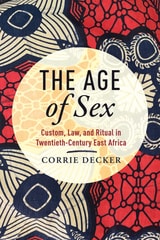
The Age of Sex
Custom, Law, and Ritual in Twentieth-Century East AfricaCorrie Decker
University of Wisconsin Press, 2025
As in much of the world, societies in precolonial East Africa—what is now Kenya, Tanzania, and Uganda—used rites of passage to chart an individual’s social and developmental progress toward adulthood. Under European colonialism, from the 1890s to the 1960s, colonial judicial systems and the emerging genre of ethnography converged to subject African people to standardized definitions of childhood and adulthood. The coexistence of rites of passage and chronological age regulations generated confusion well into the postcolonial era, and the question of when childhood ends sparked extensive debates about gender, race, and development. Corrie Decker argues that ultimately these debates came down to “the age of sex.”
In The Age of Sex, Decker demonstrates how maturation became defined as the hypothetical moment when a girl becomes a woman capable of engaging in heterosexual activity and a boy becomes a man imbued with the right and responsibility to have heterosexual intercourse. Colonial ethnographic studies reduced complex precolonial rites of passage to “puberty rites” fixated on these sexual transformations. The resulting stereotypes influenced, in turn, how colonial and postcolonial court officials decided age-of-consent and other sex crime cases. Court rituals thus legally transformed girls into women by ruling on their sexual maturity and boys into men by sentencing them to corporal punishment, marking their acceptance of heterosexual responsibilities.
In The Age of Sex, Decker demonstrates how maturation became defined as the hypothetical moment when a girl becomes a woman capable of engaging in heterosexual activity and a boy becomes a man imbued with the right and responsibility to have heterosexual intercourse. Colonial ethnographic studies reduced complex precolonial rites of passage to “puberty rites” fixated on these sexual transformations. The resulting stereotypes influenced, in turn, how colonial and postcolonial court officials decided age-of-consent and other sex crime cases. Court rituals thus legally transformed girls into women by ruling on their sexual maturity and boys into men by sentencing them to corporal punishment, marking their acceptance of heterosexual responsibilities.
[more]
The Fear of Child Sexuality
Young People, Sex, and AgencySteven Angelides
University of Chicago Press, 2019
Continued public outcries over such issues as young models in sexually suggestive ads and intimate relationships between teachers and students speak to one of the most controversial fears of our time: the entanglement of children and sexuality. In this book, Steven Angelides confronts that fear, exploring how emotional vocabularies of anxiety, shame, and even contempt not only dominate discussions of youth sexuality but also allow adults to avoid acknowledging the sexual agency of young people. Introducing case studies and trends from Australia, the United Kingdom, and North America, he challenges assumptions on a variety of topics, including sex education, age-of-consent laws, and sexting. Angelides contends that an unwillingness to recognize children’s sexual agency results not in the protection of young people but in their marginalization.
[more]