Results by title

7 books match the query 'Children and war'
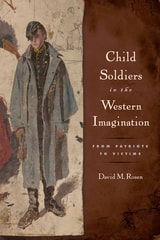
cover of Child Soldiers in the Western Imagination: From Patriots to Victims

Child Soldiers in the Western Imagination

From Patriots to Victims

Rosen, David M

Rutgers University Press, 2015

When we hear the term “child soldiers,” most Americans imagine innocent victims roped into bloody conflicts in distant war-torn lands like Sudan and Sierra Leone. Yet our own history is filled with examples of children involved in warfare—from adolescent prisoner of war Andrew Jackson to Civil War drummer boys—who were once viewed as symbols of national pride rather than signs of human degradation.
 
In this daring new study, anthropologist David M. Rosen investigates why our cultural perception of the child soldier has changed so radically over the past two centuries. Child Soldiers in the Western Imagination reveals how Western conceptions of childhood as a uniquely vulnerable and innocent state are a relatively recent invention. Furthermore, Rosen offers an illuminating history of how human rights organizations drew upon these sentiments to create the very term “child soldier,” which they presented as the embodiment of war’s human cost.
 
Filled with shocking historical accounts and facts—and revealing the reasons why one cannot spell “infantry” without “infant”—Child Soldiers in the Western Imagination seeks to shake us out of our pervasive historical amnesia. It challenges us to stop looking at child soldiers through a biased set of idealized assumptions about childhood, so that we can better address the realities of adolescents and pre-adolescents in combat. Presenting informative facts while examining fictional representations of the child soldier in popular culture, this book is both eye-opening and thought-provoking.   
[more]
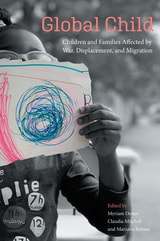
cover of Global Child: Children and Families Affected by War, Displacement, and Migration

Global Child

Children and Families Affected by War, Displacement, and Migration

Myriam Denov

Rutgers University Press, 2023
Armed conflicts continue to wreak havoc on children and families around the world with profound effects. In 2017, 420 million children—nearly one in five—were living in conflict-affected areas, an increase in 30 million from the previous year. The recent surge in war-induced migration, referred to as a “global refugee crisis” has made migration a highly politicized issue, with refugee populations and host countries facing unique challenges. We know from research related to asylum seeking families that it is vital to think about children and families in relation to what it means to stay together, what it means for parents to be separated from their children, and the kinds of everyday tensions that emerge in living in dangerous, insecure, and precarious circumstances. In Global Child, the authors draw on what they have learned through their collaborative undertakings, and highlight the unique features of participatory, arts-based, and socio-ecological approaches to studying war-affected children and families, demonstrating the collective strength as well as the limitations and ethical implications of such research. Building on work across the Global South and the Global North, this book aims to deepen an understanding of their tri-pillared approach, and the potential of this methodology for contributing to improved practices in working with war-affected children and their families.
[more]
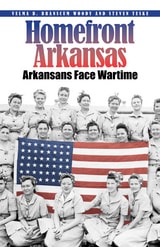
cover of Homefront Arkansas: Arkansans Face Wartime Past and Present

Homefront Arkansas

Arkansans Face Wartime Past and Present

Velma B. Branscum Woody

Butler Center for Arkansas Studies, 2009
For almost two hundred years, Arkansans have been part of America’s struggle to maintain democracy and keep the peace at home and around the globe. Homefront Arkansas: Arkansans Face Wartime Past and Present shows how war has affected those at home as well as those who served as soldiers. The chapters include: * A wounded Civil War soldier stumbles onto a homestead after a battle at Poison Springs, Arkansas, forever changing the family there * In 1875, Arkansans take sides in the Brooks-Baxter War, involving two men each claiming to be the governor of Arkansas * Arkansas volunteers follow Teddy Roosevelt into the Spanish-American War, and find troops crowded into a filthy camp as they wait to be shipped out * An African American girl leaves her native state to escape persecution, only to find that a world war is threatening to envelop her new home in England Woody’s stories provide a factual and compelling backdrop for Arkansas’s history as seen through its conflicts. Fascinated readers will follow the chronology of Arkansans who met the nation’s call both at home and abroad.
[more]
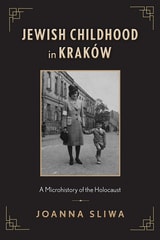
cover of Jewish Childhood in Kraków: A Microhistory of the Holocaust

Jewish Childhood in Kraków

A Microhistory of the Holocaust

Joanna Sliwa

Rutgers University Press, 2021

Winner of the 2020 Ernst Fraenkel Prize from the Wiener Holocaust Library​

Jewish Childhood in Kraków is the first book to tell the history of Kraków in the second World War through the lens of Jewish children’s experiences. Here, children assume center stage as historical actors whose recollections and experiences deserve to be told, analyzed, and treated seriously.

Sliwa scours archives to tell their story, gleaning evidence from the records of the German authorities, Polish neighbors, Jewish community and family, and the children themselves to explore the Holocaust in German-occupied Poland and in Kraków in particular. A microhistory of a place, a people, and daily life, this book plumbs the decisions and behaviors of ordinary people in extraordinary times.

Offering a window onto human relations and ethnic tensions in times of rampant violence, Jewish Childhood in Kraków is an effort both to understand the past and to reflect on the position of young people during humanitarian crises.
[more]
cover of Legacies of War: Violence, Ecologies, and Kin

Legacies of War

Violence, Ecologies, and Kin

Kimberly Theidon

Duke University Press, 2022
In Legacies of War Kimberly Theidon examines the lives of children born of wartime rape and the experiences of their mothers and communities to offer a gendered theory of harm and repair. Drawing on ethnographic research in postconflict Peru and Colombia, Theidon considers the multiple environments in which conception, pregnancy, and childbirth unfold. She reimagines harm by taking into account the impact of violence on individual people as well as on more-than-human lives, bodies, and ecologies, showing how wartime violence reveals the interdependency of all life. She also critiques policy makers, governments, and humanitarian organizations for their efforts at postconflict justice, which frequently take an anthropocentric rights-based approach that is steeped in liberal legalism. Rethinking the intergenerational reach of war while questioning what counts as sexual and reproductive violence, Theidon calls for an explicitly feminist peace-building and postconflict agenda that includes a full range of sexual and reproductive rights, including access to safe and affordable abortions.
[more]
cover of Pillars of the Nation: Child Citizens and Ugandan National Development

Pillars of the Nation

Child Citizens and Ugandan National Development

Kristen E. Cheney

University of Chicago Press, 2007

How can children simultaneously be the most important and least powerful people in a nation? In her innovative ethnography of Ugandan children—the pillars of tomorrow’s Uganda, according to the national youth anthem—Kristen E. Cheney answers this question by exploring the daily contradictions children face as they try to find their places amid the country’s rapidly changing social conditions.

Drawing on the detailed life histories of several children, Cheney shows that children and childhood are being redefined by the desires of a young country struggling to position itself in the international community. She moves between urban schools, music festivals, and war zones to reveal how Ugandans are constructing childhood as an empowering identity for the development of the nation. Moreover, through her analysis of children’s rights ideology, national government strategy, and children’s everyday concerns, Cheney also shows how these young citizens are vitally linked to the global political economy as they navigate the pitfalls and possibilities for a brighter tomorrow.
[more]
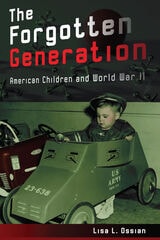
cover of The Forgotten Generation: American Children and World War II

The Forgotten Generation

American Children and World War II

Lisa L. Ossian

University of Missouri Press, 2021

Two days after the attack on Pearl Harbor, President Roosevelt addressed the nation by radio, saying, “We are all in it—all the way. Every single man, woman, and child is a partner in the most tremendous undertaking of our American history.” So began a continuing theme of the World War II years: the challenges of wartime would not be borne by adults alone. Men, women, and children would all be involved in the work of war.
The struggles endured by American civilians during the Second World War are well documented, but accounts of the war years have mostly deliberated on the grown-ups’ sacrifices. In The Forgotten Generation: American Children and World War II, Lisa L. Ossian explores the war’s full implications for the lives of children. In thematic chapters, the author delves into children’s experiences of family, school, play, work, and home, uncovering the range of effects the war had on youths of various ethnicities and backgrounds.
Since the larger U.S. culture so fervently supported the war effort, adults rarely sheltered children from the realities of the war and the trials of life on the home front. Children listened for news of battles over the radio, labored in munitions factories, and saved money for war bonds. They watched enlisted men—their fathers, uncles, and brothers—leave for duty and worried about the safety of soldiers overseas. They prayed during the D-Day invasion, mourned President Roosevelt’s death, and celebrated on V-J Day . . . all at an age when such sharp events are so difficult to understand. Ossian draws from a multitude of sources, including the writings of 1940s children, to demonstrate the great extent of these young people’s participation in the wartime culture.
World War II transformed a generation of youths as no other experience of the twentieth century would, but somehow the children at home during the war—compressed between the “Greatest Generation” and the “Baby Boomers”—slipped into the margins of U.S. history. The Forgotten Generation: American Children and World War II remembers these children and their engagement in “the most tremendous undertaking” that the war effort came to be. By bringing the depth of those experiences to light, Ossian makes a compelling contribution to the literature on American childhood and the research on this remarkable period of U.S. history.
[more]