Results by title
4 books match the query 'Children with mental disabilities'
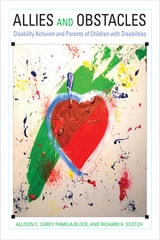
Allies and Obstacles
Disability Activism and Parents of Children with DisabilitiesAllison C. Carey, Pamela Block, and Richard K. Scotch
Temple University Press, 2020
Parents of children with disabilities often situate their activism as a means of improving the world for their child. However, some disabled activists perceive parental activism as working against the independence and dignity of people with disabilities. This thorny relationship is at the heart of the groundbreaking Allies and Obstacles.
The authors chronicle parents’ path-breaking advocacy in arenas such as the right to education and to liberty via deinstitutionalization as well as how they engaged in legal and political advocacy. Allies and Obstacles provides a macro analysis of parent activism using a social movement perspective to reveal and analyze the complex—and often tense—relationship of parents to disability rights organizations and activism.
The authors look at organizational and individual narratives using four case studies that focus on intellectual disability, psychiatric diagnoses, autism, and a broad range of physical disabilities including cerebral palsy and muscular dystrophy. These cases explore the specific ways in which activism developed among parents and people with disabilities, as well as the points of alliance and the key points of contestation. Ultimately, Allies and Obstacles develops new insights into disability activism, policy, and the family.
Fantastic Antone Succeeds
Experiences in Educating Children with Fetal Alcohol SyndromeJudith Kleinfeld
University of Alaska Press, 1993
The book consists of separate chapters written in a popular and accessible style by psychologists, teachers, and birth and adoptive parents of alcohol-affected children. Many chapters are personal stories with emotional power. A birth mother, for example, tells of her anguish when she realizes that she has recovered from her own alcoholism but her daughter cannot. This mother describes how she dealt with her grief, how she told her daughter the truth, her daughter's relief at finally understanding what was wrong, and how they both developed ways of overcoming her daughter's learning problems.
Other chapters describe how experienced teachers have learned to organize classrooms where alcohol-affected children can thrive and how therapists have learned to work with parents. One chapter summarizes medical knowledge of FAS/FAE and offers information useful for understanding a child's learning and behavioral problems and devising educational approaches. The book includes lists of important resources, organizations to contact, and descriptions of effective classroom practices for teachers.
Without minimizing the seriousness of FAS/FAE and the first priority prevention, Fantastic Antone Succeeds provides practical tools and strategies that can help alcohol-affected individuals and their families lead happier, more productive lives.
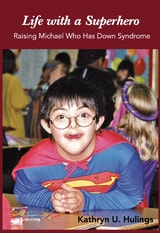
Life with a Superhero
Raising Michael Who Has Down SyndromeKathryn U. Hulings
University of North Texas Press, 2013

The Girls and Boys of Belchertown
A Social History of the Belchertown State School for the Feeble-MindedRobert Hornick
University of Massachusetts Press, 2012
During much of the twentieth century, people labeled “feeble-minded,” “mentally deficient,” and “mentally retarded” were often confined in large, publicly funded, residential institutions located on the edges of small towns and villages some distance from major population centers. At the peak of their development in the late 1960s, these institutions—frequently called “schools” or “homes”—housed 190,000 men, women, and children in the United States.
The Girls and Boys of Belchertown offers the first detailed history of an American public institution for intellectually disabled persons. Robert Hornick recounts the story of the Belchertown State School in Belchertown, Massachusetts, from its beginnings in the 1920s to its closure in the 1990s following a scandalous exposé and unprecedented court case that put the institution under direct supervision of a federal judge. He draws on personal interviews, private letters, and other unpublished sources as well as local newspapers, long out-of-print materials, and government reports to re-create what it was like to live and work at the school. More broadly, he gauges the impact of changing social attitudes toward intellectual disability and examines the relationship that developed over time between the school and the town where it was located.
What emerges is a candid and complex portrait of the Belchertown State School that neither vilifies those in charge nor excuses the injustices perpetrated on its residents, but makes clear that despite the court-ordered reforms of its final decades, the institution needed to be closed.