Results by title
3 books match the query 'Chimpanzees'

Apes on the Edge
Chimpanzee Life on the West African SavannaJill Pruetz
University of Chicago Press, 2025
Fongoli chimpanzees are unique for many reasons. Their female hunters are the only apes that regularly hunt with tools, seeking out tiny bush babies with wooden spears. Unlike most other chimps, these apes fear neither water nor fire, using shallow pools to cool off in the Senegalese heat. Up to 90 percent of their home range burns annually—the result of human hunting or clearing for gold mining—and Fongoli chimpanzees have learned to predict the movement of such fires and to avoid them.
The study of Fongoli chimps is also unique. While most primate research occurs in isolated reserves, Fongoli chimpanzees live alongside humans, and as primatologist and anthropologist Jill Pruetz reports, this shared habitat creates both challenges and opportunities. The issues faced by Fongoli chimpanzees—particularly food scarcity and environmental degradation—are also issues faced by their human neighbors. This connection is one reason Pruetz, who has studied Fongoli apes for over two decades, created the nonprofit Neighbor Ape in 2008 to provide for the welfare of the humans who share their landscape with apes. It is also why Pruetz decided to write this book, the first to offer readers a view of these chimps’ lives and to explain the specific conservation efforts needed to help them. Incorporating stories from Pruetz’s time in the field, including the compelling rescue of a young chimp from poachers, Apes on the Edge opens a fascinating window into primate research, conservation, and the inner workings of a very special population of our closest nonhuman relatives.

Chimpanzees in Context
A Comparative Perspective on Chimpanzee Behavior, Cognition, Conservation, and WelfareEdited by Lydia M. Hopper and Stephen R. Ross
University of Chicago Press, 2020
After a foreword by Jane Goodall, the book features sections that examine chimpanzee life histories and developmental milestones, behavior, methods of study, animal communication, cooperation, communication, and tool use. The book ends with chapters that consider how we can apply contemporary knowledge of chimpanzees to enhance their care and conservation. Collectively, these chapters remind us of the importance of considering the social, ecological, and cognitive context of chimpanzee behavior, and how these contexts shape our comprehension of chimpanzees. Only by leveraging these powerful perspectives do we stand a chance at improving how we understand, care for, and protect this species.
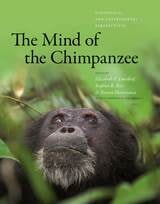
The Mind of the Chimpanzee
Ecological and Experimental PerspectivesEdited by Elizabeth V. Lonsdorf, Stephen R. Ross, and Tetsuro Matsuzawa
University of Chicago Press, 2010
Understanding the chimpanzee mind is akin to opening a window onto human consciousness. Many of our complex cognitive processes have origins that can be seen in the way that chimpanzees think, learn, and behave. The Mind of the Chimpanzee brings together scores of prominent scientists from around the world to share the most recent research into what goes on inside the mind of our closest living relative.
Intertwining a range of topics—including imitation, tool use, face recognition, culture, cooperation, and reconciliation—with critical commentaries on conservation and welfare, the collection aims to understand how chimpanzees learn, think, and feel, so that researchers can not only gain insight into the origins of human cognition, but also crystallize collective efforts to protect wild chimpanzee populations and ensure appropriate care in captive settings. With a breadth of material on cognition and culture from the lab and the field, The Mind of the Chimpanzee is a first-rate synthesis of contemporary studies of these fascinating mammals that will appeal to all those interested in animal minds and what we can learn from them.