Results by title

6 books match the query 'Chinese Diaspora'
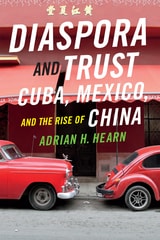
cover of Diaspora and Trust: Cuba, Mexico, and the Rise of China

Diaspora and Trust

Cuba, Mexico, and the Rise of China

Adrian H. Hearn

Duke University Press, 2016
In Diaspora and Trust Adrian H. Hearn proposes that a new paradigm of socio-economic development is gaining importance for Cuba and Mexico. Despite their contrasting political ideologies, both countries must build new forms of trust among the state, society, and resident Chinese diaspora communities if they are to harness the potentials of China’s rise. Combining political and economic analysis with ethnographic fieldwork, Hearn analyzes Cuba's and Mexico's historical relations with China, and highlights how Chinese diaspora communities are now deepening these ties. Theorizing trust as an alternative to existing models of exchange—which are failing to navigate the world's shifting economic currents—Hearn shows how Cuba and Mexico can reformulate the balance of power between state, market, and society. A new paradigm of domestic development and foreign engagement based on trust is becoming critical for Cuba, Mexico, and other countries seeking to benefit from China’s growing economic power and social influence.
[more]
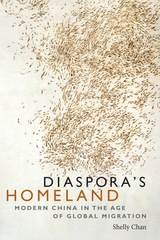
cover of Diaspora's Homeland: Modern China in the Age of Global Migration

Diaspora's Homeland

Modern China in the Age of Global Migration

Shelly Chan

Duke University Press, 2018
In Diaspora’s Homeland Shelly Chan provides a broad historical study of how the mass migration of more than twenty million Chinese overseas influenced China’s politics, economics, and culture. Chan develops the concept of “diaspora moments”—a series of recurring disjunctions in which migrant temporalities come into tension with local, national, and global ones—to map the multiple historical geographies in which the Chinese homeland and diaspora emerge. Chan describes several distinct moments, including the lifting of the Qing emigration ban in 1893, intellectual debates in the 1920s and 1930s about whether Chinese emigration constituted colonization and whether Confucianism should be the basis for a modern Chinese identity, as well as the intersection of gender, returns, and Communist campaigns in the 1950s and 1960s. Adopting a transnational frame, Chan narrates Chinese history through a reconceptualization of diaspora to show how mass migration helped establish China as a nation-state within a global system.
[more]
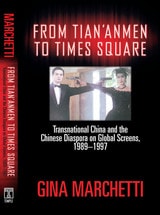
cover of From Tian'anmen to Times Square: Transnational China and the Chinese Diaspora on Global Screens, 1989-1997

From Tian'anmen to Times Square

Transnational China and the Chinese Diaspora on Global Screens, 1989-1997

Gina Marchetti

Temple University Press, 2006

Global perceptions of China have changed dramatically since the massive student protests that took place in Tian'anmen Square in April 1989. The media spotlight trained on Beijing, and the international uproar over the events of that spring still shape the world's perceptions of the People's Republic and the ways that Chinese people, within and beyond China, see and portray themselves.

In From Tian'anmen to Times Square, leading film scholar Gina Marchetti considers the complex changes in the ways that China and the Chinese have been portrayed in cinema and media arts since the Tian'anmen revolt. Drawing on her interviews with leading contemporary Chinese filmmakers, Marchetti looks at a wide range of work by Chinese and non-Chinese media artists working in China, Hong Kong, Taiwan, and Singapore and on transnational co-productions involving those places. Focusing on the intersections of race, ethnicity, gender, and sexuality on global screens, Marchetti traces the momentous political, cultural, social, and economic forces confronting contemporary media artists and filmmakers working within "Greater China."
[more]
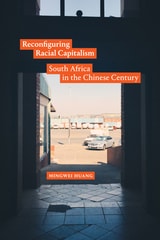
cover of Reconfiguring Racial Capitalism: South Africa in the Chinese Century

Reconfiguring Racial Capitalism

South Africa in the Chinese Century

Mingwei Huang

Duke University Press, 2024
In Reconfiguring Racial Capitalism, Mingwei Huang traces the development of new forms of racial capitalism in the twenty-first century. Through fieldwork in one of the “China malls” that has emerged along Johannesburg’s former mining belt, Huang identifies everyday relations of power and difference between Chinese entrepreneurs and African migrant workers in these wholesale shops. These relations, Huang contends, replicate and perpetuate global structures of white supremacy, anti-Blackness, capitalism, and colonialism, even when whiteness is not present. Huang argues that this dynamic reflects the sedimented legacies and continued operation of white supremacy and colonialism, which have been transformed in the shift of capitalism’s center of gravity toward China and the Global South. These new forms of racial capitalism and empire layer onto and extend histories of exploitation and racialization in South Africa. Taking a palimpsestic approach, Huang offers tools for understanding this shift and decentering contemporary Western conceptions of race, empire, and racial capitalism in the Chinese Century.
[more]
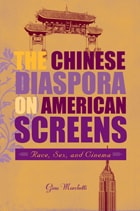
cover of The Chinese Diaspora on American Screens: Race, Sex, and Cinema

The Chinese Diaspora on American Screens

Race, Sex, and Cinema

Gina Marchetti

Temple University Press, 2012

The Chinese Diaspora on American Screens looks at the way in which issues of race and sexuality have become central concerns in cinema generated by and about Chinese communities in America after the mid-1990s. This companion volume to Marchetti's From Tian'anmen to Times Square looks specifically at the Chinese diaspora in relation to ethnic, racial, gender, and sexual identity as depicted in the cinema.

Examining films from the United States and Canada, as well as transnational co-productions, The Chinese Diaspora on American Screens includes analyses of films such as The Wedding Banquet and Double Happiness in addition to interviews with celebrated filmmakers such as Wayne Wang.

Marchetti also reflects on how Chinese identity is presented in a multitude of media forms, including commercial cinema, documentaries, experimental films, and hybrid digital media to offer a textured look at representations of the Chinese diasporic experience after Tian'anmen.
[more]
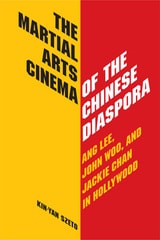
cover of The Martial Arts Cinema of the Chinese Diaspora: Ang Lee, John Woo, and Jackie Chan in Hollywood

The Martial Arts Cinema of the Chinese Diaspora

Ang Lee, John Woo, and Jackie Chan in Hollywood

Kin-Yan Szeto

Southern Illinois University Press, 2011

In The Martial Arts Cinema of the Chinese Diaspora, Kin-Yan Szeto critically examines three of the most internationally famous martial arts film artists to arise out of the Chinese diaspora and travel far from their homelands to find commercial success in the world at large: Ang Lee, John Woo, and Jackie Chan. Positing the idea that these filmmakers' success is evidence of a "cosmopolitical awareness" arising from their cross-cultural ideological engagements and geopolitical displacements, Szeto demonstrates how this unique perspective allows these three filmmakers to develop and act in the transnational environment of media production, distribution, and consumption. 

Beginning with a historical retrospective on Chinese martial arts films as a diasporic film genre and the transnational styles and ideologies of the filmmakers themselves, Szeto uses case studies to explore in depth how the forces of colonialism, Chinese nationalism, and Western imperialism shaped the identities and work of Lee, Woo, and Chan. Addressed in the volume is the groundbreaking martial arts swordplay film that achieves global success-Ang Lee's Crouching Tiger, Hidden Dragon- and its revelations about Hollywood representations of Asians, as well as concepts of male and female masculinity in the swordplay film tradition. Also investigated is the invigoration of contemporary gangster, thriller, and war films by John Woo, whose combination of artistic and historical contexts has contributed to his global success. 

Szeto then dissects Chan's mimetic representation of masculinity in his films, and the influences of his Chinese theater and martial arts training on his work. Szeto outlines the similarities and differences between the three artists' films, especially their treatments of gender, sexuality, and power. She concludes by analyzing their films as metaphors for their working conditions in the Chinese diaspora and Hollywood, and demonstrating how through their works, Lee, Woo, and Chan communicate not only with the rest of the world but also with each other. 

Far from a book simply about three filmmakers, The Martial Arts Cinema of the Chinese Diaspora investigates the transnational nature of films, the geopolitics of culture and race, and the depths of masculinity and power in movies. Szeto's interdisciplinary approach calls for nothing less than a paradigm shift in the study of Chinese diasporic filmmakers and the embodiment of cosmopolitical perspectives in the martial arts genre.
[more]