Results by title
3 books match the query 'Chinese Exclusion'
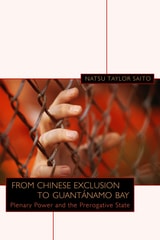
From Chinese Exclusion to Guantánamo Bay
Plenary Power and the Prerogative StateNatsu Taylor Saito
University Press of Colorado, 2007
From Chinese Exclusion to Guantánamo Bay also provides a larger context for understanding problems resulting from the exercise of plenary power. Saito explains how the rights of individuals and groups deemed Other by virtue of race or national origin have been violated under both the Constitution and international law. The differing treatment of José Padilla and John Walker Lindh - both Americans accused of terrorism - provides an example of such disparate approaches. Such executive actions and their sanction by Congress and the judiciary, Saito argues, undermine not just individual rights but the very foundations of our national security - democracy and the rule of law.
From Chinese Exclusion to Guantánamo Bay will interest readers concerned with the historical background of constitutional protection in times of war and peace and will provide fascinating new material for scholars, teachers, and students of law, history, and ethnic studies

Gastrodiplomacy
Chinese Exclusion and the Ascent of Chinese Restaurants in New York City, 1870–1943Heather Ruth Lee
University of Chicago Press, 2027
Traces how Chinese migrants challenged racialization and disenfranchisement by establishing Chinese restaurants during the Gilded Age.
In Gastrodiplomacy, Heather Ruth Lee dives deep into not just the history of Chinese restaurants in early twentieth-century New York City but the delicate, inchoate, and constantly evolving dynamics among their owners, workers, and their predominantly white clientele. Lee argues that the stylistic and capitalist choices made by restaurateurs (“gastrodiplomats”) had outsized political effects on paternalistic white diners (“gastroliberals”) who patronized their establishments, particularly when it came to racial relations in cities that were growing and diversifying. Lee is not starry-eyed—satisfying white tongues and stomachs didn’t lead to an urban utopia of peace, harmony, and brotherhood—but she shows the great and subtle influences of Chinese migrants on American urban space, culture, and metropolitan identity in a defining time.
In Lee’s capable and compelling telling, the Chinese restaurant becomes a distinctive locus for the negotiation of political power, cultural influence, urban identity, and more. Gastrodiplomacy reveals much about burgeoning and increasingly cosmopolitan American cities, as well as about their dynamic relationships with the fluidities of the American character.
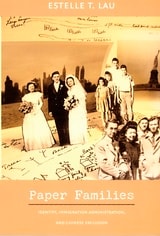
Paper Families
Identity, Immigration Administration, and Chinese ExclusionEstelle T. Lau
Duke University Press, 2006
Drawing on these documents as well as immigration case files, legislative materials, and transcripts of interviews and court proceedings, Lau reveals immigration as an interactive process. Chinese immigrants and their U.S. families were subject to regulation and surveillance, but they also manipulated and thwarted those regulations, forcing the U.S. government to adapt its practices and policies. Lau points out that the Exclusion Acts and the pseudo-familial structures that emerged in response have had lasting effects on Chinese American identity. She concludes with a look at exclusion’s legacy, including the Confession Program of the 1960s that coerced people into divulging the names of paper family members and efforts made by Chinese American communities to recover their lost family histories.