Results by title
10 books match the query 'Chinese fiction'
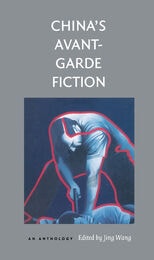
China's Avant-Garde Fiction
An AnthologyJing Wang, ed.
Duke University Press, 1998
Jing Wang has selected provocative examples of this new school of writing, which gained prominence in the late 1980s. Contradicting many long-cherished beliefs about Chinese writers—including the alleged tradition of writing as a political act against authoritarianism—these stories make a dramatic break from conventions of modern Chinese literature by demonstrating an irreverence toward history and culture and by celebrating the artificiality of storytelling. Enriched by the work of a distinguished group of translators, this collection presents an aesthetic experience that may have outraged many revolutionary-minded readers in China, but one that also occupies an important place in the canon of Chinese literature. China’s Avant-Garde Fiction brings together a group of exceptional writers (including Raise the Red Lantern author Su Tong) to the attention of an English-speaking audience.
This book will be enjoyed by those interested in Chinese literature, culture, and society—particularly readers of contemporary fiction.
Contributors. Bei Cun, Can Xue, Gei Fei, Ma Yuan, Su Tong, Sun Ganlu, Yu Hua
Translators. Eva Shan Chou, Michael S. Duke, Howard Goldblatt, Ronald R. Janssen, Andrew F. Jones, Denis C. Mair, Victor H. Mair, Caroline Mason, Beatrice Spade, Kristina M. Torgeson, Jian Zhang, Zhu Hong
Gender Politics in Modern China
Writing and FeminismTani E. Barlow, ed.
Duke University Press, 1993
Ranging from interviews with contemporary writers, to historical accounts of gendered writing in Taiwan and semi-colonial China, to close feminist readings of individual authors, these essays confront the degree to which textual stategies construct notions of gender. Among the specific themes discussed are: how femininity is produced in texts by allocating women to domestic space; the extent to which textual production lies at the base of a changing, historically specific code of the feminine; the extent to which women in modern Chinese societies are products of literary canons; the ways in which the historical processes of gendering have operated in Chinese modernity vis à vis modernity in the West; the representation of feminists as avengers and as westernized women; and the meager recognition of feminism as a serious intellectual current and a large body of theory.
Originally published as a special issue of Modern Chinese Literature (Spring & Fall 1988), this expanded book represents some of the most compelling new work in post-Mao feminist scholarship and will appeal to all those concerned with understanding a revitalized feminism in the Chinese context.
Contributors. Carolyn Brown, Ching-kiu Stephen Chan, Sung-sheng Yvonne Chang, Yu-shih Chen, Rey Chow, Randy Kaplan, Richard King, Wolfgang Kubin, Wendy Larson, Lydia Liu, Seung-Yeun Daisy Ng, Jon Solomon, Meng Yue, Wang Zheng
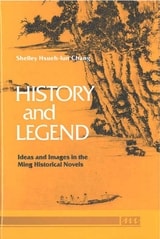
History and Legend
Ideas and Images in the Ming Historical NovelsShelley Hsueh-lun Chang
University of Michigan Press, 1990
This combination of influences in the historical novels was especially significant during the Ming dynasty because of the rise of both urban culture of great refinement and diversity and a popularizing vernacular designed to promote learning among all people. These two exuberant movements came together in the historical novel to propagate the difficult and complex Official Histories of the governing elite, as well as to adapt unofficial histories and fictitious narratives, thus opening the way to the influence of the common people in literature.
This book is the first study of the novels from a historical standpoint. Combining traditional historical research with new source material of the historical novels and with analytical strategies, Chang creates a three-dimensional picture of the “historical world” of the Ming people. Chang compares issues of the dynastic cycle and political legitimacy of a regime, human ambitions and immortality, ethics in the relations between historical personages and legendary heroes, ideals of government and grandiose imperial institutions, and supernatural power and the justice of history that emerged from the historical novels with those in the Official Histories and Confucian canon.
Modernism and the Nativist Resistance
Contemporary Chinese Fiction from TaiwanSung-sheng Yvonne Chang
Duke University Press, 1993
Situating her subject in its historical context, Sung-sheng Yvonne Chang traces the connection between Taiwan's Modernists and the liberal scholars of pre-Communist China. She discusses the Modernists' ambivalent relationship with contemporary Taiwan's conservative culture, and provides a detailed critical survey of the strife between the Modernists and the socialistically inclined, anti-Western Nativists. Chang's approach is comprehensive, combining Chinese and comparative perspectives. Employing the critical insights of Raymond Williams, Peter Burger, M. M. Bahktin, and Fredric Jameson, she investigates the complex issues involved in Chinese writers' appropriation of avant-gardism, aestheticism, and various other Western literary concepts and techniques. Within this framework, Chang offers original, challenging interpretations of major works by the best-known Chinese Modernists from Taiwan.
As an intensive introduction to a literature of considerable quality and impact, and as a case study of the global spread of Western literary Modernism, this book will be of great interest to students of Chinese and comparative literature, and to those who wish to understand the broad patterns of twentieth-century literary history.
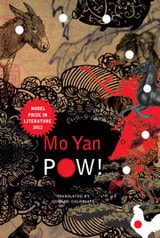
POW!
Mo Yan
Seagull Books, 2012
In this novel by the 2012 Nobel Laureate in Literature, Mo Yan, a benign old monk listens to a prospective novice’s tale of depravity, violence, and carnivorous excess while a nice little family drama—in which nearly everyone dies—unfurls. But in this tale of sharp hatchets, bad water, and a rusty WWII mortar, we can’t help but laugh. Reminiscent of the novels of dark masters of European absurdism like Günter Grass, Witold Gombrowicz, or Jakov Lind, Mo Yan’s POW! is a comic masterpiece.
In this bizarre romp through the Chinese countryside, the author treats us to a cornucopia of cooked animal flesh—ostrich, camel, donkey, dog, as well as the more common varieties. As his dual narratives merge and feather into one another, each informing and illuminating the other, Mo Yan probes the character and lifestyle of modern China. Displaying his many talents, as fabulist, storyteller, scatologist, master of allusion and cliché, and more, POW! carries the reader along quickly, hungrily, and giddily, up until its surprising dénouement.
Mo Yan has been called one of the great novelists of modern Chinese literature and the New York Times Book Review has hailed his work as harsh and gritty, raunchy and funny. He writes big, sometimes mystifying, sometimes infuriating, but always entertaining novels—and POW! is no exception.
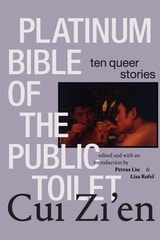
Platinum Bible of the Public Toilet
Ten Queer StoriesCui Zi'en. Edited and with an introduction by Petrus Liu and Lisa Rofel
Duke University Press, 2024
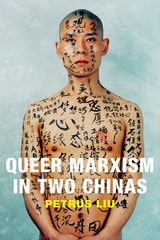
Queer Marxism in Two Chinas
Petrus Liu
Duke University Press, 2015

The Chinese Postmodern
Trauma and Irony in Chinese Avant-Garde FictionXiaobin Yang
University of Michigan Press, 2002
The book seeks to redefine Chinese modernity and postmodernity through the analyses of both orthodox and avant-garde works. In doing so, the author draws on a number of theories, psychoanalysis and deconstruction in particular, revealing the hidden connection between the deconstructive mode of writing and the experience of history after trauma and showing how avant-garde literature brings about a varied literary paradigm that defies the dominant, subject-centered one in twentieth-century China.
The distinctiveness of The Chinese Postmodern is also found in its portrayal of the changes of literary paradigms in modern Chinese literature. By way of characterizing avant-garde fiction, it provides an overview of twentieth-century Chinese literature and offers a theorization of the intellectual history of modern China. Other issues concerning literary theory are explored, including the relationships between postmodernity and totalitarian discourse, between historical trauma and literary writing, and between psychic trauma and rhetorical irony. This book will appeal to readers in the fields of Chinese literature and culture, modern Chinese history, literary theory, and comparative literature.
Xiaobin Yang is Croft Assistant Professor, University of Mississippi.
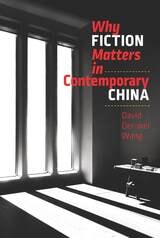
Why Fiction Matters in Contemporary China
David Der-wei Wang
Brandeis University Press, 2020
Contemporary discussions of China tend to focus on politics and economics, giving Chinese culture little if any attention. Why Fiction Matters in Contemporary China offers a corrective, revealing the crucial role that fiction plays in helping contemporary Chinese citizens understand themselves and their nation. Where history fails to address the consequences of man-made and natural atrocities, David Der-Wei Wang argues, fiction arises to bear witness to the immemorial and unforeseeable.
Beginning by examining President Xi Jinping’s call in 2013 to “tell the good China story,” Wang illuminates how contemporary Chinese cultural politics have taken a “fictional turn,” which can trace its genealogy to early modern times. He does so by addressing a series of discourses by critics within China, including Liang Qichao, Lu Xun, and Shen Congwen, as well as critics from the West such as Arendt, Benjamin, and Deleuze. Wang highlights the variety and vitality of fictional works from China as well as the larger Sinophone world, ranging from science fiction to political allegory, erotic escapade to utopia and dystopia. The result is an insightful account of contemporary China, one that affords countless new insights and avenues for understanding.
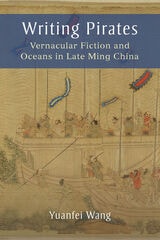
Writing Pirates
Vernacular Fiction and Oceans in Late Ming ChinaYuanfei Wang
University of Michigan Press, 2021