Results by title

7 books match the query 'Chinese language'
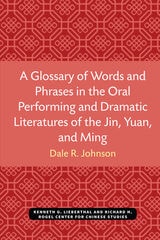
cover of A Glossary of Words and Phrases in the Oral Performing and Dramatic Literatures of the Jin, Yuan, and Ming

A Glossary of Words and Phrases in the Oral Performing and Dramatic Literatures of the Jin, Yuan, and Ming

Dale R. Johnson

University of Michigan Press, 2002
For many years, the oral performing and dramatic literatures of China from 1200 to 1600 CE were considered some of the most difficult texts in the Chinese corpus. They included ballad medleys, comic farces, Yuan music dramas, Ming music dramas, and the novel Shuihu zhuan. The Japanese scholars who first dedicated themselves to study these works in the mid-twentieth century were considered daring. As late as 1981, no comprehensive dictionary or glossary for this literature existed in any language, Asian or Western.
A Glossary of Words and Phrases fills this gap for Western readers, allowing even a relative novice who has resonable command of Chinese to read, translate, and appreciate this great body of literature with an ease undreamed of even two decades ago. The Glossary is organized into approximately 8,000 entries based on the reading notes and glosses found in various dictionaries, thesauruses, glossaries, and editions of works from the period. Main entries are listed alphabetically in the pinyin romanization system. In addition to glosses, entries include symbolic annotations, guides to pronunciation, and text citations. The result is a broadly useful glossary serving the needs of students of this literature as well as scholars researching Jin and Yuan language and its usage.
[more]
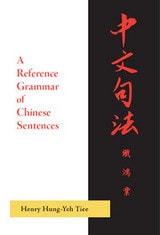
cover of A Reference Grammar of Chinese Sentences with Exercises

A Reference Grammar of Chinese Sentences with Exercises

Henry Hung-Yeh Tiee

University of Arizona Press, 1986
Begins with simple single-word-subject and simple-predicate sentences and moves systematically to transformed simple sentences and finally to compound and complex sentences. Each sentence structure is not only descriptively analyzed, but also formulated in a pedagogical pattern with examples. Exercises are provided in each unit.
[more]
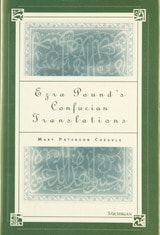
cover of Ezra Pound's Confucian Translations

Ezra Pound's Confucian Translations

Mary Paterson Cheadle

University of Michigan Press, 1997
Ezra Pound professed a "belief" in Confucianism from the early 1930s till the end of his life. His interpretation of Confucianism, however, changed over time, and those changes are reflected in the four translations of Confucian texts he produced between 1928 and 1954. Based on painstaking new research, Ezra Pound's Confucian Translations for the first time traces the evolution of Pound's Confucianism during the historical and personal turmoil of this period. Pound's Confucian translations are less correct "philology" than the "re-creation" of works that he hoped would have a potent influence on the twentieth-century West. What Pound first admired in Confucianism was a respect for individuality simultaneous with a concern for social order. From the late 1930s through the Second World War, Pound developed a "totalitarian" Confucianism whose consummation would be a "harmony" of man, earth, and heaven. After the defeat of the Axis powers in 1945 and Pound's arrest on charges of treason against the United States for his activities in Italy during the war, his Confucianism reverted to an emphasis on verbal precision and the importance of individual integrity. In addition to tracing the evolution of Pound's beliefs, Ezra Pound's Confucian Translations elucidates the Confucian elements in The Cantos and suggests a reading of that epic from the point of view of Pound's Confucianism. Ezra Pound's Confucian Translations will be crucial to students of Pound and will also be read by sinologists, scholars of comparative literature, and anyone studying translation.
[more]
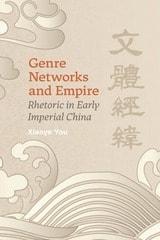
cover of Genre Networks and Empire: Rhetoric in Early Imperial China

Genre Networks and Empire

Rhetoric in Early Imperial China

Xiaoye You

Southern Illinois University Press, 2023

A decolonial reading of Han Dynasty rhetoric reveals the logics and networks that governed early imperial China
 
In Genre Networks and Empire, Xiaoye You integrates a decolonial and transnational approach to construct a rhetorical history of early imperial China. You centers ancient Chinese rhetoric by focusing on how an imperial matrix of power was established in the Han Dynasty through genres of rhetoric and their embodied circulation, and through epistemic constructs such as the Way, heaven, ritual, and yin-yang.
 
Through the concept of genre networks, derived from both ancient Chinese and Western scholarship, You unlocks the mechanisms of early Chinese imperial bureaucracy and maps their far-reaching influence. He considers the communication of governance, political issues, court consultations, and the regulation of the inner quarters of empire. He closely reads debates among government officials, providing insight into their efforts to govern and legitimize the regime and their embodiment of different schools of thought. Genre Networks and Empire embraces a variety of rhetorical forms, from edicts, exam essays, and commentaries to instruction manuals and memorials. It captures a range of literary styles serving the rhetorical purposes of praise and criticism. In the context of court documentation, these genre networks reflect systems of words in motion, mediated governmental decisions and acts, and forms of governmental logic, strategy, and reason.
 
A committed work of decolonial scholarship, Genre Networks and Empire shows, through Chinese words and writing, how the ruling elites of Han China forged a linguistic matrix of power, a book that bears implications for studies of rhetoric and empire in general.
 
[more]
cover of Reading Chinese Fortune Cookie: The Making of Chinese American Rhetoric

Reading Chinese Fortune Cookie

The Making of Chinese American Rhetoric

LuMing Mao

Utah State University Press, 2006

ecent scholarship tends to explain such influences as contributing to language hybridity---an advance over the traditional "deficit model." But Mao suggests that the "hybridity" approach is perhaps too arid or sanitized, missing rich nuances of mutual exchange, resistance, or even subversion. Through his concept of "togetherness in difference, Mao suggests that speakers of hybrid discourse may not be attempting the standard (and failing), but instead may be deliberately importing cultural material to create a distance between themselves and the standard. This practice, over time, becomes a process that transforms English, enriching and enlarging it through the infusion of non-Western discourse features, subverting power structures, and even providing unique humorous touches.

Of interest to scholars in composition, cultural studies, and linguistics as well, Reading Chinese Fortune Cookie leads in an important new direction for both our understanding and our teaching of English.
[more]
cover of The Eater's Guide to Chinese Characters

The Eater's Guide to Chinese Characters

James D. McCawley

University of Chicago Press, 1984

Lauded by Calvin Trillin as a man who "does not have to make to with translations like 'Shredded Three Kinds' in Chinese restaurants," in The Eater's Guide to Chinese Characters, James D. McCawley offers everyone a guide to deciphering the mysteries of Chinese menus and the opportunity to enjoy new eating experiences. An accessible primer as well as a handy reference, this book shows how Chinese characters are written and referred to, both in script and in type. McCawley provides a guide to pronunciation and includes helpful exercises so users can practice ordering. His novel system of arranging the extensive glossary—which ranges from basics such as "rice" and "fish" to exotica like "Buddha Jumps Wall"—enables even the beginner to find characters quickly and surely. He also includes the nonstandard forms of characters that often turn up on menus.

With this guide in hand, English speakers hold the key to a world of tantalizing—and otherwise unavailable—Chinese dishes.
[more]
cover of Written on Bamboo and Silk: The Beginnings of Chinese Books and Inscriptions, Second Edition

Written on Bamboo and Silk

The Beginnings of Chinese Books and Inscriptions, Second Edition

Tsuen-Hsuin Tsien

University of Chicago Press, 2004

Paleography, which often overlaps with archaeology, deciphers ancient inscriptions and modes of writing to reveal the knowledge and workings of earlier societies. In this now-classic paleographic study of China, Tsuen-Hsuin Tsien traces the development of Chinese writing from the earliest inscriptions to the advent of printing, with specific attention to the tools and media used. This edition includes material that treats the many major documents and ancient Chinese artifacts uncovered over the forty years since the book’s first publication, as well as an afterword by Edward L. Shaughnessy.
Written on Bamboo and Silk has long been considered a landmark in its field. Critical in this regard is the excavation of numerous sites throughout China, where hundreds of thousands of documents written on bamboo and silk—as well as other media—were found, including some of the earliest copies of historical, medical, astronomical, military, and religious texts that are now essential to the study of early Chinese literature, history, and philosophy. Discoveries such as these have made the amount of material evidence on the origins and evolution of communication throughout Chinese history exceedingly broad and rich, and yet Tsien succeeds in tackling it all and building on the earlier classic work that changed
[more]