Results by title

12 books match the query 'Chinese poetry'
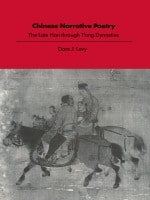
cover of Chinese Narrative Poetry: The Late Han Through T'ang Dynasties

Chinese Narrative Poetry

The Late Han Through T'ang Dynasties

Dore J. Levy

Duke University Press, 1988

Chinese Narrative Poetry brings a new perspective to some of China's best-loved and most influential poems, including Ts'ai Yen's "Poem of Affliction," Po Chu-yi's "Song of Everlasting Sorrow," and Wei Chuang's recently discovered "Song of the Lady of Ch'in." Composed in the shih form during the Late Han, Six Dynasties, and T'ang periods, these poems stand out as masterworks of narrative art. Yet paradoxically, their narrative qualities have been little recognized or explored in either traditional Chinese or modern Western scholarship. The reason for this neglect is that Western literary traditions acknowledge their origins in epic poetry and thus take narrative for granted, but the Chinese tradition is fundametally based on lyric and does not admit of a separate category for narrative poetry.

Drawing on both classical Chinese critical works and the most recent Western contributions to the theory of narrative, Levy shows how narrative elements developed out of the lyrical conventions of shih. In doing so, she accomplishes a double purpose, guiding the modern reader to an understanding of the nature of narrative in Chinese poetry and shedding light on the ways in which Chinese poets adapted the devises of lyric to the needs of a completely different expressive mode.

Students of Chinese literature will welcome this pathbreaking study, but Chinese Narrative Poetry will interest other scholars as well because it addresses questions of crucial importance for literary theory and comparative literature, particularly the central issue of the applicability of Western critical concepts to non-Western literature and culture.
[more]
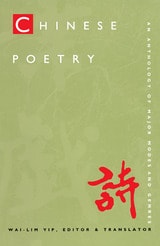
cover of Chinese Poetry, 2nd ed., Revised: An Anthology of Major Modes and Genres

Chinese Poetry, 2nd ed., Revised

An Anthology of Major Modes and Genres

Wai-lim Yip, editor and translator

Duke University Press, 1997

This is the first paperback edition of a classic anthology of Chinese poetry. Spanning two thousand years—from the Book of Songs (circa 600 B.C.) to the chü form of the Yuan Dynasty (1260–1368)—these 150 poems cover all major genres that students of Chinese poetry must learn.
Newly designed, the unique format of this volume will enhance its reputation as the definitive introduction to Chinese poetry, while its introductory essay on issues of Chinese aesthetics will continue to be an essential text on the problems of translating such works into English. Each poem is printed with the original Chinese characters in calligraphic form, coordinated with word-for-word annotations, and followed by an English translation. Correcting more than a century of distortion of the classical Chinese by translators unconcerned with the intricacies and aesthetics of the Chinese language, these masterful translations by Wai-lim Yip, a noted and honored translator and scholar, allow English readers to enter more easily into the dynamic of the original poems. Each section of the volume is introduced by a short essay on the mode or genre of poem about to be presented and is followed by a comprehensive bibliography.
[more]
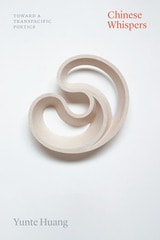
cover of Chinese Whispers: Toward a Transpacific Poetics

Chinese Whispers

Toward a Transpacific Poetics

Yunte Huang

University of Chicago Press, 2022

Chinese Whispers examines multiple contact zones between the Anglophone and Sinophone worlds, investigating how poetry both enables and complicates the transpacific production of meaning.
 
In this new book, the noted critic and best-selling author Yunte Huang explores the dynamics of poetry and poetics in the age of globalization, particularly questions of translatability, universality, and risk in the transpacific context. “Chinese whispers” refers to an American children’s game dating to the years of the Cold War, a period in which everything Chinese, or even Chinese sounding, was suspect. Taking up various manifestations of the phrase in the twentieth and twenty-first centuries, Huang investigates how poetry, always to a significant degree untranslatable, complicates the transpacific production of meanings and values.

The book opens with the efforts of I. A. Richards, arguably the founder of Anglo-American academic literary criticism, to promote Basic English in China in the early twentieth century. It culminates by resituating Ernest Fenollosa’s famous essay “The Chinese Written Character as a Medium for Poetry,” exploring the ways in which Chinese has historically enriched but also entrapped the Western conception of language.
 
[more]
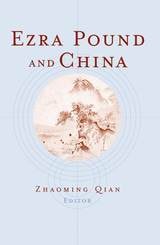
cover of Ezra Pound and China

Ezra Pound and China

Zhaoming Qian, Editor

University of Michigan Press, 2003

Ezra Pound and China, the first collection to explore the American poet's career-long relationship with China, considers how Pound's engagement with the Orient broadens the textual, cultural, and political boundaries of his modernism. The book's contributors discuss, among other topics, issues of cultural transmission; the influence of Pound's Chinese studies on twentieth-century poetics; the importance of his work to contemporary theories of translation; and the effects of Confucianism, Buddhism, and Taoism on Pound's political and economic thought.
Richly illustrated, the book draws readers closer to the heart of Pound's vision. Ezra Pound and China will become an invaluable resource to students and scholars of Pound, cultural studies, translation theory, poetics, Confucianism, and literary transmission and reception.
Zhaoming Qian is Professor of English, the University of New Orleans.
[more]
cover of Ezra Pound's Confucian Translations

Ezra Pound's Confucian Translations

Mary Paterson Cheadle

University of Michigan Press, 1997
Ezra Pound professed a "belief" in Confucianism from the early 1930s till the end of his life. His interpretation of Confucianism, however, changed over time, and those changes are reflected in the four translations of Confucian texts he produced between 1928 and 1954. Based on painstaking new research, Ezra Pound's Confucian Translations for the first time traces the evolution of Pound's Confucianism during the historical and personal turmoil of this period. Pound's Confucian translations are less correct "philology" than the "re-creation" of works that he hoped would have a potent influence on the twentieth-century West. What Pound first admired in Confucianism was a respect for individuality simultaneous with a concern for social order. From the late 1930s through the Second World War, Pound developed a "totalitarian" Confucianism whose consummation would be a "harmony" of man, earth, and heaven. After the defeat of the Axis powers in 1945 and Pound's arrest on charges of treason against the United States for his activities in Italy during the war, his Confucianism reverted to an emphasis on verbal precision and the importance of individual integrity. In addition to tracing the evolution of Pound's beliefs, Ezra Pound's Confucian Translations elucidates the Confucian elements in The Cantos and suggests a reading of that epic from the point of view of Pound's Confucianism. Ezra Pound's Confucian Translations will be crucial to students of Pound and will also be read by sinologists, scholars of comparative literature, and anyone studying translation.
[more]
cover of Interventions into Modernist Cultures: Poetry from Beyond the Empty Screen

Interventions into Modernist Cultures

Poetry from Beyond the Empty Screen

Amie Elizabeth Parry

Duke University Press, 2007

Interventions into Modernist Cultures is a comparative analysis of the cultural politics of modernist writing in the United States and Taiwan. Amie Elizabeth Parry argues that the two sites of modernism are linked by their representation or suppression of histories of US imperialist expansion, Cold War neocolonial military presence, and economic influence in Asia. Focusing on poetry, a genre often overlooked in postcolonial theory, she contends that the radically fragmented form of modernist poetic texts is particularly well suited to representing U.S. imperialism and neocolonial modernities.

Reading various works by US expatriates Ezra Pound and Gertrude Stein, Parry compares the cultural politics of U.S. canonical modernism with alternative representations of temporality, hybridity, erasure, and sexuality in the work of the Taiwanese writers Yü Kwang-chung and Hsia Yü and the Asian American immigrant author Theresa Hak Kyung Cha. Juxtaposing poems by Pound and Yü Kwang-chung, Parry shows how Yü’s fragmented, ambivalent modernist form reveals the effects of neocolonialism while Pound denies and obscures U.S. imperialism in Asia, asserting a form of nondevelopmental universalism through both form and theme. Stein appropriates discourses of American modernity and identity to represent nonnormative desire and sexuality, and Parry contrasts this tendency with representations of sexuality in the contemporary experimental poetry of Hsia Yü. Finally, Parry highlights the different uses of modernist forms by Pound in his Cantos—which incorporate a multiplicity of decontextualized and ahistorical voices—and by Cha in her 1982 novel Dictee, a historicized, multilingual work. Parry’s sophisticated readings provide a useful critical framework for apprehending how “minor modernisms” illuminate the histories erased by certain canonical modernist texts.

[more]
cover of New Cathay: Contemporary Chinese Poetry

New Cathay

Contemporary Chinese Poetry

Edited by Ming Di

Tupelo Press, 2013

The most up-to-date anthology of contemporary Chinese poetry, translated by American poets and edited by the executive editor of the bilingual literary journal Poetry East West. Showcasing the achievement of Chinese poetry in the last twenty years, a time of tremendous literary ferment, this collection focuses on a diversity of exciting poets from the mainland, highlighting Duo Duo (laureate of the 2010 Neustadt International Prize for Literature) and Liao Yiwu (recipient of 2012 Peace Prize of the German Book Trade organization) along with not yet well-known but brilliant poets such as Zang Di and Xiao Kaiyu and younger poets Jiang Tao and Lü Yue. The anthology includes interviews with the poets and a fascinating survey of their opinions on “Ten Favorite Chinese poets” and “Ten Best-Known Western poets in China.” Featured poets: Duo Duo, Wang Xiaoni, Bai Hua, Zhang Shuguang, Sun Wenbo, Wang Jiaxin, Liao Yiwu, Song Lin, Xiao Kaiyu, Lü De’an, Feng Yan, Yang Xiaobin, Zang Di, Ya Shi, Mai Mang, Lan Lan, Jiang Tao, Jiang Hao, Lü Yue, Hu Xudong, Yi Lai, Jiang Li, Zheng Xiaoqiong, Qiu Qixuan, and Li Shumin. With translations by Neil Aitken, Katie Farris, Ming Di, Christopher Lupke, Tony Barnstone, Afaa Weaver, Jonathan Stalling, Nick Admussen, Eleanor Goodman, Ao Wang, Dian Li, Kerry Shawn Keys, Jennifer Kronovet, Elizabeth Reitzell, and Cody Reese.
[more]
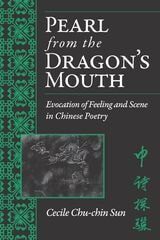
cover of Pearl from the Dragon’s Mouth: Evocation of Scene and Feeling in Chinese Poetry

Pearl from the Dragon’s Mouth

Evocation of Scene and Feeling in Chinese Poetry

Cecile C. C. Sun

University of Michigan Press, 1995
The interplay between the external world (ching) and the poet’s inner world (ch’ing) lies at the heart of Chinese poetry, and understanding the interaction of the two is crucial to understanding this work from within its own tradition. Closely coordinating her discussions of poetry and criticism so that practice and theory become mutually enriching and illuminating, Sun offers sensitive and original readings of poems and a wealth of insights into Chinese poetics.
[more]
cover of Poems of the Five Mountains: An Introduction to the Literature of the Zen Monasteries

Poems of the Five Mountains

An Introduction to the Literature of the Zen Monasteries

Marian Ury

University of Michigan Press, 1992
This second, revised edition of a pioneering volume, long out of print, presents translations of Japanese Zen poems on sorrow, old age, homesickness, the seasons, the ravages of time, solitude, the scenic beauty of the landscape of Japan, and monastic life. Composed by Japanese Zen monks who lived from the last quarter of the thirteenth century to the middle of the fifteenth century, these poems represent a portion of the best of the writing called in Japanese gozan bungaku, “literature of the five mountains.”
“Five mountains” or “five monasteries” refers to the system by which the Zen monasteries were hierarchically ordered and governed. For the monks in the monasteries, poetry functioned as a means not only of expressing religious convictions and personal feelings but also of communicating with others in a civilized and courteous fashion. Effacing barriers of time and space, the practice of Chinese poetry also made it possible for Japanese authors to feel at one with their Chinese counterparts and the great poets of antiquity. This was a time when Zen as an institution was being established and contact with the Chinese mainland becoming increasingly frequent—ten of the sixteen poets represented here visited China.
Marian Ury has provided a short but substantial introduction to the Chinese poetry of Japanese gozan monasteries, and her translations of the poetry are masterful. Poems of the Five Mountains is an important work for anyone interested in Japanese literature, Chinese literature, East Asian Religion, and Zen Buddhism.
[more]
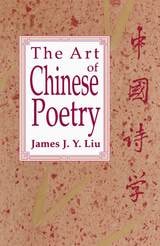
cover of The Art of Chinese Poetry

The Art of Chinese Poetry

James J. Y. Liu

University of Chicago Press, 1966

This concise introduction to Chinese poetry serves as a primer for English-speakers eager to expand their understanding and enjoyment of Chinese culture. James J. Y. Liu first examines the Chinese language as a medium of poetic expression and, contrary to the usual focus on the visual qualities of Chinese script, emphasizes the auditory effects of Chinese verse. He provides a succinct survey of Chinese poetry theory and concludes with his own view of poetry, based upon traditional Chinese concepts.

"[This] books should be read by all those interested in Chinese poetry."—Achilles Fang, Poetry

"[This is] a significant contribution to the understanding and appreciation of Chinese poetry, lucidly presented in a way that will attract a wide audience, and offering an original synthesis of Chinese and Western views that will stimulate and inspire students of poetry everywhere."—Hans H. Frankel, Harvard Journal of Asiatic Studies

"This is a book which can be recommended without reservation to anyone who wants to explore the world of Chinese poetry in translation."—James R. Hightower, Journal of Asian Studies
[more]
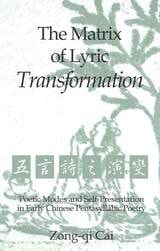
cover of The Matrix of Lyric Transformation: Poetic Modes and Self-Presentation in Early Chinese Pentasyllabic Poetry

The Matrix of Lyric Transformation

Poetic Modes and Self-Presentation in Early Chinese Pentasyllabic Poetry

Cai Zong-qi

University of Michigan Press, 1997
Pentasyllabic poetry has been a focus of critical study since the appearance of the earliest works of Chinese literary criticism in the Six Dynasties period. Throughout the subsequent dynasties, traditional Chinese critics continued to examine pentasyllabic poetry as a leading poetic type and to compile various comprehensive anthologies of it.
The Matrix of Lyric Transformation enriches this tradition, using modern analytical methods to explore issues of self-expression and to trace the early formal, thematic, and generic developments of this poetic form. Beginning with a discussion of the Yüeh-fu and ku-shih genres of the Han period, Cai Zong-qi introdues the analytical framework of modes from Western literary criticism to show how the pentasyllabic poetry changed over time. He argues that changing practices of poetic composition effected a shift from a dramatic mode typical of folk compositions to a narrative mode and finally to lyric and symbolic modes developed in literati circles.
[more]
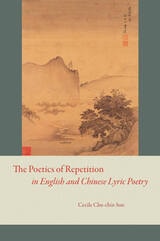
cover of The Poetics of Repetition in English and Chinese Lyric Poetry

The Poetics of Repetition in English and Chinese Lyric Poetry

Cecile Chu-chin Sun

University of Chicago Press, 2010

For more than half a century, Chinese-Western comparative literature has been recognized as a formal academic discipline, but critics and scholars in the field have done little to develop a viable, common basis for comparison between these disparate literatures. In this pioneering book, Cecile Chu-chin Sun establishes repetition as the ideal perspective from which to compare the poetry and poetics from these two traditions.

Sun contends that repetition is at the heart of all that defines the lyric as a unique art form and, by closely examining its use in Chinese and Western poetry, she demonstrates howone can identify important points of convergence and divergence. Through a representative sampling of poems from both traditions, she illustrates how the irreducible generic nature of the lyric transcends linguistic and cultural barriers but also reveals the fundamental distinctions between the traditions. Most crucially, she dissects the two radically different conceptualizations of reality—mimesis and xing—that serve as underlying principles for the poetic practices of each tradition.

Skillfully integrating theory and practice, The Poetics of Repetition in English and Chinese Lyric Poetryprovides a much-needed model for future study of Chinese and English poetry as well as lucid, succinct interpretations of individual poems.

[more]