Results by title
8 books match the query 'Choice (Psychology)'
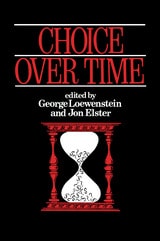
Choice Over Time
George Loewenstein
Russell Sage Foundation, 1992
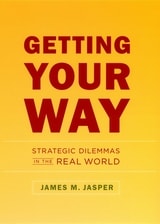
Getting Your Way
Strategic Dilemmas in the Real WorldJames M. Jasper
University of Chicago Press, 2006
Getting other people to do what we want is a useful skill for anyone. Whether you’re seeking a job, negotiating a deal, or angling for that big promotion, you’re engaged in strategic thought and action. In such moments, you imagine what might be going on in another person’s head and how they’ll react to what you do or say. At the same time, you also try to pick the best way to realize your goals, both with and without the other person’s cooperation. Getting Your Way teaches us how to win that game by offering a fuller understanding of how strategy works in the real world.
As we all know, rules of strategy are regularly discovered and discussed in popular books for business executives, military leaders, and politicians. Those works with their trendy lists of pithy maxims and highly effective habits can help people avoid mistakes or even think anew about how to tackle their problems. But they are merely suggestive, as each situation we encounter in the real world is always more complex than anticipated, more challenging than we had hoped. James M. Jasper here shows us how to anticipate those problems before they actually occur—by recognizing the dilemmas all strategic players must negotiate, with each option accompanied by a long list of costs and risks. Considering everyday dilemmas in a broad range of familiar settings, from business and politics to love and war, Jasper explains how to envision your goals, how to make the first move, how to deal with threats, and how to employ strategies with greater confidence.
Alexander the Great, Genghis Khan, Rosa Parks, Hugo Chávez, and David Koresh all come into play in this smart and engaging book, one that helps us recognize and prepare for the many dilemmas inherent in any strategic action.

Insights in Decision Making
A Tribute to Hillel J. EinhornEdited by Robin M. Hogarth
University of Chicago Press, 1990
The volume is based on a recent conference held to honor the work and memory of the late Hillel J. Einhorn, a pioneering scholar in behavioral decision research. Composed of contributions by leading researchers, Insights in Decision Making provides a state-of-the-art image of work in this field.
The range of topics covered includes conceptual and technical issues the bridge the gap between theory and the practical concern of improving decision making, difficulties in statistical thinking, experimental studies of processes of judgment and choice, and the emergence of new paradigms for studying decision behavior.
Providing many avenues for future research, Insights in Decision Making will be essential reading for students of the psychology of decision making and will prove valuable to readers in psychology, economics, statistics, and management.
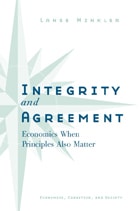
Integrity and Agreement
Economics When Principles Also MatterLanse Minkler
University of Michigan Press, 2009
"Two impressive features of this book are its clarity of purpose and the breadth of disciplinary resources to which it appeals."
---Geoffrey Brennan, Professor of Economics, Australian National University
"Facing massive evidence that people do not act generally as self-regarding payoff maximizers, economists have become increasingly interested in issues of cooperation, altruism, identity, and morality. Lanse Minkler's contribution is particularly important because of his powerful argument that the evidence of cooperation cannot be explained adequately by a more complicated preference function. A disposition for honesty is not simply a matter of preference---it is an issue of personal integrity, identity, and commitment. This has major implications. In particular we have to reconstruct the theory of the firm from first principles. No economist committed to the pursuit of truth should ignore this volume."
---Geoffrey Hodgson, Research Professor in Business Studies, University of Hertfordshire, United Kingdom, and Editor in Chief of the Journal of Institutional Economics
"This is an interesting account of the role of integrity---preference-integrity and commitment-integrity---on economic behavior. While drawing knowledge from traditional subfields of economics, it also includes insights gleaned from psychology and philosophy, showing their effects in varied areas such as political behavior, the employment relation, religion, and human rights. In this exciting volume Lanse Minkler does an excellent job of incorporating various newer concepts of fairness and integrity into economic analysis."
---Ernst Fehr, Professor and Head of the Chair of Microeconomics and Experimental Economic Research and Director of the Institute for Empirical Research in Economics, University of Zurich
Social scientists who treat humans as rational beings driven exclusively by self-interest ignore a key factor shaping human behavior: the influence of moral principles. Starting with the elementary principle "lying is wrong," economic theorist Lanse Minkler examines the ways in which a sense of morality guides real-life decision making.
Whether one feels committed to specific or general moral principles, Minkler explains, integrity demands consistently acting on that commitment. Because truthfulness is the most basic moral principle, integrity means honesty. And honesty extends beyond truth-telling. It requires good faith when entering an agreement and then standing by one's word. From this premise, Minkler explores the implications of integrity for contracts between buyers and sellers and understandings between employers and employees. He also finds a role for integrity in an individual's religious vows, an elected official's accountability to constituents, and a community's obligation to human rights.
Integrity and Agreement reintroduces morality as a factor for economists, sociologists, psychologists, and political scientists to consider in their efforts to comprehend human behavior.
Lanse Minkler is Associate Professor of Economics at the University of Connecticut.
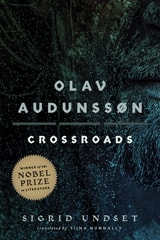
Olav Audunssøn
III. CrossroadsSigrid Undset
University of Minnesota Press, 2022
The third volume in the Nobel Prize–winning writer’s epic story of medieval Norway, finely capturing Undset’s fluid, natural style in the first English translation in nearly a century
In the early fourteenth century, Norway is a kingdom in political turmoil, struggling with opposing forces within its own borders and drawn into strife with neighboring Sweden and Denmark. Bloody family vendettas and conflicting loyalties sparked by the irrepressible passion of a boy and his foster sister (also his betrothed) have now set in motion a series of terrible consequences—with a legacy of betrayal, murder, and disgrace that will echo down through the generations. Crossroads, the third of Olav Audunssøn’s four volumes, finds Olav heartbroken by loss and further estranged from his son. To escape his grief, Olav leaves his home estate of Hestviken and agrees to serve as captain on a small merchant ship headed to London. There, separated from everything familiar to him, Olav begins a visionary journey that will send him far into the forest and deep into his soul. Questioning past decisions and future plans, Olav must grapple with his own perceptions of love and guilt, sin and penitence, vengeance and forgiveness.
Set in a time and place where royalty and religion vie for power, and bloodlines and loyalties are law, Crossroads summons a powerful picture of Northern life in medieval times, as the Swedish Academy noted in awarding Sigrid Undset the Nobel Prize in 1928. Conveying both the intimate drama and epic sweep of Olav’s story as grief and guilt drive him to ever more desperate action, Crossroads is a moving and masterly re-creation of a vanished world tainted by bloodshed and haunted by sin and retribution.
As with Kristin Lavransdatter, her earlier medieval epic, Undset immersed herself in the legal, religious, and historical documents of the time while writing Olav Audunssøn to create astoundingly authentic and compelling portraits of Norwegian life in the Middle Ages. And as in her translation of Kristin Lavransdatter, Tiina Nunnally does full justice to Undset’s natural, fluid prose, in a style that delicately and lyrically conveys the natural world, the complex culture, and the fraught emotional territory against which Olav’s story inexorably unfolds.
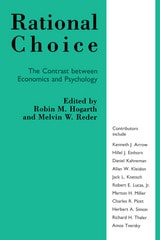
Rational Choice
Edited by Robin M. Hogarth and Melvin W. Reder
University of Chicago Press, 1987
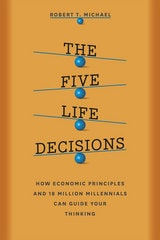
The Five Life Decisions
How Economic Principles and 18 Million Millennials Can Guide Your ThinkingRobert T. Michael
University of Chicago Press, 2016
Economist Robert T. Michael won’t tell you what to choose. Instead, he’ll show you how to make smarter choices. Michael focuses on five critical decisions we all face about college, career, partners, health, and parenting. He uses these to demonstrate how the science of scarcity and choice—concepts used to guide major business decisions and shape national legislation—can offer a solid foundation for our own lives. Employing comparative advantage can have a big payoff when picking a job. Knowing how to work the marketplace can minimize uncertainty when choosing a partner. And understanding externalities—the ripple of results from our actions—can clarify the if and when of having children.
Michael also brings in data from the National Longitudinal Survey of Youth, a scientific sample of 18 million millennials in the United States that tracks more than a decade of young adult choices and consequences. As the survey’s longtime principal investigator and project director, Michael shows that the aggregate decisions can help us understand what might lie ahead along many possible paths—offering readers insights about how their own choices may turn out.
There’s no singular formula for always making the right choice. But the adaptable framework and rich data at the heart of The Five Life Decisions will help you feel confident in whatever you decide.
Time and Decision
Economic and Psychological Perspectives of Intertemporal ChoiceGeorge Loewenstein
Russell Sage Foundation, 2003