Results by title
4 books match the query 'Christendom'
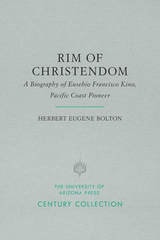
Rim of Christendom
A Biography of Eusebio Francisco Kino, Pacific Coast PioneerHerbert Eugene Bolton; Foreword by John L. Kessell
University of Arizona Press, 1984
"This re-issued biography recounts [Kino's] work with loving detail and with an accuracy that has survived slight amendments. Its accompanying plates, maps, and bibliography enhance a text that should find a place in every serious library."—Religious Studies Review
"This is truly an epic work, an absolute standard for any Southwestern collection."—Book Talk
Select maps from the 1984 edition of Rim of Christendom are now available online through the UA Campus Repository.
"This is truly an epic work, an absolute standard for any Southwestern collection."—Book Talk
Select maps from the 1984 edition of Rim of Christendom are now available online through the UA Campus Repository.
[more]
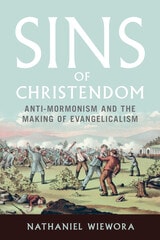
Sins of Christendom
Anti-Mormonism and the Making of EvangelicalismNathaniel Wiewora
University of Illinois Press, 2024
Evangelical criticism of the Church of Jesus Christ of Latter-day Saints dates back to the earliest days of the Church. Nathaniel Wiewora uses the diverse animus expressed by evangelicals to illuminate how they used an imaginary Church as a proxy to disagree, attack, compromise, and settle differences among themselves. As Wiewora shows, the evangelical practice to contrast itself with the emerging faith not only encompassed but also went beyond religious matters. If Joseph Smith was accused of muddling religious truth, he and his followers also faced accusations of immoral economic practices and a sinful regard for wealth that reflected worries within the evangelical world. Attacks on Latter-day Saints’ emotional religious displays, the Book of Mormon’s authenticity, and the dangerous ideas represented by Nauvoo paralleled similar conflicts. Wiewora traces how the failure to blunt the Church’s success led evangelicals to change their own methods and pursue the religious education infrastructure that came to define parts of the movement.
[more]
The Dividing of Christendom
Christopher Dawson
Catholic University of America Press, 2026
Christopher Dawson, the renowned historian of culture, offered an overarching narrative in two volumes of the rise and fall of Christian unity within Western Civilization in lectures he delivered at Harvard University between 1958 and 1962. Volume 1, The Formation of Christendom, laid out Dawson’s anthropological approach to culture in general and to the formation of Christian culture in particular. Volume 2, The Dividing of Christendom, examines the forces that led to the dissolution of European unity and the rise of a new secular vision of humanity with its hopes set on material progress.
Dawson begins the tale of dissolution in the Middle Ages, examining its spiritual, intellectual, and social causes. A Church in desperate need of reform, divided in its allegiance during the Great Western Schism, could not muster the collective will to overcome laxity and corruption. Nominalism and voluntarism unraveled the great intellectual synthesis of scholasticism. Political and economic forces, burdened by feudal restraints, needed only a catalyst to overturn the old order.
The Dividing of Christendom highlights the social and cultural forces that shaped the Age of Reformations and its aftermath. While not neglecting the importance of theological claims, Dawson explains how political ambition and consolidation of power played a role just as significant. Furthermore, the distinct theological vision of the different reformations of the sixteenth century created a new culture, focused much more on the individual and an emphasis on industry. The mystical extravagance of the Baroque period, which characterized the Catholic renewal of southern Europe and spread throughout the world, eventually gave way to the more utilitarian values of the ascendant European north.
Religious wars resulted in a secularism that prioritized science and economics in the shaping of modern culture. The Enlightenment, in particular, initiated a campaign against throne and altar that paved the way for political revolutions. Successful movements of religious revival occurred simultaneously, as Dawson traces their influence on the American colonies, particularly Puritanism and Methodism. Nevertheless, those bent on material progress as a kind of new religion undermined the spiritual foundations of Christian culture so completely that we must seek to rediscover a new source of internal vigor and unity to overcome our cultural crisis.
[more]
The Formation of Christendom
Christopher Dawson
Catholic University of America Press, 2026
Together with its sequel The Dividing of Christendom, this book was the fruit of the Harvard lectures that Christopher Dawson delivered as the first occupant of the Charles Chauncey Stillman Chair of Roman Catholic Studies from 1958-1962. Here, as in all his works, he sees religion as the dynamic element of culture.
This work traces the formation of Christian culture from its roots in the Judeo-Christian tradition through the rise and fall of medieval Christendom, and ends with an epilogue in which the author reflects on the defining characteristics of Christianity in general and the Catholic Church in particular.
In the introductory section of this work, Dawson highlights the importance of language in the origin and development of civilization. Christina Scott, the author’s daughter and first biographer, summarises Dawson’s ideas on this point in her work A Historian and his World: “In the beginning was the word: language was the gateway to the human world and was the single factor that distinguished man from the animal kingdom.” Language, as Dawson wrote, “enables man to think, to create a new world of imagination and reason.”
In parts two and three Dawson traces the beginnings of Christian culture in the first centuries after Christ through to the decline of medieval unity. Some of the tantalizing chapter headings include The Christian and Jewish Idea of Revelation, The Foundation of Europe: The Monks of the West, The Carolingian Age, Feudal Europe and the Age of Anarchy, The Achievement of Medieval Thought, and East and West in the Middle Ages.
Dawson shared with Arnold Toynbee the ideal of a universal spiritual society as the goal of history; but whereas Dr. Toynbee saw this as achievable by a consensus of the great world religions, Dawson concludes his work with a clear exposition of the Catholic ideal of a universal spiritual society. It provides an excellent summary of the author’s view of the uniqueness and universality of the Catholic Church, as well as its fundamentally non-sectarian basis.
His concluding words demonstrate his commitment to the concept of unity: “On the other hand, if Christianity were to lead the nations still further apart from one another into spiritual disunity, it would defeat the central purpose of the Church’s institution.”
[more]