Results by title
4 books match the query 'Christian literature, English (Old)'
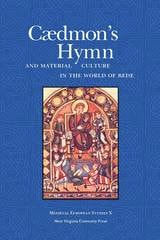
Caedmon's Hymn and Material Culture in the World of Bede
ALLEN J. FRANTZEN
West Virginia University Press, 2007
The essays in this book use the nine-line poem known as Cædmon’s Hymn as a lens on the world of Bede’s Ecclesiastical History. A cowherd who is given a divine gift, Cædmon retells the great narratives of Christian history in the traditional form of Anglo-Saxon verse. An immense amount has been written about this episode, much of it concentrating on the hymn’s significance in the history of English literature. Relatively little attention, however, has been paid to what the story of Cædmon and his hymn might tell us about the material, as well as the textual, culture of Bede’s world. The essays in this collection seek to connect Cædmon’s Hymn to Bede’s material world in various ways. Each chapter begins with the hymn and moves from the text to the worlds of scientific thought, settlements and social hierarchy, monastic reform, and ordinary things. The connections explored here are a sampling of the material concerns Cædmon’s Hymn raises.
The Power of Words
Anglo-Saxon Studies Presented to Donald G. Scragg on his Seventieth BirthdayANGLO-SAXON STUDIES PRESENTED TO DONALD G. SCRAGG ON HIS SEVENTIETH BIRTHDAYHugh Magennis
West Virginia University Press, 2006
The Power of Words: Anglo-Saxon Studies Presented to Donald G. Scragg on his Seventieth Birthday edited by Jonathan Wilcox and Hugh Magennis will find its place on the same shelf with these and other such valuable tomes in the discipline. This is a complex and carefully edited book, that showcases the work of some of Professor Scragg’s best students and most admiring professional friends. The contents range from several studies in homiletic literature, one of Professor Scragg’s own passions, to other of his pursuits, including editing theory and orthography. These are not, however, derivative essays that recommend a single adjustment in a reading or to a source study; instead, they are studies that do what Professor Scragg himself did: they observe clues to larger realities, and they point the way to a broader comprehension of our discipline and its several methodologies.
Tradition And Belief
Religious Writing in Late Anglo-Saxon EnglandClara A. Lees
University of Minnesota Press, 1999
Looks at early religious texts and their influence on medieval literature and culture.
Looks at early religious texts and their influence on medieval literature and culture.
In this major study of Anglo-Saxon religious texts-sermons, homilies, and saints’ lives written in Old English-Clare A. Lees reveals how the invention of preaching transformed the early medieval church, and thus the culture of medieval England. By placing Anglo-Saxon prose within a social matrix, her work offers a new way of seeing medieval literature through the lens of culture.To show how the preaching mission of the later Anglo-Saxon church was constructed and received, Lees explores the emergence of preaching from the traditional structures of the early medieval church-its institutional knowledge, genres, and beliefs. Understood as a powerful rhetorical, social, and epistemological process, preaching is shown to have helped define the sociocultural concerns specific to late Anglo-Saxon England.The first detailed study of traditionality in medieval culture, Tradition and Belief is also a case study of one cultural phenomenon from the past. As such-and by concentrating on the theoretically problematic areas of history, religious belief, and aesthetics-the book contributes to debates about the evolving meaning of culture.ISBN 0-8166-3002-X Cloth £34.50 $49.95xxISBN 0-8166-3003-8 Paper £14.00 $19.95x232 Pages 5 7/8 x 9 NovemberMedieval Cultures Series, volume 19Translation inquiries: University of Minnesota Press
Via Crucis
Essays on Early Medieval Sources and IdeasTHOMAS N. HALL
West Virginia University Press, 2002
This book originated as a series of papers delivered at a Symposium on Irish and Anglo-Saxon Literary Culture in Honor of J. E. Cross, held in conjunction with the 30th International Congress on Medieval Studies at Kalamazoo in May 1996. The purpose of that symposium was to bring together a number of friends and admirers of Professor Cross to celebrate his remarkably rich career as a scholar of Old English and Insular Latin literature; Anglo-Saxon manuscripts; and medieval sermons, saints’ lives, and apocrypha.