Results by title
3 books match the query 'Christiansen, Paul'
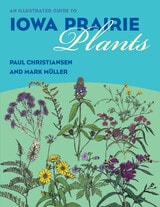
An Illustrated Guide to Iowa Prairie Plants
Paul Christiansen
University of Iowa Press, 1999
Iowa is the only state completely within the tallgrass prairie formation. Thanks to rich soil, adequate rainfall, and warm summer temperatures, hundreds of species combine to produce a diverse and colorful and ever-changing landscape. Using text and maps by Paul Christiansen and newly created drawings by Mark Müller, this first comprehensive guide to the prairie plants native to Iowa provides all the information necessary for identifying and distinguishing even the most similar species.
Species are described from the ground up: stem, leaf, bud, flower, fruit, and habitat. The time of flowering and fruiting is given for the central part of Iowa. Where several species are closely related, a common member of the group is fully described, and the other species are compared with the first. Each species is paired with a distribution map. The superbly detailed illustrations, all of which were drawn specifically for this handbook, capture the general shape of each plant as well as its characteristic features. A guide to family identification, information about extant and restored prairies in Iowa, and a glossary are also included.
Farmers who settled Iowa in the 1800s viewed the great green sea of grasses and wildflowers as a challenge to be replaced with cropfields and pastures. Today we realize that the prairie is an addictive, restorative, aesthetically satisfying place for study and recreation. An Illustrated Guide to Iowa Prairie Plants is designed to enable those who want to go beyond the most common plants to identify all native species and to learn more about their distribution, structure, and natural history.
Art and Contemporaneity
Edited by Frank Ruda and Jan Voelker
Diaphanes, 2015
Art and Contemporaneity features contributions from leading scholars, including Alain Badiou and Alexander García Düttmann, who bring theories of aesthetic philosophy to bear on one of the most crucial questions about contemporary art: how do works of art come to exist within and in relation to time? A specific temporality of an artwork emerges from the material and political conditions of its production. But works of art also forge new relationships to time in their reception, which are continually superimposed upon layers of history. With a broad range of perspectives, Art and Contemporaneity offers a sustained reflection on the relationship between art and time, and it will appeal to those interested in both the theory and practice of contemporary art.
River Octopus
Paul Christiansen
University of Arkansas Press, 2027
Just before leaving America, the speaker of Paul Christiansen’s River Octopus works his final shift at a Wisconsin liquor shop: “customers move down aisles selecting / companions for picnics, Packer parties, poker games, / birthdays, weddings, wakes, moments of tremendous / sadness and terrible happiness, hours spent waiting / for tomorrow to emerge like a lit coastline through fog.” The rituals of daily life likewise preoccupy the poet in his adoptive home of Vietnam, where he observes butchers, ice makers, and other street vendors with an outsider’s vast, solitary yearning. Whether driving the landscapes of his native Midwest, surveying the visual cornucopias of Saigon’s public markets, or traversing the populous waterways of the Mekong Delta, the poet seems to be haunted by a question he poses early in the collection: “What if this is the world doing the best it can do?”
Ultimately, Christiansen’s “subtle and searching poems urge us toward an understanding of self if we are to brave the wild uncertainties that surround us,” series editor Patricia Smith observes. “There is still beauty in our bewilderment, our feelings of smallness and helplessness, and River Octopus brings forth that beauty with an additive meld of driving narrative, crisp languaging, and unerring sensory detail akin to a photography of words.”