Results by title

3 books match the query 'Cinema at'
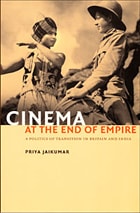
cover of Cinema at the End of Empire: A Politics of Transition in Britain and India

Cinema at the End of Empire

A Politics of Transition in Britain and India

Priya Jaikumar

Duke University Press, 2006

How did the imperial logic underlying British and Indian film policy change with the British Empire’s loss of moral authority and political cohesion? Were British and Indian films of the 1930s and 1940s responsive to and responsible for such shifts? Cinema at the End of Empire illuminates this intertwined history of British and Indian cinema in the late colonial period. Challenging the rubric of national cinemas that dominates film studies, Priya Jaikumar contends that film aesthetics and film regulations were linked expressions of radical political transformations in a declining British empire and a nascent Indian nation. As she demonstrates, efforts to entice colonial film markets shaped Britain’s national film policies, and Indian responses to these initiatives altered the limits of colonial power in India. Imperially themed British films and Indian films envisioning a new civil society emerged during political negotiations that redefined the role of the state in relation to both film industries.

In addition to close readings of British and Indian films of the late colonial era, Jaikumar draws on a wealth of historical and archival material, including parliamentary proceedings, state-sponsored investigations into colonial filmmaking, trade journals, and intra- and intergovernmental memos regarding cinema. Her wide-ranging interpretations of British film policies, British initiatives in colonial film markets, and genres such as the Indian mythological film and the British empire melodrama reveal how popular film styles and controversial film regulations in these politically linked territories reconfigured imperial relations. With its innovative examination of the colonial film archive, this richly illustrated book presents a new way to track historical change through cinema.
[more]
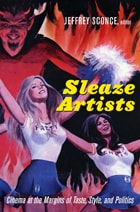
cover of Sleaze Artists: Cinema at the Margins of Taste, Style, and Politics

Sleaze Artists

Cinema at the Margins of Taste, Style, and Politics

Jeffrey Sconce, ed.

Duke University Press, 2007

Bad Girls Go to Hell. Cannibal Holocaust. Eve and the Handyman. Examining film culture’s ongoing fascination with the low, bad, and sleazy faces of cinema, Sleaze Artists brings together film scholars with a shared interest in the questions posed by disreputable movies and suspect cinema. They explore the ineffable quality of “sleaze” in relation to a range of issues, including the production realities of low-budget exploitation pictures and the ever-shifting terrain of reception and taste.

Writing about horror, exploitation, and sexploitation films, the contributors delve into topics ranging from the place of the “Aztec horror film” in debates about Mexican national identity to a cycle of 1960s films exploring homosexual desire in the military. One contributor charts the distribution saga of Mario Bava’s 1972 film Lisa and the Devil through the highs and lows of art cinema, fringe television, grindhouse circuits, and connoisseur DVD markets. Another offers a new perspective on the work of Doris Wishman, the New York housewife turned sexploitation director of the 1960s who has become a cult figure in bad-cinema circles over the past decade. Other contributors analyze the relation between image and sound in sexploitation films and Italian horror movies, the advertising strategies adopted by sexploitation producers during the early 1960s, the relationship between art and trash in Todd Haynes’s oeuvre, and the ways that the Friday the 13th series complicates the distinction between “trash” and “legitimate” cinema. The volume closes with an essay on why cinephiles love to hate the movies.

Contributors. Harry M. Benshoff, Kay Dickinson, Chris Fujiwara, Colin Gunckel, Joan Hawkins, Kevin Heffernan, Matt Hills, Chuck Kleinhans, Tania Modleski, Eric Schaefer, Jeffrey Sconce, Greg Taylor
[more]
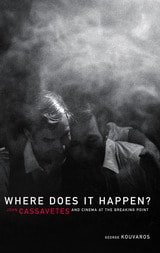
cover of Where Does It Happen: John Cassavetes And Cinema At The Breaking Point

Where Does It Happen

John Cassavetes And Cinema At The Breaking Point

George Kouvaros

University of Minnesota Press, 2004

“A good movie,” John Cassavetes has remarked, “will ask you questions you don’t already know the answers to.” And in his films, Cassavetes is as good as his word. Taking up the radical question that Cassavetes’s films consistently pose—specifically, where is the line between actor and character, fiction and reality, film and life?—George Kouvaros reveals the unique and illuminating position that Cassavetes’s work occupies at the intersection of filmmaking and film theory.Central to any understanding of Cassavetes’s achievement is the issue of performance. Looking at the work of Gena Rowlands, Ben Gazzara, and Cassavetes himself in films such as Faces, A Woman under the Influence, and The Killing of a Chinese Bookie, Kouvaros shows how performative instances—gestures, words, or glances—open up intimations of dramas belonging neither strictly to these films nor to the everyday worlds in which they are immersed. A major reassessment of the filmmaker as a formal experimenter, Where Does It Happen? gives Cassavetes his due as a filmmaker whose critical place in the modern cinema is only now becoming clear. George Kouvaros is senior lecturer in the School of Theatre, Film, and Dance at the University of New South Wales, Australia.
[more]