Results by title
7 books match the query 'Cinemas'
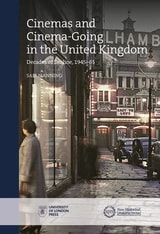
Cinemas and Cinema-Going in the United Kingdom
Decades of Decline, 1945–1965Sam Manning
University of London Press, 2020
Cinema-going was the most popular commercial leisure activity in the United Kingdom during the first half of the twentieth century, with attendance growing significantly during World War II and peaking in 1946 with 1.6 billion recorded admissions. Though “going to the pictures” remained a popular pastime for the remainder of the forties, the transition from war to peacetime altered citizens’ leisure habits. During the fifties, a range of factors led to rapid declines in attendance, and by 1965, admissions had plummeted to 327 million.
Cinema attendance fell in all regions, but the speed, nature, and extent of this decline varied widely across the United Kingdom. By presenting detailed case studies of two similarly-sized industrial cities, Belfast and Sheffield, this book adds nuance and detail to the discussion of regional variations in film exhibition and audience habits. Using a wide range of sources, such as oral testimony, box-office data, newspapers, and trade journals, Cinemas and Cinema-Going in the United Kingdom conveys the diverse and ever-changing nature of the cinema industry.
Cinema attendance fell in all regions, but the speed, nature, and extent of this decline varied widely across the United Kingdom. By presenting detailed case studies of two similarly-sized industrial cities, Belfast and Sheffield, this book adds nuance and detail to the discussion of regional variations in film exhibition and audience habits. Using a wide range of sources, such as oral testimony, box-office data, newspapers, and trade journals, Cinemas and Cinema-Going in the United Kingdom conveys the diverse and ever-changing nature of the cinema industry.
[more]
Cinemas in Transition in Central and Eastern Europe after 1989
Catherine Portuges
Temple University Press, 2013
The cinemas of Eastern and Central Europe have been moving away from earlier Cold War perspectives and iconographies toward identifications more closely linked to a redefined Europe. Cinemas in Transition in Central and Eastern Europe after 1989 studies the shifts in the dynamics between film production, exhibition, and reception in Eastern bloc countries as they moved from state-sponsored systems toward the free market.
The contributors and editors of this exciting volume examine the interrelations between thematic, aesthetic, and infrastructural changes; the globalization of the international cinema marketplace; and the problems and promises arising from the privatization of national cinemas.
Cinemas in Transition in Central and Eastern Europe after 1989 also addresses the strategies employed for preserving national cinemas and cultures through an analysis of films from the Czech and Slovak republics, the former German Democratic Republic, Hungary, Poland, Romania, Ukraine, and the former Yugoslavia. The study provides a picture of Eastern European cinema at a critical juncture as well as its connections to the emergent world of transnational media.
Contributors include Barton Byg, Alexandra Foamente, Andrew Horton, Dina Iordanova, Ewa Mazierska, Bohdan Y. Nebesio, and Bogdan Stefanescu,
[more]
Cinemas of Bisexual Transgression
Jacob Engelberg
Duke University Press, 2026
In Cinemas of Bisexual Transgression, Jacob Engelberg makes the case for radically recalibrating queer film studies, taking as a starting point those cinematic figures who resist categorization within the gay-straight binary. Engelberg’s engagement with bisexual transgression on film illuminates the mutability and instability of sexuality, and of sociocultural structures more broadly by resisting the censure of images as politically harmful as well as the celebration of transgression as inherently subversive. Instead, Engelberg understands bisexual transgression as a process whereby sociocultural rules are made knowable by being contested. From 1970s vampire films to 1990s erotic thrillers, from lesbian imaginings of female bisexuality to European art cinema’s reckonings with HIV/AIDS, bisexual figures on film embody anxieties around the precarity of binary sexuality while revealing the contingencies of sexuality’s cinematic signification. Revivifying the underexploited contributions of bisexual theory, Cinemas of Bisexual Transgression proposes a new mode of film theorization and analysis that examines the rich space between and beyond dominant categories of sexual organization, where sexual unpredictability, the allure of the forbidden, and the precarity of sexual signification are illuminated.
[more]

Cinemas of the Other
A Personal Journey with Film-Makers from Central AsiaGönül Dönmez-Colin
Intellect Books, 2012
Updated collections of recent interviews with filmmakers whose works represent trends in the film industries of Central Asia and the Middle East, these two new geospecific editions expand upon the earlier volume Cinemas of the Other: A Personal Journey with Film-Makers from the Middle East and Central Asia.
Following an introduction delineating the histories of the film industries of the countries that make up the Middle East and Central Asia—including Iran, Turkey, and the Central Asian republics of Kazakhstan, Kyrgyzstan, Tajikstan, Turkmenistan, and Uzbekistan—both books contain interviews stretching over a decade, which position the filmmakers and their creative concerns within the social or political context of their respective countries. The striking variety of approaches toward each interview creates a rich diversity of tone and opens the door to a better understanding of images of “otherness” in film. In addition to transcripts of the interviews, each chapter also includes stills from important films discussed, biographical information about the filmmakers, and filmographies of their works.
Gönül Dönmez-Colin offers in these expanded editions a carefully researched and richly detailed firsthand account of the developments and trends in these regional film industries that is sure to be appreciated by film scholars and researchers of the Middle East and Central Asia.
[more]
Cinemas of the Other
A Personal Journey with Film-Makers from Iran and TurkeyGönül Dönmez-Colin
Intellect Books, 2012
Updated collections of recent interviews with filmmakers whose works represent trends in the film industries of Central Asia and the Middle East, these two new geospecific editions expand upon the earlier volume Cinemas of the Other: A Personal Journey with Film-Makers from the Middle East and Central Asia.
Following an introduction delineating the histories of the film industries of the countries that make up the Middle East and Central Asia—including Iran, Turkey, and the Central Asian republics of Kazakhstan, Kyrgyzstan, Tajikstan, Turkmenistan, and Uzbekistan—both books contain interviews stretching over a decade, which position the filmmakers and their creative concerns within the social or political context of their respective countries. The striking variety of approaches toward each interview creates a rich diversity of tone and opens the door to a better understanding of images of “otherness” in film. In addition to transcripts of the interviews, each chapter also includes stills from important films discussed, biographical information about the filmmakers, and filmographies of their works.
Gönül Dönmez-Colin offers in these expanded editions a carefully researched and richly detailed firsthand account of the developments and trends in these regional film industries that is sure to be appreciated by film scholars and researchers of the Middle East and Central Asia.
[more]
Multiple Modernities
Cinemas & Popular Media In Transcultural East AsiaJenny Lau
Temple University Press, 2002
Multiple Modernities explores the cultural terrain of East Asia. Arguing that becoming modern happens differently in different places, the contributors examines popular culture—most notable cinema and television—to see how modernization, as both a response to the West and as a process that is unique in its own right in the region, operates on a mass level.Included in this collection are significant explorations of popular culture in East Asia, including Chinese new cinema and rock music, Korean cinema, Taiwanese television, as well as discussions of alternative arts in general.While each essay focuses on specific nations or cinemas, the collected effect of reading them is to offer a comprehensive, in-depth picture of how popular culture in East Asia operates to both generate and reflect the immense change this significant region of the world is undergoing.
[more]
The Visceral Screen
Between the Cinemas of John Cassavetes and David CronenbergRobert Furze
Intellect Books, 2015
Narrative and spectacle describe two extremes of film content, but the oeuvres of John Cassavetes and David Cronenberg resist such categorization. Instead, Robert Furze argues, the defining characteristic of these directors’ respective approaches is that of “visceral” cinema—a term that illustrates the anxiety these filmmakers provoke in their audiences. Cassavetes demonstrates this through disregard for plot structure and character coherence, while Cronenberg's focus is on graphic depictions of mutilation, extreme forms of bodily transformation, and violence.
The Visceral Screen sets out to articulate alternative ways of appreciating film aesthetics outside the narrative/spectacle continuum. Cassavetes and Cronenberg are established auteurs, but the elements of their films that appear to be barriers to their artistic status—for example, slipshod method and lingering violence or pre-digital special effects—are reassessed here as other indicators of creativity. In this way, Furze encourages debates of what makes a film good or bad—beyond how much it is seen to adhere to particular, established models of filmmaking.
The Visceral Screen sets out to articulate alternative ways of appreciating film aesthetics outside the narrative/spectacle continuum. Cassavetes and Cronenberg are established auteurs, but the elements of their films that appear to be barriers to their artistic status—for example, slipshod method and lingering violence or pre-digital special effects—are reassessed here as other indicators of creativity. In this way, Furze encourages debates of what makes a film good or bad—beyond how much it is seen to adhere to particular, established models of filmmaking.
[more]