Results by title
3 books match the query 'Cinematic Imagination'
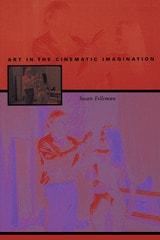
Art in the Cinematic Imagination
By Susan Felleman
University of Texas Press, 2006
Bringing an art historical perspective to the realm of American and European film, Art in the Cinematic Imagination examines the ways in which films have used works of art and artists themselves as cinematic and narrative motifs. From the use of portraits in Vertigo to the cinematic depiction of women artists in Artemisia and Camille Claudel, Susan Felleman incorporates feminist and psychoanalytic criticism to reveal individual and collective perspectives on sex, gender, identity, commerce, and class.
Probing more than twenty films from the postwar era through contemporary times, Art in the Cinematic Imagination considers a range of structurally significant art objects, artist characters, and art-world settings to explore how the medium of film can amplify, reinvent, or recontextualize the other visual arts. Fluently speaking across disciplines, Felleman's study brings a broad array of methodologies to bear on questions such as the evolution of the "Hollywood Love Goddess" and the pairing of the feminine with death on screen.
A persuasive approach to an engaging body of films, Art in the Cinematic Imagination illuminates a compelling and significant facet of the cinematic experience.
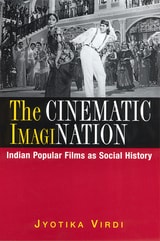
The Cinematic ImagiNation
Indian Popular Films as Social HistoryVirdi, Jyotika
Rutgers University Press, 2003
--Gina Marchetti, author of Romance and the "Yellow Peril": Race, Sex, and Discursive Strategies in Hollywood Fiction
India produces more films than any other country in the world, and these works are avidly consumed by non-Western cultures in Africa, Eastern Europe, the Middle East, and by the Indian communities in Australia, Britain, the Caribbean Islands, and North America. Jyotika Virdi focuses on how this dominant medium configures the "nation" in post-Independence Hindi cinema. She scrutinizes approximately thirty films that have appeared since 1950 and demonstrates how concepts of the nation form the center of this cinema's moral universe. As a kind of storytelling, Indian cinema provides a fascinating account of social history and cultural politics, with the family deployed as a symbol of the nation. Virdi demonstrates how the portrayal of the nation as a mythical community in Hindi films collapses under the weight of its own contradictions--irreconcilable differences that encompass gender, sexuality, family, class, and religious communities. Through these film narratives, the author traces transactions among the various constituencies that struggle, accommodate, coexist uneasily, or reconstitute each other over time, and, in the process, reveal the topography of postcolonial culture.
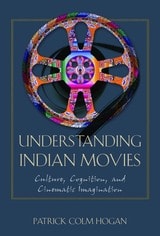
Understanding Indian Movies
Culture, Cognition, and Cinematic ImaginationBy Patrick Colm Hogan
University of Texas Press, 2008
Indian movies are among the most popular in the world. However, despite increased availability and study, these films remain misunderstood and underappreciated in much of the English-speaking world, in part for cultural reasons.
In this book, Patrick Colm Hogan sets out through close analysis and explication of culturally particular information about Indian history, Hindu metaphysics, Islamic spirituality, Sanskrit aesthetics, and other Indian traditions to provide necessary cultural contexts for understanding Indian films. Hogan analyzes eleven important films, using them as the focus to explore the topics of plot, theme, emotion, sound, and visual style in Indian cinema. These films draw on a wide range of South Asian cultural traditions and are representative of the greater whole of Indian cinema. By learning to interpret these examples with the tools Hogan provides, the reader will be able to take these skills and apply them to other Indian films.
But this study is not simply culturalist. Hogan also takes up key principles from cognitive neuroscience to illustrate that all cultures share perceptual, cognitive, and emotional elements that, when properly interpreted, can help to bridge gaps between seemingly disparate societies. Hogan locates the specificity of Indian culture in relation to human universals, and illustrates this cultural-cognitive synthesis through his detailed interpretations of these films. This book will help both scholars and general readers to better understand and appreciate Indian cinema.