Results by title
5 books match the query 'Cioran, E. M.'
History and Utopia
E. M. Cioran
University of Chicago Press, 1998
In this book, Cioran writes of politics, of history, and of the utopian dream.
"A small masterwork . . . a stringent examination of some persistent and murky notions in human history. . . . It is best to read Cioran while sitting. The impact upon the intellect can be temporarily stunning, and motor systems may give way under the assault."—Joseph Patrick Kennedy, Houston Chronicle
"Cioran has a claim to be regarded as among the handful of original minds . . . writing today."—New York Times
"A sort of final philosopher of the Western world. [Cioran's] statements have the compression of poetry and the audacity of cosmic clowning."—Washington Post
E. M. Cioran (1911-1995) was born and educated in Romania and lived in Paris from 1937 until his death. He is the author of numerous works, including On the Heights of Despair, also available from the University of Chicago Press.
[more]
On the Heights of Despair
E. M. Cioran
University of Chicago Press, 1992
A classic work of philosophical reflection on despair, decay, and the futility of existence that Publishers Weekly said “puts Cioran in the company of Nietzsche and Kierkegaard”
Born of a terrible insomnia—"a dizzying lucidity which would turn even paradise into hell"—this book presents the potent, self-lacerating insights of the youthful E. M. Cioran, a self-described "Nietzsche still complete with his Zarathustra, his poses, his mystical clown's tricks, a whole circus of the heights."
On the Heights of Despair shows Cioran's first grappling with themes he would return to in his later, mature works: despair and decay, absurdity and alienation, futility and the irrationality of existence. It also presents Cioran as a connoisseur of apocalypse, a theoretician of despair, for whom writing and philosophy both share the "lyrical virtues" that alone lead to a metaphysical revelation.
On the Heights of Despair shows Cioran's first grappling with themes he would return to in his later, mature works: despair and decay, absurdity and alienation, futility and the irrationality of existence. It also presents Cioran as a connoisseur of apocalypse, a theoretician of despair, for whom writing and philosophy both share the "lyrical virtues" that alone lead to a metaphysical revelation.
A book to keep at your bedside, as epigrammatic as it is insightful, On the Heights of Despair offers not consolation, but engaging, thought-provoking companionship.
[more]
Tears and Saints
E. M. Cioran
University of Chicago Press, 1995
By the mid-1930s, Emil Cioran was already known as a leader of a new generation of politically committed Romanian intellectuals. Researching another, more radical book, Cioran was spending hours in a library poring over the lives of saints. As a modern hagiographer, Cioran "dreamt" himself "the chronicler of these saints' falls between heaven and earth, the intimate knower of the ardors in their hearts, the historian of God's insomniacs." Inspired by Nietzsche's Beyond Good and Evil, Cioran "searched for the origin of tears." He asked himself if saints could be "the sources of tears' better light."
"Who can tell?" he wrote in the first paragraph of this book, first published in Romania in 1937. "To be sure, tears are their trace. Tears did not enter the world through the saints; but without them we would never have known that we cry because we long for a lost paradise." By following in their traces, "wetting the soles of one's feet in their tears," Cioran hoped to understand how a human being can renounce being human. Written in Cioran's characteristic aphoristic style, this flamboyant, bold, and provocative book is one of his most important—and revelatory—works.
Cioran focuses not on martyrs or heroes but on the mystics—primarily female—famous for their keening spirituality and intimate knowledge of God. Their Christianity was anti-theological, anti-institutional, and based solely on intuition and sentiment. Many, such as Catherine of Siena, Teresa of Avila, and Saint John of the Cross, have produced classic works of mystical literature; but Cioran celebrates many more minor and unusual figures as well.
Following Nietzsche, he focuses explicitly on the political element hidden in saints' lives. In his hands, however, their charitable deeds are much less interesting than their thirst for pain and their equally powerful capacity to endure it. Behind their suffering and their uncanny ability to renounce everything through ascetic practices, Cioran detects a fanatical will to power.
"Like Nietzsche, Cioran is an important religious thinker. His book intertwines God and music with passion and tears. . . . [Tears and Saints] has a chillingly contemporary ring that makes this translation important here and now."—Booklist
[more]
The New Gods
E. M. Cioran
University of Chicago Press, 1974
Dubbed “Nietzsche without his hammer” by literary critic James Wood, the Romanian philosopher E. M. Cioran is known as much for his profound pessimism and fatalistic approach as for the lyrical, raging prose with which he communicates them. Unlike many of his other works, such as On the Heights of Despair and Tears and Saints, The New Gods eschews his usual aphoristic approach in favor of more extensive and analytic essays.
Returning to many of Cioran’s favorite themes, The New Gods explores humanity’s attachment to gods, death, fear, and infirmity, in essays that vary widely in form and approach. In “Paleontology” Cioran describes a visit to a museum, finding the relatively pedestrian destination rife with decay, death, and human weakness. In another chapter, Cioran explores suicide in shorter, impressionistic bursts, while “The Demiurge” is a shambolic exploration of man’s relationship with good, evil, and God. All the while, The New Gods reaffirms Cioran’s belief in “lucid despair,” and his own signature mixture of pessimism and skepticism in language that never fails to be a pleasure. Perhaps his prose itself is an argument against Cioran’s near-nihilism: there is beauty in his books.
[more]
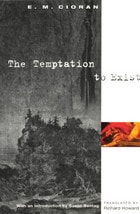
The Temptation to Exist
E. M. Cioran
University of Chicago Press, 1998
This collection of eleven essays originally appeared in France thirty years ago and created a literary whirlwind on the Left Bank. Cioran writes incisively about Western civilizations, the writer, the novel, mystics, apostles, and philosophers.
"A sort of final philosopher of the Western world. His statements have the compression of poetry and the audacity of cosmic clowning."—Washington Post
"An intellectual bombshell that blasts away at all kinds of cant, sham and conventionality. . . . [Cioran's] language is so erotic, his handling of words so seductive, that the act of reading becomes an encounter in the erogenous zone."—Jonah Raskin, L.A. Weekly
[more]