Results by title
3 books match the query 'City planners'
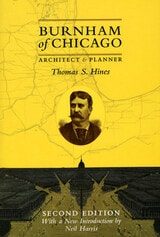
Burnham of Chicago
Architect and Planner, Second EditionThomas S. Hines
University of Chicago Press, 2008
“In every sense this is the definitive biography.”—Harry Weese, Chicago Tribune

Jane Jacobs
Urban VisionaryAlice Sparberg Alexiou
Rutgers University Press, 2006
Today, we take for granted the wisdom of renovating old factory buildings into malls or condos, of making once decaying waterfronts into vibrant public spaces, of protecting historic buildings under landmark laws, and of building public housing on a human scale rather than as high-rises. In contemporary cities, it is now common for community groups to plant gardens in empty lots and to buy abandoned apartment buildings from the city for a dollar and fix them up.
But these and other urban planning policies and practices have not always been accepted. Before they became widespread, they were the visionary ideas of the writer and urban commentator Jane Jacobs. Best known in the United States for her path-breaking efforts to preserve the character of Greenwich Village, Jacobs is the author of the classic 1961 book, The Death and Life of Great American Cities, one of the most influential works ever published in urban studies. The architectural critic Herbert Muschamp wrote in the New York Times that its publication “was one of twentieth-century architecture’s most traumatic events. Its impact is still felt in cities across the land.”
In this analysis of Jane Jacobs’s ideas and work, Alice Sparberg Alexiou tells the remarkable story of a woman who without any formal training in planning became a prominent spokesperson for sensible urban change. Besides writing the seminal book about contemporary cities, Jacobs organized successful community battles in New York against powerful interests. She resisted urban renewal in the West Village in the 1960s, helped defeat the Lower Manhattan Expressway, advocated the pleasures of street life that she called “sidewalk ballet,” and opposed the original Twin Towers plans. She was also active in the anti–Vietnam War movement, which eventually led her to move to Canada. There she continued her grass-roots activism, including helping to prevent the construction of an expressway that would have cut through several neighborhoods in Toronto.
Based on a rich array of interviews and primary source material, this book brings long-overdue attention to Jacobs’s far-reaching influence as an original thinker and effective activist.
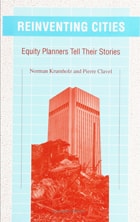
Reinventing Cities
Equity Planners Tell Their StoriesNorman Krumholz and Pierre Clavel
Temple University Press, 1994
Reinventing Cities emphasizes the extraordinary accomplishments of eleven urban planners who work for the needs of low income and working class people. Through the voices of equity planners who have worked "in the trenches" of city halls, Norman Krumholz and Pierre Clavel explore the inner dimensions of social change, economic development, community organizing, and the dynamics of implementing and producing fair housing. Preceded by "snapshots" that describe the demographics, politics, and economics of each specific city or region, the editors' interviews with these leading progressive planners highlight productive strategies, disquieting failures, and the cities in which the fought for equity.
Included are conversations with Rick Cohen, former director of Jersey City's Department of Housing and Economic Development; Dale F. Bertsch, former first director of the Miami Valley Regional Planning Commission, Dayton, Ohio; Robert Mier, former commissioner of the Department of Economic Development (DED); Kari J. Moe, former deputy commissioner of Research and Development, DED'; Arturo Vazquez, former director of Mayor Washington's Office of Employment and Training, Chicago; Margaret D. Strachan, former city commissioner, Portland, Oregon; Peter Dreier, former housing director, Boston Redevelopment Authority, and policy aide to Mayor Raymond Flynn; Billie Bramhall, planning staff, Mayor Federico Pena, Denver, Colorado; Howard Stanback, city manager, Hartford, Connecticut; Derek Shearer, former Planning Commission chairman, Santa Monica, California; and Kenneth Grimes, senior planning analyst, San Diego Housing Commission.
In the series Conflicts in Urban and Regional Development, edited by John R. Logan and Todd Swanstrom.