Results by title
15 books match the query 'Ciudad Juárez'
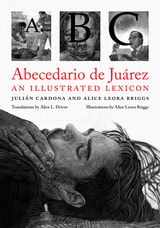
Abecedario de Juárez
An Illustrated LexiconJulián Cardona and Alice Leora Briggs, with translations by Alice L. Driver; illustrations by Alice Leora Briggs
University of Texas Press, 2022
Uses key words and striking images to explore violence and everyday life in Juárez, Mexico.
Juárez, Mexico, is known for violence. The femicides of the 1990s, and the cartel mayhem that followed, made it one of the world's most dangerous cities. Along with the violence came a new lexicon that traveled from person to person, across rivers and borders—wherever it was needed to explain the horrors taking place. From personal interviews, media accounts, and conversations on the street, Julián Cardona and Alice Leora Briggs have collected the words and slang that make up the brutal language of Juárez, creating a glossary that serves as a linguistic portrait of the city and its violence. Organized alphabetically, the entries consist of Spanish and Spanglish, accompanied by short English definitions. Some also feature a longer narrative drawn from interviews—stories that put the terms in context and provide a personal counterpoint to media reports of the same events. Letters, and many of the entries, are supplemented with Briggs’s evocative illustrations, which are reminiscent of Hans Holbein’s famous Alphabet of Death. Together, the words, drawings, and descriptions in ABCedario de Juárez both document and interpret the everyday violence of this vital border city.
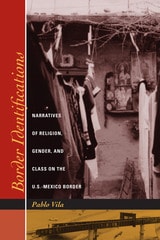
Border Identifications
Narratives of Religion, Gender, and Class on the U.S.-Mexico BorderBy Pablo Vila
University of Texas Press, 2005
From poets to sociologists, many people who write about life on the U.S.-Mexico border use terms such as "border crossing" and "hybridity" which suggest that a unified culture—neither Mexican nor American, but an amalgamation of both—has arisen in the borderlands. But talking to people who actually live on either side of the border reveals no single commonly shared sense of identity, as Pablo Vila demonstrated in his book Crossing Borders, Reinforcing Borders: Social Categories, Metaphors, and Narrative Identities on the U.S.-Mexico Frontier. Instead, people living near the border, like people everywhere, base their sense of identity on a constellation of interacting factors that includes regional identity, but also nationality, ethnicity, and race.
In this book, Vila continues the exploration of identities he began in Crossing Borders, Reinforcing Borders by looking at how religion, gender, and class also affect people's identifications of self and "others" among Mexican nationals, Mexican immigrants, Mexican Americans, Anglos, and African Americans in the Cuidad Juárez-El Paso area. Among the many fascinating issues he raises are how the perception that "all Mexicans are Catholic" affects Mexican Protestants and Pentecostals; how the discourse about proper gender roles may feed the violence against women that has made Juárez the "women's murder capital of the world"; and why class consciousness is paradoxically absent in a region with great disparities of wealth. His research underscores the complexity of the process of social identification and confirms that the idealized notion of "hybridity" is only partially adequate to define people's identity on the U.S.-Mexico border.
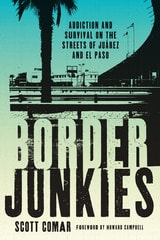
Border Junkies
Addiction and Survival on the Streets of Juárez and El PasoBy Scott Comar
University of Texas Press, 2011
The drug war that has turned Juárez, Mexico, into a killing field that has claimed more than 7,000 lives since 2008 captures headlines almost daily. But few accounts go all the way down to the streets to investigate the lives of individual drug users. One of those users, Scott Comar, survived years of heroin addiction and failed attempts at detox and finally cleaned up in 2003. Now a graduate student at the University of Texas at El Paso in the history department's borderlands doctoral program, Comar has written Border Junkies, a searingly honest account of his spiraling descent into heroin addiction, surrender, change, and recovery on the U.S.-Mexico border.
Border Junkies is the first book ever written about the lifestyle of active addiction on the streets of Juárez. Comar vividly describes living between the disparate Mexican and American cultures and among the fellow junkies, drug dealers, hookers, coyote smugglers, thieves, and killers who were his friends and neighbors in addiction—and the social workers, missionaries, shelter workers, and doctors who tried to help him escape. With the perspective of his anthropological training, he shows how homelessness, poverty, and addiction all fuel the use of narcotics and the rise in their consumption on the streets of Juárez and contribute to the societal decay of this Mexican urban landscape. Comar also offers significant insights into the U.S.-Mexico borderland's underground and peripheral economy and the ways in which the region's inhabitants adapt to the local economic terrain.
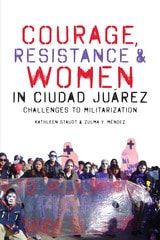
Courage, Resistance, and Women in Ciudad Juárez
Challenges to MilitarizationBy Kathleen Staudt and Zulma Y. Méndez
University of Texas Press, 2015
Ciudad Juárez has recently become infamous for its murder rate, which topped 3,000 in 2010 as competing drug cartels grew increasingly violent and the military responded with violence as well. Despite the atmosphere of intimidation by troops, police, and organized criminals, women have led the way in civil society activism, spurring the Juárez Resistance and forging powerful alliances with anti-militarization activists.
An in-depth examination of la Resistencia Juarense, Courage, Resistance, and Women in Ciudad Juárez draws on ethnographic research to analyze the resistance’s focus on violence against women, as well as its clash with the war against drugs championed by Mexican President Felipe Calderón with the support of the United States. Through grounded insights, the authors trace the transformation of hidden discourses into public discourses that openly challenge the militarized border regimes. The authors also explore the advocacy carried on by social media, faith-based organizations, and peace-and-justice activist Javier Sicilia while Calderón faced U.S. political schisms over the role of border trade in this global manufacturing site.
Bringing to light on-the-ground strategies as well as current theories from the fields of sociology, political anthropology, and human rights, this illuminating study is particularly significant because of its emphasis on the role of women in local and transnational attempts to extinguish a hot zone. As they overcome intimidation to become game-changing activists, the figures featured in Courage, Resistance, and Women in Ciudad Juárez offer the possibility of peace and justice in the wake of seemingly irreconcilable conflict.
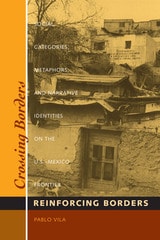
Crossing Borders, Reinforcing Borders
Social Categories, Metaphors, and Narrative Identities on the U.S.-Mexico FrontierBy Pablo Vila
University of Texas Press, 2000
Along the U.S.-Mexico frontier, where border crossings are a daily occurrence for many people, reinforcing borders is also a common activity. Not only does the U.S. Border Patrol strive to "hold the line" against illegal immigrants, but many residents on both sides of the border seek to define and bound themselves apart from groups they perceive as "others."
This pathfinding ethnography charts the social categories, metaphors, and narratives that inhabitants of El Paso and Ciudad Juárez use to define their group identity and distinguish themselves from "others." Pablo Vila draws on over 200 group interviews with more than 900 area residents to describe how Mexican nationals, Mexican immigrants, Mexican Americans, African Americans, and Anglos make sense of themselves and perceive their differences from others.
This research uncovers the regionalism by which many northern Mexicans construct their sense of identity, the nationalism that often divides Mexican Americans from Mexican nationals, and the role of ethnicity in setting boundaries among Anglos, Mexicans, and African Americans. Vila also looks at how gender, age, religion, and class intertwine with these factors. He concludes with fascinating excerpts from re-interviews with several informants, who modified their views of other groups when confronted by the author with the narrative character of their identities.
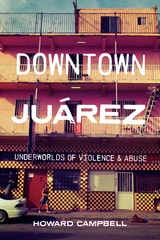
Downtown Juárez
Underworlds of Violence and AbuseHoward Campbell
University of Texas Press, 2021
At least 200,000 people have died in Mexico’s so-called drug war, and the worst suffering has been in Ciudad Juárez, across the border from El Paso, Texas. How did it get so bad? After three decades studying that question, Howard Campbell doesn’t believe there is any one answer. Misguided policies, corruption, criminality, and the borderland economy are all factors. But none of these reasons explain how violence in downtown Juárez has become heartbreakingly “normal.”
A rigorous yet moving account, Downtown Juárez is informed by the sex workers, addicts, hustlers, bar owners, human smugglers, migrants, and down-and-out workers struggling to survive in an underworld where horrifying abuses have come to seem like the natural way of things. Even as Juárez’s elite northeast section thrives on the profits of multinational corporations, and law-abiding citizens across the city mobilize against crime and official malfeasance, downtown’s cantinas, barrios, and brothels are tyrannized by misery.
Campbell’s is a chilling perspective, suggesting that, over time, violent acts feed off each other, losing their connection to any specific cause. Downtown Juárez documents this banality of evil—and confronts it—with the stories of those most affected.
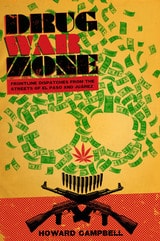
Drug War Zone
Frontline Dispatches from the Streets of El Paso and JuárezBy Howard Campbell
University of Texas Press, 2009
Winner, Southwest Book Award, Border Regional Library Association, 2011
Thousands of people die in drug-related violence every year in Mexico. Ciudad Juárez, Chihuahua, adjacent to El Paso, Texas, has become the most violent city in the Mexican drug war. Much of the cocaine, marijuana, and methamphetamine consumed in the United States is imported across the Mexican border, making El Paso/Juárez one of the major drug-trafficking venues in the world.
In this anthropological study of drug trafficking and anti-drug law enforcement efforts on the U.S.-Mexico border, Howard Campbell uses an ethnographic perspective to chronicle the recent Mexican drug war, focusing especially on people and events in the El Paso/Juárez area. It is the first social science study of the violent drug war that is tearing Mexico apart.
Based on deep access to the drug-smuggling world, this study presents the drug war through the eyes and lives of direct participants. Half of the book consists of oral histories from drug traffickers, and the other half from law enforcement officials. There is much journalistic coverage of the drug war, but very seldom are the lived experiences of traffickers and "narcs" presented in such vivid detail. In addition to providing an up-close, personal view of the drug-trafficking world, Campbell explains and analyzes the functioning of drug cartels, the corruption that facilitates drug trafficking, the strategies of smugglers and anti-narcotics officials, and the perilous culture of drug trafficking that Campbell refers to as the "Drug War Zone."
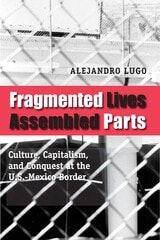
Fragmented Lives, Assembled Parts
Culture, Capitalism, and Conquest at the U.S.-Mexico BorderBy Alejandro Lugo
University of Texas Press, 2008
Southwest Book Award, Border Regional Library Association, 2008
Association of Latina and Latino Anthropologists Book Award, 2009
Established in 1659 as Misión de Nuestra Señora de Guadalupe de los Mansos del Paso del Norte, Ciudad Juárez is the oldest colonial settlement on the U.S.-Mexico border-and one of the largest industrialized border cities in the world. Since the days of its founding, Juárez has been marked by different forms of conquest and the quest for wealth as an elaborate matrix of gender, class, and ethnic hierarchies struggled for dominance. Juxtaposing the early Spanish invasions of the region with the arrival of late-twentieth-century industrial "conquistadors," Fragmented Lives, Assembled Parts documents the consequences of imperial history through in-depth ethnographic studies of working-class factory life.
By comparing the social and human consequences of recent globalism with the region's pioneer era, Alejandro Lugo demonstrates the ways in which class mobilization is itself constantly being "unmade" at both the international and personal levels for border workers. Both an inside account of maquiladora practices and a rich social history, this is an interdisciplinary survey of the legacies, tropes, economic systems, and gender-based inequalities reflected in a unique cultural landscape. Through a framework of theoretical conceptualizations applied to a range of facets—from multiracial "mestizo" populations to the notions of border "crossings" and "inspections," as well as the recent brutal killings of working-class women in Ciudad Juárez—Fragmented Lives, Assembled Parts provides a critical understanding of the effect of transnational corporations on contemporary Mexico, calling for official recognition of the desperate need for improved working and living conditions within this community.
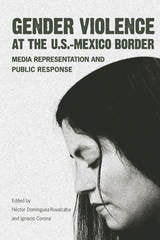
Gender Violence at the U.S.–Mexico Border
Media Representation and Public ResponseEdited by Héctor Domínguez-Ruvalcaba and Ignacio Corona
University of Arizona Press, 2012
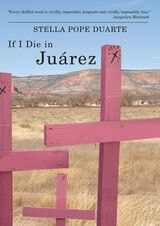
If I Die in Juárez
Stella Pope Duarte
University of Arizona Press, 2008
Based on the author’s interviews with relatives of murdered women, If I Die in Juárez is brilliantly crafted to give readers the experience of walking in the shoes of women who daily risk being abducted and murdered in the “capital city of murdered women,” joining thousands of others who for more than a decade have disappeared from Juárez, las desaparecidas, brutally murdered by assassins who have gone unpunished. The agony of one of the darkest tales in human history brings to light a strange hope, illusive yet constant, resisting lies, betrayal, and the desert’s silent sentence of death.
Read an in-depth review of If I Die in Juárez here or click here for a study guide. If I Die in Juárez was also reviewed on KNAU's Southwest Book Review program. Listen here!
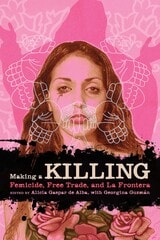
Making a Killing
Femicide, Free Trade, and La FronteraEdited by Alicia Gaspar de Alba, with Georgina Guzmán
University of Texas Press, 2010
Since 1993, more than five hundred women and girls have been murdered in Ciudad Juárez across the border from El Paso, Texas. At least a third have been sexually violated and mutilated as well. Thousands more have been reported missing and remain unaccounted for. The crimes have been poorly investigated and have gone unpunished and unresolved by Mexican authorities, thus creating an epidemic of misogynist violence on an increasingly globalized U.S.-Mexico border.
This book, the first anthology to focus exclusively on the Juárez femicides, as the crimes have come to be known, compiles several different scholarly "interventions" from diverse perspectives, including feminism, Marxism, critical race theory, semiotics, and textual analysis. Editor Alicia Gaspar de Alba shapes a multidisciplinary analytical framework for considering the interconnections between gender, violence, and the U.S.-Mexico border. The essays examine the social and cultural conditions that have led to the heinous victimization of women on the border—from globalization, free trade agreements, exploitative maquiladora working conditions, and border politics, to the sexist attitudes that pervade the social discourse about the victims. The book also explores the evolving social movement that has been created by NGOs, mothers' organizing efforts, and other grassroots forms of activism related to the crimes. Contributors include U.S. and Mexican scholars and activists, as well as personal testimonies of two mothers of femicide victims.
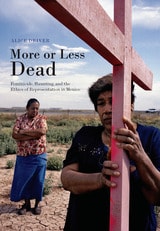
More or Less Dead
Feminicide, Haunting, and the Ethics of Representation in MexicoAlice Driver
University of Arizona Press, 2015
More or Less Dead analyzes how such violence against women has been represented in news media, books, films, photography, and art. Alice Driver argues that the various cultural reports often express anxiety or criticism about how women traverse and inhabit the geography of Ciudad Juárez and further the idea of the public female body as hypersexualized. Rather than searching for justice, the various media—art, photography, and even graffiti—often reuse victimized bodies in sensationalist, attention-grabbing ways. In order to counteract such views, local activists mark the city with graffiti and memorials that create a living memory of the violence and try to humanize the victims of these crimes.
The phrase “more or less dead” was coined by Chilean author Roberto Bolaño in his novel 2666, a penetrating fictional study of Juárez. Driver explains that victims are “more or less dead” because their bodies are never found or aren’t properly identified, leaving families with an uncertainty lasting for decades—or forever.
The author’s clear, precise journalistic style tackles the ethics of representing feminicide victims in Ciudad Juárez. Making a distinction between the words “femicide” (the murder of girls or women) and “feminicide” (murder as a gender-driven event), one of her interviewees says, “Women are killed for being women, and they are victims of masculine violence because they are women. It is a crime of hate against the female gender. These are crimes of power.”
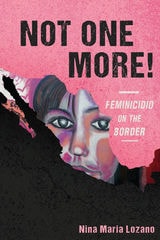
Not One More!
Feminicidio on the BorderNina Maria Lozano
The Ohio State University Press, 2019
Finding theories of new materialism inadequate to explain the feminicidios, Lozano critiques and extends this approach—advancing instead a new theoretical framework, border materialism, to argue that capitalist systems of neoliberalism and free trade are directly correlated to the killing of women on the US–Mexico border. Through the author’s fifteen-plus years of on-the-ground fieldwork, readers are presented with firsthand accounts, testimonies, and new social movement strategies from family members and activists attempting to stop these gendered crimes.
By offering concrete case studies—including analysis of maquiladoras/factories and free trade zones, public monuments and murals memorializing the victims, rastreos/searches by family members for victims’ DNA remains, and testimony from Mothers, family members, and activists—Not One More! lays bare the socioeconomic and geopolitical forces at work in the killing of women in Juárez.
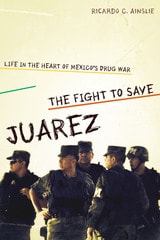
The Fight to Save Juárez
Life in the Heart of Mexico's Drug WarBy Ricardo C. Ainslie
University of Texas Press, 2013
The city of Juárez is ground zero for the drug war that is raging across Mexico and has claimed close to 60,000 lives since 2007. Almost a quarter of the federal forces that former President Felipe Calderón deployed in the war were sent to Juárez, and nearly 20 percent of the country’s drug-related executions have taken place in the city, a city that can be as unforgiving as the hardest places on earth. It is here that the Mexican government came to turn the tide. Whatever happens in Juárez will have lasting repercussions for both Mexico and the United States.
Ricardo Ainslie went to Juárez to try to understand what was taking place behind the headlines of cartel executions and other acts of horrific brutality. In The Fight to Save Juárez, he takes us into the heart of Mexico’s bloodiest city through the lives of four people who experienced the drug war from very different perspectives—Mayor José Reyes Ferriz, a mid-level cartel player’s mistress, a human rights activist, and a photojournalist. Ainslie also interviewed top Mexican government strategists, including members of Calderón’s security cabinet, as well as individuals within U.S. law enforcement. The dual perspective of life on the ground in the drug war and the “big picture” views of officials who are responsible for the war’s strategy, creates a powerful, intimate portrait of an embattled city, its people, and the efforts to rescue Juárez from the abyss.
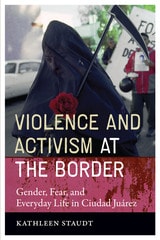
Violence and Activism at the Border
Gender, Fear, and Everyday Life in Ciudad JuarezBy Kathleen Staudt
University of Texas Press, 2008
Between 1993 and 2003, more than 370 girls and women were murdered and their often-mutilated bodies dumped outside Ciudad Juárez in Chihuahua, Mexico. The murders have continued at a rate of approximately thirty per year, yet law enforcement officials have made no breakthroughs in finding the perpetrator(s). Drawing on in-depth surveys, workshops, and interviews of Juárez women and border activists, Violence and Activism at the Border provides crucial links between these disturbing crimes and a broader history of violence against women in Mexico. In addition, the ways in which local feminist activists used the Juárez murders to create international publicity and expose police impunity provides a unique case study of social movements in the borderlands, especially as statistics reveal that the rates of femicide in Juárez are actually similar to other regions of Mexico.
Also examining how non-governmental organizations have responded in the face of Mexican law enforcement's "normalization" of domestic violence, Staudt's study is a landmark development in the realm of global human rights.