Results by title

4 books match the query 'Civic'
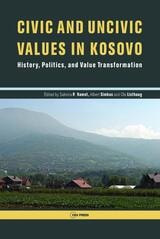
cover of Civic and Uncivic Values in Kosovo: History, Politics, and Value Transformation

Civic and Uncivic Values in Kosovo

History, Politics, and Value Transformation

Sabrina P. Ramet

Central European University Press, 2015

This volume is driven by the conviction that the key to the establishment of stable liberal democracy anywhere in the world and, in this case, in Kosovo lies in the completion of three interrelated tasks: first, the creation of effective political institutions, based on the principle of the separation of powers (including the independence of the judiciary); second, the promotion of the rule of law; and, third, the promotion of civic values, including tolerance or ethnic/religious/sexual minorities, trust, and respect for the harm principle. In fact, there are problems across all three measures, including with judicial independence, with the rule of law, and with civic values. On the last of these, research findings show that the citizens of Kosovo rank extremely low on trust of other citizens, low on engagement in social organizations, and tolerance of gays, lesbians, and atheists, but high on trust in the political institutions of their country and in pride of their newly independent state.
[more]
cover of Civic and Uncivic Values in Poland: Value Transformation, Education, and Culture

Civic and Uncivic Values in Poland

Value Transformation, Education, and Culture

Sabrina P. Ramet

Central European University Press, 2019

Poland, like many societies across the world, is becoming more polarized in diverse areas of life, as contending forces seek to advance incompatible agendas. The polarization over values in Polish politics was evident already before communism collapsed but became more obvious in the following years and reached a crescendo after the October 2015 parliamentary elections, which brought a right-wing party into power. This volume focuses on the years since 1989, looking at the clash between civic values (the rule of law, individual rights, tolerance, respect for the harm principle, equality, and neutrality of the state in matters of religion) and uncivic values (the rule of a dictator or dictatorial party, contempt for individual rights, bigotry, disrespect for the harm principle, unequal treatment of people whether through discrimination or through exploitation, and state favoritism of one religion over others). The authors address voting behavior, political parties, anti-Semitism, homophobia, the role of the Catholic Church, and reflections in history textbooks, fi lm, and even rock music. This volume makes clear that for the foreseeable future the conflict in Poland between traditional, conservative values and liberal, civic values is likely to continue, provoking tensions and protests.
[more]
cover of Civic and Uncivic Values: Serbia in the Post-Miloševic Era

Civic and Uncivic Values

Serbia in the Post-Miloševic Era

Ola Listhaug

Central European University Press, 2011
Discusses Serbia’s struggle for democratic values after the fall of the Miloševic regime provoked by the NATO war, and after the trauma caused by the secession of Kosovo. Are the value systems of the post-Miloševic era true stumbling blocks of a delayed transition of this country? Seventeen contributors from Norway, Serbia, Italy, Germany, Poland and some other European countries covered a broad range of topics in order to provide answers to this question. The subjects of their investigations were national myths and symbols, history textbooks, media, film, religion, inter-ethnic dialogue, transitional justice, political party agendas and other related themes. The authors of the essays represent different scholarly disciplines whose theoretical conceptions and frameworks are employed in order to analyze two alternative value systems in Serbia: liberal, cosmopolitan and civic on the one hand, and traditional, provincial, nationalist on the other.
[more]
cover of Going Public: Civic and Community Engagement

Going Public

Civic and Community Engagement

Hiram E. Fitzgerald

Michigan State University Press, 2013

The terms “civic engagement” and “community engagement” have various definitions, but they are united by the sense that individuals who are civically engaged not only are concerned about the quality of life in their communities but also take action to improve conditions for the common good. In the United States, to be civically engaged means to actively participate in a civil democratic society. Going Public examines programs related to civic engagement and the ways in which faculty and students participate in communities in order to improve them. Engagement scholarship is a scholarship of action, a scholarship of practice that takes place both in and with the community. Within the framework of this new scholarship, the mission of the academy does not begin and end with intellectual discovery and fact-finding. Rather, the academy joins forces with the community, and together they use their knowledge and resources to address pressing social, civic, economic, and moral problems. Each chapter in this book tells a unique story of community engagement and the scholarship of practice in a diverse range of settings, documenting successes and failures, the unintended consequences, and the questions yet to be answered.

[more]