Results by title

4 books match the query 'Civic Culture'
cover of Before Norms: Institutions and Civic Culture

Before Norms

Institutions and Civic Culture

Robert W. Jackman and Ross A. Miller

University of Michigan Press, 2005

The potato famines of the nineteenth century were long attributed to Irish indolence. The Stalinist system was blamed on a Russian proclivity for autocracy. Muslim men have been accused of an inclination to terrorism. Is political behavior really the result of cultural upbringing, or does the vast range of human political action stem more from institutional and structural constraints?
This important new book carefully examines the role of institutions and civic culture in the establishment of political norms. Jackman and Miller methodically refute the Weberian cultural theory of politics and build in its place a persuasive case for the ways in which institutions shape the political behavior of ordinary citizens. Their rigorous examination of grassroots electoral participation reveals no evidence for even a residual effect of cultural values on political behavior, but instead provides consistent support for the institutional view. Before Norms speaks to urgent debates among political scientists and sociologists over the origins of individual political behavior.
Robert W. Jackman is Professor of Political Science at the University of California, Davis. Ross A. Miller is Associate Professor of Political Science at Santa Clara University.
[more]
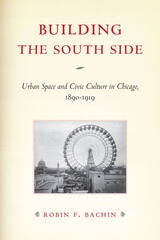
cover of Building the South Side: Urban Space and Civic Culture in Chicago, 1890-1919

Building the South Side

Urban Space and Civic Culture in Chicago, 1890-1919

Robin F. Bachin

University of Chicago Press, 2004
Building the South Side explores the struggle for influence that dominated the planning and development of Chicago's South Side during the Progressive Era. Robin F. Bachin examines the early days of the University of Chicago, Chicago’s public parks, Comiskey Park, and the Black Belt to consider how community leaders looked to the physical design of the city to shape its culture and promote civic interaction.
Bachin highlights how the creation of a local terrain of civic culture was a contested process, with the battle for cultural authority transforming urban politics and blurring the line between private and public space. In the process, universities, parks and playgrounds, and commercial entertainment districts emerged as alternative arenas of civic engagement.
 “Bachin incisively charts the development of key urban institutions and landscapes that helped constitute the messy vitality of Chicago’s late nineteenth- and early twentieth-century public realm.”—Daniel Bluestone, Journal of American History
"This is an ambitious book filled with important insights about issues of public space and its use by urban residents. . . . It is thoughtful, very well written, and should be read and appreciated by anyone interested in Chicago or cities generally. It is also a gentle reminder that people are as important as structures and spaces in trying to understand urban development."
—Maureen A. Flanagan, American Historical Review
[more]
cover of MAKING SENSE OF THE CITY: LOCAL GOVERNMENT, CIVIC CULTURE, AND COMMUNITY LIFE IN URBAN AMERICA

MAKING SENSE OF THE CITY

LOCAL GOVERNMENT, CIVIC CULTURE, AND COMMUNITY LIFE IN URBAN AMERICA

ROBERT B. FAIRBANKS

The Ohio State University Press, 2001

Making Sense of the City explores the ways in which urbanites have attempted to confront the challenges of urban life during the nineteenth and twentieth centuries. In the spirit of Zane L. Miller, whom this volume honors, the nine contributors focus closely on the words and actions of individuals, institutions, and organizations who participated in the public discourse about what the city was or could be. Through an examination of such topics as city charters, city planning texts, neighborhood organizations, municipal recreation programs, urban government reforms, urban identity, and fair housing campaigns, the authors offer insight into the process through which ideas about the nature of the city have affected action in the urban environment.

Contributing authors are

  • Robert B. Fairbanks
  • Patricia Mooney-Melvin
  • Judith Spraul-Schmidt
  • Alan I. Marcus
  • Robert A. Burnham
  • Andrea Tuttle Kornbluh
  • Bradley D. Cross
  • Charles F. Casey-Leininger
  • Roger W. Lotchin
[more]
cover of New Day Begun: African American Churches and Civic Culture in Post-Civil Rights America

New Day Begun

African American Churches and Civic Culture in Post-Civil Rights America

R. Drew Smith, ed.

Duke University Press, 2003

New Day Begun presents the findings of the first major research project on black churches’ civic involvement since C. Eric Lincoln and Lawrence H. Mamiya’s landmark study The Black Church in the African American Experience. Since the passage of the 1964 Civil Rights Act and the 1965 Voting Rights Act, the scale and scope of African American churches’ civic involvement have changed significantly: the number of African American clergy serving in elective and appointive offices has noticeably increased, as have joint efforts by black churches and government agencies to implement policies and programs. Filling a vacuum in knowledge about these important developments, New Day Begun assesses the social, political, and ecclesiastical factors that have shaped black church responses to American civic and political life since the Civil Rights movement.

This collection of essays analyzes the results of an unprecedented survey of nearly 2,000 African American churches across the country conducted by The Public Influences of African-American Churches Project, which is based at Morehouse College in Atlanta. These essays—by political scientists, theologians, ethicists, and others—draw on the survey findings to analyze the social, historical, and institutional contexts of black church activism and to consider the theological and moral imperatives that have shaped black church approaches to civic life—including black civil religion and womanist and afrocentric critiques. They also look at a host of faith-based initiatives addressing economic development and the provision of social services. New Day Begun presents necessary new interpretations of how black churches have changed—and been changed by—contemporary American political culture.

Contributors.
Lewis Baldwin, Allison Calhoun-Brown, David D. Daniels III, Walter Earl Fluker, C.R.D. Halisi, David Howard-Pitney, Michael Leo Owens, Samuel Roberts, David Ryden, Corwin Smidt, R. Drew Smith

[more]