Results by title
2 books match the query 'Civic Education'
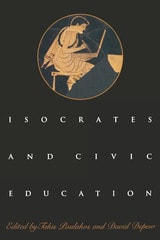
Isocrates and Civic Education
Edited by Takis Poulakos and David Depew
University of Texas Press, 2004
Civic virtue and the type of education that produces publicly minded citizens became a topic of debate in American political discourse of the 1980s, as it once was among the intelligentsia of Classical Athens. Conservatives such as former National Endowment for the Humanities chairman William Bennett and his successor Lynn Cheney held up the Greek philosopher Aristotle as the model of a public-spirited, virtue-centered civic educator. But according to the contributors in this volume, a truer model, both in his own time and for ours, is Isocrates, one of the preeminent intellectual figures in Greece during the fourth century B.C.
In this volume, ten leading scholars of Classics, rhetoric, and philosophy offer a pathfinding interdisciplinary study of Isocrates as a civic educator. Their essays are grouped into sections that investigate Isocrates' program in civic education in general (J. Ober, T. Poulakos) and in comparison to the Sophists (J. Poulakos, E. Haskins), Plato (D. Konstan, K. Morgan), Aristotle (D. Depew, E. Garver), and contemporary views about civic education (R. Hariman, M. Leff). The contributors show that Isocrates' rhetorical innovations carved out a deliberative process that attached moral choices to political questions and addressed ethical concerns as they could be realized concretely. His notions of civic education thus created perspectives that, unlike the elitism of Aristotle, could be used to strengthen democracy.
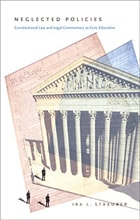
Neglected Policies
Constitutional Law and Legal Commentary as Civic EducationIra L. Strauber
Duke University Press, 2002
Strauber situates agnostic skepticism within contemporary legal thought, explaining how it draws upon sociological jurisprudence, legal realism, and critical legal studies. Through studies of cases involving pornography, adoption custody battles, flag burning, federalism, and environmental politics, he demonstrates how agnostic skepticism applies to constitutional issues. Strauber contends that training in skeptical critique will enable a new kind of civic education and culture—one in which citizens are increasingly tolerant of the ambiguities and contradictions inherent in the law and politics of a pluralistic society.
Using insights from the social sciences to examine the ways constitutional cases are studied and taught, Neglected Policies will interest scholars of jurisprudence, political science, and the sociology of law.