Results by title
7 books match the query 'Civil Rights Era'

Changing Perspectives
Black-Jewish Relations in Houston during the Civil Rights EraAllison E. Schottenstein
University of North Texas Press, 2021
[more]
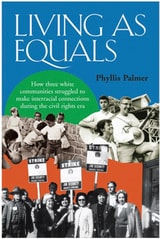
Living as Equals
How Three White Communities Struggled to Make Interracial Connections During the Civil Rights EraPhyllis Palmer
Vanderbilt University Press, 2008
Using interviews with leaders and participants, as well as historical archives, the author documents three interracial sites where white Americans put themselves into unprecedented relationships with African Americans, Mexican Americans, and Asian Americans. In teen summer camps in the New York City and Los Angeles areas, students from largely segregated schools worked and played together; in Washington, DC, families fought blockbusting and white flight to build an integrated neighborhood; and in San Antonio, white community activists joined in coalition with Mexican American groups to advocate for power in a city government monopolized by Anglos. Women often took the lead in organizations that were upsetting patterns of men's protective authority at the same time as white people's racial dominance.
[more]
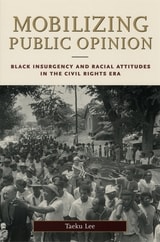
Mobilizing Public Opinion
Black Insurgency and Racial Attitudes in the Civil Rights EraTaeku Lee
University of Chicago Press, 2002
What motivates us to change our opinions during times of political protest and social unrest? To investigate this question, Taeku Lee's smartly argued book looks to the critical struggle over the moral principles, group interests, and racial animosities that defined public support for racial policies during the civil rights movement, from the late 1940s to the mid-1960s. Challenging the conventional view that public opinion is shaped by elites, Lee crafts an alternate account of the geographic, institutional, historical, and issue-specific contexts that form our political views. He finds that grassroots organizations and local protests of ordinary people pushed demands for social change into the consciousness of the general public. From there, Lee argues, these demands entered the policy agendas of political elites. Evidence from multiple sources including survey data, media coverage, historical accounts, and presidential archives animate his argument.
Ultimately, Mobilizing Public Opinion is a timely, cautionary tale about how we view public opinion and a compelling testament to the potential power of ordinary citizens.
Ultimately, Mobilizing Public Opinion is a timely, cautionary tale about how we view public opinion and a compelling testament to the potential power of ordinary citizens.
[more]
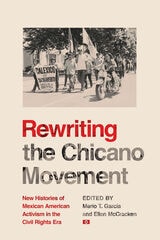
Rewriting the Chicano Movement
New Histories of Mexican American Activism in the Civil Rights EraMario T. García
University of Arizona Press, 2021
The Chicano Movement, el movimiento, is known as the largest and most expansive civil rights and empowerment movement by Mexican Americans up to that time. It made Chicanos into major American political actors and laid the foundation for today’s Latino political power. Rewriting the Chicano Movement is a collection of powerful new essays on the Chicano Movement that expand and revise our understanding of the movement. These essays capture the commitment, courage, and perseverance of movement activists, both men and women, and their struggles to achieve the promises of American democracy.
The essays in this volume broaden traditional views of the Chicano Movement that are too narrow and monolithic. Instead, the contributors to this book highlight the role of women in the movement, the regional and ideological diversification of the movement, and the various cultural fronts in which the movement was active. Rewriting the Chicano Movement stresses that there was no single Chicano Movement but instead a composite of movements committed to the same goal of Chicano self-determination. Scholars, students, and community activists interested in the history of the Chicano Movement can best start by reading this book.
Contributors: Holly Barnet-Sanchez, Tim Drescher, Jesús Jesse Esparza, Patrick Fontes, Mario T. García, Tiffany Jasmín González, Ellen McCracken, Juan Pablo Mercado, Andrea Muñoz, Michael Anthony Turcios, Omar Valerio-Jiménez
[more]
Richmond's Priests and Prophets
Race, Religion, and Social Change in the Civil Rights EraDouglas E. Thompson
University of Alabama Press, 2017
Explores the ways in which white Christian leaders in Richmond, Virginia navigated the shifting legal and political battles around desegregation even as members of their congregations struggled with their own understanding of a segregated society
Douglas E. Thompson’s Richmond’s Priests and Prophets: Race, Religion, and Social Change in the Civil Rights Era presents a compelling study of religious leaders’ impact on the political progression of Richmond, Virginia, during the time of desegregation. Scrutinizing this city as an entry point into white Christians’ struggles with segregation during the 1950s, Thompson analyzes the internal tensions between ministers, the members of their churches, and an evolving world.
In the mid-twentieth-century American South, white Christians were challenged repeatedly by new ideas and social criteria. Neighborhood demographics were shifting, public schools were beginning to integrate, and ministers’ influence was expanding. Although many pastors supported the transition into desegregated society, the social pressure to keep life divided along racial lines placed Richmond’s ministers on a collision course with forces inside their own congregations. Thompson reveals that, to navigate the ideals of Christianity within a complex historical setting, white religious leaders adopted priestly and prophetic roles.
Moreover, the author argues that, until now, the historiography has not viewed white Christian churches with the nuance necessary to understand their diverse reactions to desegregation. His approach reveals the ways in which desegregationists attempted to change their communities’ minds, while also demonstrating why change came so slowly—highlighting the deeply emotional and intellectual dilemma of many southerners whose worldview was fundamentally structured by race and class hierarchies.
[more]
The Sit-Ins
Protest and Legal Change in the Civil Rights EraChristopher W. Schmidt
University of Chicago Press, 2018
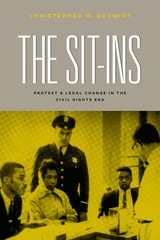
On February 1, 1960, four African American college students entered the Woolworth department store in Greensboro, North Carolina, and sat down at the lunch counter. This lunch counter, like most in the American South, refused to serve black customers. The four students remained in their seats until the store closed. In the following days, they returned, joined by growing numbers of fellow students. These “sit-in” demonstrations soon spread to other southern cities, drawing in thousands of students and coalescing into a protest movement that would transform the struggle for racial equality.
The Sit-Ins tells the story of the student lunch counter protests and the national debate they sparked over the meaning of the constitutional right of all Americans to equal protection of the law. Christopher W. Schmidt describes how behind the now-iconic scenes of African American college students sitting in quiet defiance at “whites only” lunch counters lies a series of underappreciated legal dilemmas—about the meaning of the Constitution, the capacity of legal institutions to remedy different forms of injustice, and the relationship between legal reform and social change. The students’ actions initiated a national conversation over whether the Constitution’s equal protection clause extended to the activities of private businesses that served the general public. The courts, the traditional focal point for accounts of constitutional disputes, played an important but ultimately secondary role in this story. The great victory of the sit-in movement came not in the Supreme Court, but in Congress, with the passage of the Civil Rights Act of 1964, landmark legislation that recognized the right African American students had claimed for themselves four years earlier. The Sit-Ins invites a broader understanding of how Americans contest and construct the meaning of their Constitution.
The Sit-Ins tells the story of the student lunch counter protests and the national debate they sparked over the meaning of the constitutional right of all Americans to equal protection of the law. Christopher W. Schmidt describes how behind the now-iconic scenes of African American college students sitting in quiet defiance at “whites only” lunch counters lies a series of underappreciated legal dilemmas—about the meaning of the Constitution, the capacity of legal institutions to remedy different forms of injustice, and the relationship between legal reform and social change. The students’ actions initiated a national conversation over whether the Constitution’s equal protection clause extended to the activities of private businesses that served the general public. The courts, the traditional focal point for accounts of constitutional disputes, played an important but ultimately secondary role in this story. The great victory of the sit-in movement came not in the Supreme Court, but in Congress, with the passage of the Civil Rights Act of 1964, landmark legislation that recognized the right African American students had claimed for themselves four years earlier. The Sit-Ins invites a broader understanding of how Americans contest and construct the meaning of their Constitution.
[more]
We Shall Overcome
Press Photographs of Nashville during the Civil Rights EraKathryn E. Delmez
Vanderbilt University Press, 2023
Named One of the "Best Art Books of 2018" by the New York Times
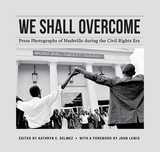
Fifty years after Martin Luther King Jr.'s death—and at a time when race relations and social justice are again at the forefront of our country's consciousness—this book expands on a Frist Art Museum exhibition to present a selection of approximately one hundred photographs that document an important period in Nashville's struggle for racial equality. The images were taken between 1957, the year that desegregation in public schools began, and 1968, when the National Guard was called in to surround the state capitol in the wake of the civil rights leader's assassination in Memphis.
Of central significance are photographs of lunch counter sit-ins in early 1960, led by a group of students, including John Lewis (who contributed the book's foreword) and Diane Nash, from local historically black colleges and universities. The demonstrations were so successful that King stated just a few weeks later at Fisk University: "I did not come to Nashville to bring inspiration but to gain inspiration from the great movement that has taken place in this community." The role that Nashville played in the national civil rights movement as a hub for training students in nonviolent protest and as the first Southern city to integrate places of business is a story that warrants reexamination.
The book also provides an opportunity to consider the role of images and the media in shaping public opinion, a relevant subject in today's news-saturated climate. Photographs from the archives of both daily newspapers are included: the Tennessean, which was the more liberal publication, and the Nashville Banner, a conservative paper whose leadership seemed less interested in covering events related to racial issues. Some of the photographs in the exhibition had been selected to be published in the papers, but many were not, and their disclosure reveals insight into the editorial process. In several images, other photojournalists and news crews are visible, serving as a reminder of the almost constant presence of the camera during these historic times.
Essays by Linda Wynn of Fisk University and the Tennessee Historical Commission and Susan H. Edwards, executive director of the Frist Art Museum, offer historical context on Nashville during the civil rights era and on photojournalism, respectively. Congressman John Lewis's foreword recounts memories of his time in Nashville and reminds us that there is still work to be done to build King's Beloved Community.
[more]