Results by title
5 books match the query 'Civil War Diary'
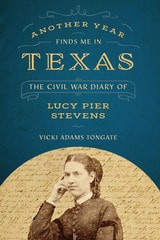
Another Year Finds Me in Texas
The Civil War Diary of Lucy Pier StevensBy Vicki Adams Tongate
University of Texas Press, 2016
Lucy Pier Stevens, a twenty-one-year-old woman from Ohio, began a visit to her aunt’s family near Bellville, Texas, on Christmas Day, 1859. Little did she know how drastically her life would change on April 4, 1861, when the outbreak of the Civil War made returning home impossible. Stranded in enemy territory for the duration of the war, how would she reconcile her Northern upbringing with the Southern sentiments surrounding her?
Lucy Stevens’s diary—one of few women’s diaries from Civil War–era Texas and the only one written by a Northerner—offers a unique perspective on daily life at the fringes of America’s bloodiest conflict. An articulate, educated, and keen observer, Stevens took note seemingly of everything—the weather, illnesses, food shortages, parties, church attendance, chores, schools, childbirth, death, the family’s slaves, and political and military news. As she confided her private thoughts to her journal, she unwittingly revealed how her love for her Texas family and the Confederate soldier boys she came to care for blurred her loyalties, even as she continued to long for her home in Ohio. Showing how the ties of heritage, kinship, friendship, and community transcended the sharpest division in US history, this rare diary and Vicki Adams Tongate’s insightful historical commentary on it provide a trove of information on women’s history, Texas history, and Civil War history.
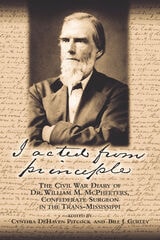
I Acted from Principle
The Civil War Diary of Dr. William M. McPheeters, Confederate Surgeon in the Trans-MississippiCynthia DeHaven Pitcock
University of Arkansas Press, 2000
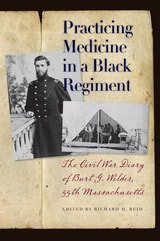
Practicing Medicine in a Black Regiment
The Civil War Diary of Burt G. Wilder, 55th MassachusettsRichard M. Reid
University of Massachusetts Press, 2010
Burt Green Wilder, a Boston-born, Harvard-educated doctor-in-training, was among the first white officers commissioned to staff the 55th Massachusetts. Like other officers serving in the state's African American units, Wilder was selected for his military experience, his "firm Anti-Slavery principles," and his faith in the value of black troops. From the time he joined the 55th in May 1863 until the regiment was discharged in September 1865, Wilder recorded his experiences and observations. He described the day-to-day activities of a Civil War surgeon, the indignities suffered by black enlisted men at the hands of a War Department that denied them the same treatment offered to white troops, and the role of the regiment in the campaign around Charleston and in Florida.
Service in the southern states also allowed Wilder to indulge a passion for natural science and comparative anatomy, including the collection of unusual species, one of which—the spider known as Nephila wilderi—still bears his name. After the war he completed his medical studies at Harvard and joined the faculty of Cornell University, where he became a distinguished professor of zoology as well as an outspoken advocate of racial equality.
In his introduction to the volume, Richard M. Reid analyzes Burt Wilder's diary and places it within the context of the war, the experience of African American troops, and Wilder's life and career.
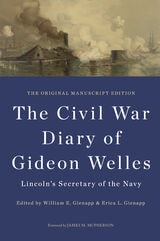
The Civil War Diary of Gideon Welles, Lincoln's Secretary of the Navy
The Original Manuscript EditionGideon Welles, Edited by William E. Gienapp and Erica L. Gienapp; Foreword by James M. McPherson
University of Illinois Press, 2014
Perhaps the hardest-working member of the cabinet, Welles still found time to keep a detailed diary that has become one of the key documents for understanding the inner workings of the Lincoln administration. In this new edition, William E. and Erica L. Gienapp have restored Welles’s original observations, gleaned from the manuscript diaries at the Library of Congress and freed from his many later revisions, so that the reader can experience what he wrote in the moment. With his vitriolic pen, Welles captures the bitter disputes over strategy and war aims, lacerates colleagues from Secretary of State William H. Seward to General-in-Chief Henry Halleck, and condemns the actions of the self-serving southern elite he sees as responsible for the war. He just as easily waxes eloquent about the Navy's wartime achievements, extols the virtues of Lincoln, and drops in a tidbit of Washington gossip.
Carefully edited and extensively annotated, this edition contains a wealth of supplementary material. The appendixes include short biographies of the members of Lincoln’s cabinet, the retrospective Welles wrote after leaving office covering the period missing from the diary proper, and important letters regarding naval matters and international law.
The Civil War Diary of Rev. James Sheeran, C.Ss.R.
Patrick J. Hayes
Catholic University of America Press, 2017