Results by title
6 books match the query 'Civil rights lawyers'
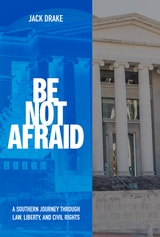
Be Not Afraid
A Southern Journey Through Law, Liberty, and Civil RightsJack Drake
University of Alabama Press, 2026
A civil rights attorney’s unflinching memoir about the fight against segregation and systemic racism through landmark legal battles in Alabama
Be Not Afraid: A Southern Journey Through Law, Liberty, and Civil Rights is a timely and unflinching memoir from civil rights attorney Jack Drake, who has spent decades on the front lines of Alabama’s legal battles for racial justice. Raised in a segregated community in Gardendale, Alabama, Drake came of age during the civil rights movement and became a pivotal figure in cases that reshaped the state’s legal and moral landscape.
Drake helped reform Alabama’s grossly inadequate mental health system and supported voting rights efforts throughout Alabama. His career underscores the crucial role private attorneys and grassroots advocates played in enforcing civil rights laws long after their passage.
Through vivid recollections of courtroom battles, civil rights alliances, and personal transformation, Be Not Afraid offers an intimate view into the persistence and courage required to challenge systemic injustice. At a time when debates over equity and democracy remain pressing, Drake’s story is both a powerful reflection on the past and a call to action for the present. It speaks to the enduring importance of legal advocacy and community solidarity in the fight for a more just society, making it essential reading for those engaged in civil rights history, law, or social change.
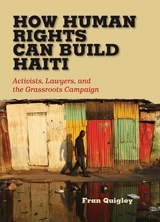
How Human Rights Can Build Haiti
Activists, Lawyers, and the Grassroots CampaignFran Quigley
Vanderbilt University Press, 2014
The only way to transform Haiti's dismal human rights legacy is through a bottom-up social movement, supported by local and international challenges to the status quo. That recipe for reform mirrors the strategy followed by Mario Joseph, Brian Concannon, and their clients and colleagues profiled in this book. Together, Joseph, Concannon, and their allies represent Haiti's best hope to escape the cycle of disaster, corruption, and violence that has characterized the country's two-hundred-year history. At the same time, their efforts are creating a template for a new and more effective human rights-focused strategy to turn around failed states and end global poverty.
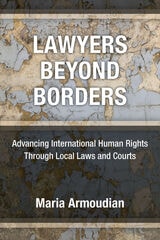
Lawyers Beyond Borders
Advancing International Human Rights Through Local Laws and CourtsMaria Armoudian
University of Michigan Press, 2021
Despite international conventions and human rights declarations, millions of people have suffered and continue to suffer torture, slavery, or violent deaths, with no remedy or recourse. They have fallen, in essence, “below the law,” outside of law’s protection. Often violated by their own governments, sometimes with support from transnational corporations, or nations benefiting from human rights violations, how can these victims find justice? Lawyers Beyond Borders reveals the inner workings of the advances and retreats in the quest for redress and restoration of human rights for those whom international legal-political systems have failed. The process of justice begins in the US, with a handful of human rights lawyers steeped in the American tradition of advancing civil rights through civil litigation. As the civil rights movement gained traction and an ample supply of lawyers, this small cadre turned their attention toward advancing international human rights, via the US legal system. They sought to build another piece of the rights revolution, this time for survivors of egregious human rights violations in faraway lands. These cases were among the most unlikely to be slated for victory: The abuses occurred abroad; the victims are aliens, usually with few, if any, resources; the perpetrators are politically powerful, resourced, and well connected, often members of governments, militaries, or multinational corporations. The legal and political systems’ structures are mostly stacked against these survivors, many who bear the scars of trauma and terror.
Lawyers Beyond Borders is about agency. It is about how, in the face of powerful interests and seemingly insurmountable obstacles—political, psychological, economic, geographical, and physical—a small group of lawyers and survivors navigated a terrain of daunting barriers to begin building, case-by-case, new pathways to justice for those who otherwise would have none.
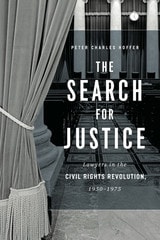
The Search for Justice
Lawyers in the Civil Rights Revolution, 1950–1975Peter Charles Hoffer
University of Chicago Press, 2019
The Search for Justice is a look the role of the lawyers throughout the period, focusing on one of the central issues of the time: school segregation. The most notable participants to address this issue were the public interest lawyers of the NAACP’s Legal Defense Fund, whose counselors brought lawsuits and carried out appeals in state and federal courts over the course of twenty years. But also playing a part in the story were members of the bar who defended Jim Crow laws explicitly or implicitly and, in some cases, also served in state or federal government; lawyers who sat on state and federal benches and heard civil rights cases; and, finally, law professors who analyzed the reasoning of the courts in classrooms and public forums removed from the fray. With rich, copiously researched detail, Hoffer takes readers through the interactions of these groups, setting their activities not only in the context of the civil rights movement but also of their full political and legal legacies, including the growth of corporate private legal practice after World War II and the expansion of the role of law professors in public discourse, particularly with the New Deal. Seeing the civil rights era through the lens of law enables us to understand for the first time the many ways in which lawyers affected the course and outcome of the movement.
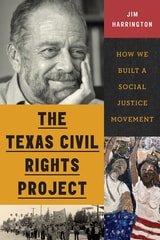
The Texas Civil Rights Project
How We Built a Social Justice MovementJim Harrington
University of Texas Press, 2025
Texas civil rights icon Jim Harrington recounts his lifelong fight for equality, winning major reforms for farmworkers and disabled Texans and helping build a movement for social justice.
Jim Harrington arrived in South Texas in 1973, ready to file class action lawsuits and “save the world.” Over the following fifty years, he built one of Texas’s key civil rights organizations and played an essential role in many of its greatest victories.
Harrington takes readers on his journey from a Midwest seminary to a United Farm Workers office in the Rio Grande Valley and on to founding the Texas Civil Rights Project. He fought for the rights of a wide range of Texans, bringing justice to victims of police brutality, injured farmworkers, silenced students, and people with disabilities excluded from full participation in society, building a movement for social justice, and a family, along the way. These major gains were tempered by heartbreaking losses, and Harrington recounts the difficult work of persevering in the face of injustice.
Framed by a foreword from Judge Lora Livingston and an afterword by Congressman Greg Casar, The Texas Civil Rights Project is at once a history of the struggle for equality over the last fifty years, a celebration of the individuals and grassroots organizations who fought hard to improve the lives of others, and a memoir of a singular force who pushed the Texas justice system to live up to its ideals.
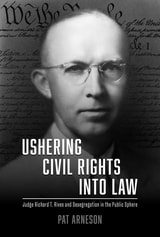
Ushering Civil Rights into Law
Judge Richard T. Rives and Desegregation in the Public SpherePat Arneson
University of Alabama Press, 2026
Illuminates the life and legacy of a federal jurist from Alabama, an unexpected but ardent defender of equal rights for all citizens under the law
Ushering Civil Rights into Law: Judge Richard T. Rives and Desegregation in the Public Sphere by Pat Arneson is a long-overdue exploration of one of the most consequential yet overlooked figures of the modern Civil Rights Movement. As debates over judicial philosophy and Civil Rights continue, Judge Richard T. Rives’s story serves as a powerful reminder of the judiciary’s role in shaping a more just society.
A native of Montgomery, Alabama, Judge Richard T. Rives served on the US Court of Appeals for the Fifth Circuit during the height of America’s battle over racial segregation. Once aligned with segregationist views, Rives underwent a profound evolution, emerging as a key legal architect of desegregation. His landmark ruling on behalf of the court in Browder v. Gayle ended segregation on Montgomery’s public buses and expanded the scope of Brown v. Board of Education beyond education. Rives’s decisions invalidated the legal underpinnings of Jim Crow laws and furthered equality in public education, voting rights, and jury selection. Writing for the court, Rives authored legal precedents that fundamentally reshaped the nation.
Through archival research, Arneson examines the cultural and political pressures Rives faced, the legal strategies he employed, and the lasting impact of his work. Constitutional rights remain a flashpoint in American discourse. Ushering Civil Rights into Law reveals how one judge’s principled stance helped define the legal landscape of modern Civil Rights and underscores the enduring significance of his legacy.