Results by title
6 books match the query 'Civility'

A Social History of Truth
Civility and Science in Seventeenth-Century EnglandSteven Shapin
University of Chicago Press, 1994
In A Social History of Truth, Shapin engages these universal questions through an elegant recreation of a crucial period in the history of early modern science: the social world of gentlemen-philosophers in seventeenth-century England. Steven Shapin paints a vivid picture of the relations between gentlemanly culture and scientific practice. He argues that problems of credibility in science were practically solved through the codes and conventions of genteel conduct: trust, civility, honor, and integrity. These codes formed, and arguably still form, an important basis for securing reliable knowledge about the natural world.
Shapin uses detailed historical narrative to argue about the establishment of factual knowledge both in science and in everyday practice. Accounts of the mores and manners of gentlemen-philosophers are used to illustrate Shapin's broad claim that trust is imperative for constituting every kind of knowledge. Knowledge-making is always a collective enterprise: people have to know whom to trust in order to know something about the natural world.

In Pursuit of Civility
Manners and Civilization in Early Modern EnglandKeith Thomas
Brandeis University Press, 2018
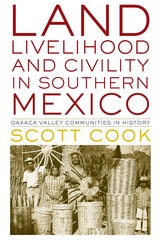
Land, Livelihood, and Civility in Southern Mexico
Oaxaca Valley Communities in HistoryBy Scott Cook
University of Texas Press, 2014
In the Valley of Oaxaca in Mexico’s Southern Highland region, three facets of sociocultural life have been interconnected and interactive from colonial times to the present: first, community land as a space to live and work; second, a civil-religious system managed by reciprocity and market activity wherein obligations of citizenship, office, and festive sponsorships are met by expenditures of labor-time and money; and third, livelihood. In this book, noted Oaxacan scholar Scott Cook draws on thirty-five years of fieldwork (1965–1990) in the region to present a masterful ethnographic historical account of how nine communities in the Oaxaca Valley have striven to maintain land, livelihood, and civility in the face of transformational and cumulative change across five centuries.
Drawing on an extensive database that he accumulated through participant observation, household surveys, interviews, case studies, and archival work in more than twenty Oaxacan communities, Cook documents and explains how peasant-artisan villagers in the Oaxaca Valley have endeavored over centuries to secure and/or defend land, worked and negotiated to subsist and earn a living, and striven to meet expectations and obligations of local citizenship. His findings identify elements and processes that operate across communities or distinguish some from others. They also underscore the fact that landholding is crucial for the sociocultural life of the valley. Without land for agriculture and resource extraction, occupational options are restricted, livelihood is precarious and contingent, and civility is jeopardized.

Laughter and Civility
The Theater of Emma GadLynn R. Wilkinson
University of Wisconsin Press, 2020
Laughter and Civility, the first biographical and scholarly volume to examine and contextualize her dramas, deeply explores how and why influential women are so often excluded from the canon. Lynn R. Wilkinson provides insightful readings into all twenty-five of Gad’s plays and demonstrates how writers and intellectuals of the time, including Georg and Edvard Brandes, took her critically acclaimed work seriously. This volume rightfully reinstates Emma Gad’s work into the repertory of European drama and is crucial for scholars interested in turn‐of‐the‐century Scandinavian drama, literature, culture, and politics.
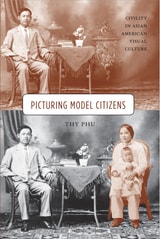
Picturing Model Citizens
Civility in Asian American Visual CultureThy Phu
Temple University Press, 2012
At the heart of the model minority myth—often associated with Asian Americans—is the concept of civility. In this groundbreaking book, Picturing Model Citizens, Thy Phu exposes the complex links between civility and citizenship, and argues that civility plays a crucial role in constructing Asian American citizenship.
Featuring works by Arnold Genthe, Carl Iwasaki, Toyo Miyatake, Nick Ut, and others, Picturing Model Citizens traces the trope of civility from the nineteenth to the twenty-first centuries. Through an examination of photographs of Chinese immigrants, Japanese internment camps, the Hiroshima Maidens project, napalm victims, and the SARS epidemic, Phu explores civility's unexpected appearance in images that draw on discourses of intimacy, cultivation, apology, and hygiene. She reveals how Asian American visual culture illustrates not only cultural ideas of civility, but also contests the contradictions of state-defined citizenship.
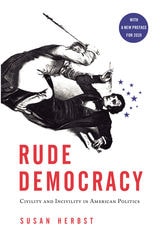
Rude Democracy
Civility and Incivility in American PoliticsAuthored by Susan Herbst
Temple University Press, 2020
Democracy is, by its very nature, often rude. But there are limits to how uncivil we should be. In her timely and important book, Rude Democracy, Susan Herbst explores the ways we discuss public policy, how we treat each other as we do, and how we can create a more civil national culture.
Herbst uses the examples of Sarah Palin and Barack Obama to illustrate her case. She scrutinizes Palin as both victim and perpetrator of incivility, including close analysis of her speeches on the 2008 campaign trail, the tone at her rallies, and her interactions with her audience. Turning to Barack Obama, Herbst argues that a key 2009 speech reveals much about his own perspective on American civility as it pertains to contentious issues such as abortion, and notes, too, what the controversy surrounding the speech reveals about the nature of public opinion in the United States. She also dissects Palin’s and Obama’s roles in the 2009 health care debate. Finally, in a fascinating chapter, Herbst examines how young people come to form their own attitudes about civility and political argument.
In Rude Democracy, Susan Herbst insists that Americans need to recognize the bad tendencies and habits we have developed, use new media for more effective debate, and develop a tougher and more strategic political skin. She urges us to boost both the intelligence and productivity of our debates, noting that the effort demands a commitment to the nature of argument itself. Rude Democracy outlines a plan for moving forward and creating a more civil climate for American politics.