Results by title

3 books match the query 'Civilization, Arab'

cover of A Call for Heresy: Why Dissent Is Vital to Islam and America

A Call for Heresy

Why Dissent Is Vital to Islam and America

Anouar Majid

University of Minnesota Press, 2007

A Call for Heresy discovers unexpected common ground in one of the most inflammatory issues of the twenty-first century: the deepening conflict between the Islamic world and the United States. Moving beyond simplistic answers, Anouar Majid argues that the Islamic world and the United States are both in precipitous states of decline because, in each, religious, political, and economic orthodoxies have silenced the voices of their most creative thinkers—the visionary nonconformists, radicals, and revolutionaries who are often dismissed, or even punished, as heretics.

The United States and contemporary Islam share far more than partisans on either side admit, Majid provocatively argues, and this “clash of civilizations” is in reality a clash of competing fundamentalisms. Illustrating this point, he draws surprising parallels between the histories and cultures of Islam and the United States and their shortsighted suppression of heresy (zandaqa in Arabic), from Muslim poets and philosophers like Ibn Rushd (known in the West as Averroës) to the freethinker Thomas Paine, and from Abu Bakr Razi and Al-Farabi to Thomas Jefferson and Abraham Lincoln. He finds bitter irony in the fact that Islamic culture is now at war with a nation whose ideals are losing ground to the reactionary forces that have long condemned Islam to stagnation.

The solution, Majid concludes, is a long-overdue revival of dissent. Heresy is no longer a contrarian’s luxury, for only through encouraging an engaged and progressive intellectual tradition can the nations reverse their decline and finally work together for global justice and the common good of humanity.


Anouar Majid is founding chair and professor of English at the University of New England and the author of Freedom and Orthodoxy: Islam and Difference in the Post-Andalusian Age; Unveiling Traditions: Postcolonial Islam in a Polycentric World; and Si Yussef, a novel. He is also cofounder and editor of Tingis, a Moroccan-American magazine of ideas and culture.
[more]
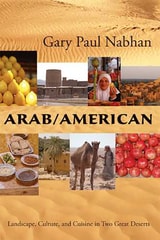
cover of Arab/American: Landscape, Culture, and Cuisine in Two Great Deserts

Arab/American

Landscape, Culture, and Cuisine in Two Great Deserts

Gary Paul Nabhan

University of Arizona Press, 2008

The landscapes, cultures, and cuisines of deserts in the Middle East and North America have commonalities that have seldom been explored by scientists—and have hardly been celebrated by society at large. Sonoran Desert ecologist Gary Nabhan grew up around Arab grandparents, aunts, uncles, and cousins in a family that has been emigrating to the United States and Mexico from Lebanon for more than a century, and he himself frequently travels to the deserts of the Middle East. In an era when some Arabs and Americans have markedly distanced themselves from one another, Nabhan has been prompted to explore their common ground, historically, ecologically, linguistically, and gastronomically. Arab/American is not merely an exploration of his own multicultural roots but also a revelation of the deep cultural linkages between the inhabitants of two of the world’s great desert regions. Here, in beautifully crafted essays, Nabhan explores how these seemingly disparate cultures are bound to each other in ways we would never imagine. With an extraordinary ear for language and a truly adventurous palate, Nabhan uncovers surprising convergences between the landscape ecology, ethnogeography, agriculture, and cuisines of the Middle East and the binational Desert Southwest. There are the words and expressions that have moved slowly westward from Syria to Spain and to the New World to become incorporated—faintly but recognizably—into the language of the people of the U.S.–Mexico borderlands. And there are the flavors—piquant mixtures of herbs and spices—that have crept silently across the globe and into our kitchens without our knowing where they came from or how they got here. And there is much, much more. We also learn of others whose work historically spanned these deserts, from Hadji Ali (“Hi Jolly”), the first Moslem Arab to bring camels to America, to Robert Forbes, an Arizonan who explored the desert oases of the Sahara. These men crossed not only oceans but political and cultural barriers as well. We are, we recognize, builders of walls and borders, but with all the talk of “homeland” today, Nabhan reminds us that, quite often, borders are simply lines drawn in the sand.
[more]
cover of Desiring Arabs

Desiring Arabs

Joseph A. Massad

University of Chicago Press, 2007

Sexual desire has long played a key role in Western judgments about the value of Arab civilization. In the past, Westerners viewed the Arab world as licentious, and Western intolerance of sex led them to brand Arabs as decadent; but as Western society became more sexually open, the supposedly prudish Arabs soon became viewed as backward. Rather than focusing exclusively on how these views developed in the West, in Desiring Arabs Joseph A. Massad reveals the history of how Arabs represented their own sexual desires. To this aim, he assembles a massive and diverse compendium of Arabic writing from the nineteenth century to the present in order to chart the changes in Arab sexual attitudes and their links to Arab notions of cultural heritage and civilization.
           
A work of impressive scope and erudition, Massad’s chronicle of both the history and modern permutations of the debate over representations of sexual desires and practices in the Arab world is a crucial addition to our understanding of a frequently oversimplified and vilified culture.
 
“A pioneering work on a very timely yet frustratingly neglected topic. . . . I know of no other study that can even begin to compare with the detail and scope of [this] work.”—Khaled El-Rouayheb, Middle East Report
 
“In Desiring Arabs, [Edward] Said’s disciple Joseph A. Massad corroborates his mentor’s thesis that orientalist writing was racist and dehumanizing. . . . [Massad] brilliantly goes on to trace the legacy of this racist, internalized, orientalist discourse up to the present.”—Financial Times
[more]