Results by title
2 books match the query 'Clark, Jennifer Hayes'
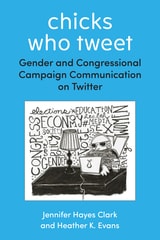
Chicks Who Tweet
Gender and Congressional Campaign Communication on TwitterJennifer Hayes Clark and Heather K. Evans
University of Michigan Press, 2027
Does gender shape campaign communication? Drawing on an original dataset of candidate tweets across six election cycles, Chicks Who Tweet demonstrates that gender systematically shapes congressional campaign messaging. Not only does gender predict the issues candidates emphasize, but also the tone of their communication and their strategic decisions to engage in negative campaigning. Even after controlling for partisanship, incumbency status, district competitiveness, and overall tweeting volume, gender remains a robust and statistically significant predictor of issue emphasis.
Working to reclaim the label “chicks,” the authors show that women candidates are acutely aware of the gendered stereotypes that shape voter expectations and media coverage. Women candidates tweet more frequently than men and are more likely to criticize their opponents. However, they often face backlash to negative campaigning that men do not. Interviews with campaign communication directors and staff further illuminate how strategic messaging decisions are filtered through gendered expectations about credibility, likability, and leadership. The authors also look at how race and ethnicity interact with gender to shape issue framing and agenda-setting strategies. Although social media platforms offer women candidates new avenues to articulate representational claims and mobilize supporters, Chicks Who Tweet shows that gendered double standards still constrain strategic choices and contribute to ongoing disparities in congressional representation.
Minority Parties in U.S. Legislatures
Conditions of InfluenceJennifer Hayes Clark
University of Michigan Press, 2015
Challenging conventional assumptions that the majority party dominates the legislature, Jennifer Hayes Clark investigates precisely the ways in which—and under what conditions—members of the minority party successfully pursue their interests. For this study, Clark collects fine-grained data from both the U.S. Congress and state legislatures to get a close look at three key points in the legislative process: committee assignments, bill cosponsorship, and roll-call votes. She finds that minority party members are not systematically excluded throughout the policymaking process. Indeed, their capacity to shape legislative decision-making is enhanced when party polarization is low, when institutional prerogatives are broadly dispersed rather than centralized, and when staff resources are limited. Under these conditions, bipartisanship bill cosponsorship and voting coalitions are also more prevalent.
With the sharp increase of partisan polarization in state legislatures and in Congress, it is essential to understand how and when a minority party can effectively represent constituents.