Results by title
29 books match the query 'Classical philology'

Classical Philology, volume 116 number 2 (April 2021)
The University of Chicago Press
University of Chicago Press Journals, 2021
Classical Philology, volume 116 number 3 (July 2021)
The University of Chicago Press
University of Chicago Press Journals, 2021
Classical Philology, volume 116 number 4 (October 2021)
The University of Chicago Press
University of Chicago Press Journals, 2021
Classical Philology, volume 117 number 1 (January 2022)
The University of Chicago Press
University of Chicago Press Journals, 2022
Classical Philology, volume 117 number 2 (April 2022)
The University of Chicago Press
University of Chicago Press Journals, 2022
Classical Philology, volume 117 number 3 (July 2022)
The University of Chicago Press
University of Chicago Press Journals, 2022
Classical Philology, volume 117 number 4 (October 2022)
The University of Chicago Press
University of Chicago Press Journals, 2022
Classical Philology, volume 118 number 1 (January 2023)
The University of Chicago Press
University of Chicago Press Journals, 2023
Classical Philology, volume 118 number 2 (April 2023)
The University of Chicago Press
University of Chicago Press Journals, 2023
Classical Philology, volume 118 number 3 (July 2023)
The University of Chicago Press
University of Chicago Press Journals, 2023
Classical Philology, volume 119 number 1 (January 2024)
The University of Chicago Press
University of Chicago Press Journals, 2024
Classical Philology, volume 119 number 2 (April 2024)
The University of Chicago Press
University of Chicago Press Journals, 2024
Classical Philology, volume 119 number 3 (July 2024)
The University of Chicago Press
University of Chicago Press Journals, 2024
Classical Philology, volume 119 number 4 (October 2024)
The University of Chicago Press
University of Chicago Press Journals, 2024
Classical Philology, volume 120 number 1 (January 2025)
The University of Chicago Press
University of Chicago Press Journals, 2025
Classical Philology, volume 120 number 2 (April 2025)
The University of Chicago Press
University of Chicago Press Journals, 2025
Classical Philology, volume 120 number 3 (July 2025)
The University of Chicago Press
University of Chicago Press Journals, 2025
Classical Philology, volume 120 number 4 (October 2025)
The University of Chicago Press
University of Chicago Press Journals, 2025
Classical Philology, volume 121 number 1 (January 2026)
The University of Chicago Press
University of Chicago Press Journals, 2026
Classical Philology, volume 121 number 2 (April 2026)
The University of Chicago Press
University of Chicago Press Journals, 2026
Classical Philology, volume 121 number 3 (July 2026)
The University of Chicago Press
University of Chicago Press Journals, 2026
Classical Philology, volume 121 number 4 (October 2026)
The University of Chicago Press
University of Chicago Press Journals, 2026
Classics from Papyrus to the Internet
An Introduction to Transmission and ReceptionBy Jeffrey M. Hunt, R. Alden Smith, and Fabio Stok
University of Texas Press, 2017
Winner, PROSE Award, Classics, Association of American Publishers (AAP), 2018
Writing down the epic tales of the Trojan War and the wanderings of Odysseus in texts that became the Iliad and the Odyssey was a defining moment in the intellectual history of the West, a moment from which many current conventions and attitudes toward books can be traced. But how did texts originally written on papyrus in perhaps the eighth century BC survive across nearly three millennia, so that today people can read them electronically on a smartphone?
Classics from Papyrus to the Internet provides a fresh, authoritative overview of the transmission and reception of classical texts from antiquity to the present. The authors begin with a discussion of ancient literacy, book production, papyrology, epigraphy, and scholarship, and then examine how classical texts were transmitted from the medieval period through the Renaissance and the Enlightenment to the modern era. They also address the question of reception, looking at how succeeding generations responded to classical texts, preserving some but not others. This sheds light on the origins of numerous scholarly disciplines that continue to shape our understanding of the past, as well as the determined effort required to keep the literary tradition alive. As a resource for students and scholars in fields such as classics, medieval studies, comparative literature, paleography, papyrology, and Egyptology, Classics from Papyrus to the Internet presents and discusses the major reference works and online professional tools for studying literary transmission.
Complacency
Classics and Its Displacement in Higher EducationJohn T. Hamilton
University of Chicago Press, 2022
In response to philosopher Simon Blackburn’s portrayal of complacency as a vice that impairs university study at its core, John T. Hamilton examines the history of complacency in classics and its implications for our contemporary moment.
The subjects, philosophies, and literatures of ancient Greece and Rome were once treated as the foundation of learning, with everything else devolving from them. Hamilton investigates what this model of superiority, derived from the golden age of the classical tradition, shares with the current hegemony of mathematics and the natural sciences. He considers how the qualitative methods of classics relate to the quantitative positivism of big data, statistical reasoning, and presumably neutral abstraction, which often dismiss humanist subjectivity, legitimize self-sufficiency, and promote a fresh brand of academic complacency. In acknowledging the reduced status of classics in higher education today, he questions how scholarly striation and stagnation continue to bolster personal, ethical, and political complacency in our present era.
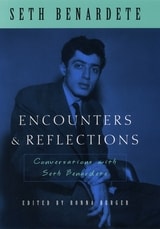
Encounters and Reflections
Conversations with Seth BenardeteSeth Benardete
University of Chicago Press, 2002
The first part of the book discloses vignettes about fellow students, colleagues, and acquaintances of Benardete's who later became major figures in the academic and intellectual life of twentieth-century America. We glimpse the student days of Allan Bloom, Stanley Rosen, George Steiner, and we discover the life of the mind as lived by well-known scholars such as David Grene, Jacob Klein, and Benardete's mentor Leo Strauss. We also encounter a number of other learned, devoted, and sometimes eccentric luminaries, including T.S. Eliot, James Baldwin, Werner Jaeger, John Davidson Beazley, and Willard Quine. In the book's second part, Benardete reflects on his own intellectual growth and on his ever-evolving understanding of the texts and ideas he spent a lifetime studying. Revisiting some of his recurrent themes—among them eros and the beautiful, the city and the law, and the gods and the human soul—Benardete shares his views on thinkers such as Plato, Homer, and Heidegger, as well as the relations between philosophy and science and between Christianity and ancient Roman thought.
Engaging and informative, Encounters and Reflections brings Benardete's thought to life to enlighten and inspire a new generation of thinkers.
Postclassicisms
The Postclassicisms Collective
University of Chicago Press, 2020
Structured around three primary concepts—value, time, and responsibility—and nine additional concepts, Postclassicisms asks scholars to reflect upon why they choose to work in classics, to examine how proximity to and distance from antiquity has been—and continues to be—figured, and to consider what they seek to accomplish within their own scholarly practices. Together, the authors argue that a stronger critical self-awareness, an enhanced sense of the intellectual history of the methods of classics, and a greater understanding of the ethical and political implications of the decisions that the discipline makes will lead to a more engaged intellectual life, both for classicists and, ultimately, for society. A timely intervention into the present and future of the discipline, Postclassicisms will be required reading for professional classicists and students alike and a model for collaborative disciplinary intervention by scholars in other fields.
Practicing Classics
A MemoirLee T. Pearcy
University of Michigan Press, 2026
Practicing Classics is a memoir about education in America between the end of WWII and the early 21st century. Not only does it consider memory, its truths, and its deceptions, but it also unravels the complexities of class, race, gender, and social positioning in education. Lee Pearcy’s story begins with the 1957 desegregation crisis at Little Rock Central High School and its aftermath, describing how growing up in this environment shaped his academic and personal life.
As he came to study Latin and then Classics, Pearcy’s education intersected with the student disturbances at Columbia University in 1968 and a feminist revolution that brought significant numbers of women into the classical professoriate. He gives a first-hand account of a scandalous episode in the toxic administrative culture that characterized the classics department at the University of Texas in the 1980s. Against the background of these events, he unfolds his own education as a classicist and his development from apprentice to journeyman to confident teacher of Latin and Greek. Practicing Classics will engage readers who care about American education, classical studies, or the ways that choices, chances, and contingencies shaped one man’s life.
The Genesis of Lachmann's Method
Sebastiano Timpanaro
University of Chicago Press, 2005
This important work, which brought Timpanaro international repute, now appears in its first English translation. The Genesis of Lachmann's Method examines the origin, development, and validity of Lachmann's model as well as its association with Lachmann himself. It remains a fundamental work on the history and methods of philology, and Glenn W. Most's translation makes this seminal study available to an English-speaking audience. Revealing Timpanaro's extraordinary talent as a textual critic and world-class scholar, this book will be indispensable to classicists, textual critics, biblical scholars, historians of science, and literary theorists.
The Life and Work of Francis Willey Kelsey
Archaeology, Antiquity, and the ArtsJohn Griffiths Pedley
University of Michigan Press, 2011
President of the Archaeological Institute of America, professor at the University of Michigan from 1889 to 1927, and president of the American Philological Association, Francis Kelsey was crucially involved in the founding or growth of major educational institutions. He came to maturity in a period of great technological change in communications, transportation, and manufacturing. Kelsey took full advantage of such innovations in his ceaseless drive to promote education for all, to further the expansion of knowledge, and to champion the benefits of the study of antiquity.
A vigorous traveler around the United States, Europe, and the Mediterranean, Kelsey strongly believed in the value of personally viewing sites ancient and modern and collecting artifacts that could be used by the new museums and universities that were springing up in the United States. This collecting habit put him in touch with major financiers of the day, including Charles Freer, Andrew Carnegie, and J. P. Morgan, as he sought their help for important projects.
Drawing heavily on Kelsey's daily diaries now held at the University of Michigan's Bentley Historical Library, John Griffiths Pedley gives us a biography that records the wide-ranging activities of a gifted and energetic scholar whose achievements mirrored the creative and contributive innovations of his contemporary Americans.