Results by title

4 books match the query 'Clawson, Dan'
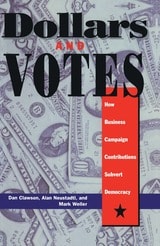
cover of Dollars And Votes

Dollars And Votes

Dan Clawson

Temple University Press, 1998

Recent scandals, including questionable fun-raising tactics by the current administration, have brought campaign finance reform into the forefront of the news and the  public consciousness. Dollars and Votes goes beyond the partial, often misleading, news stories and official records to explain how our campaign system operates. The authors conducted thorough interviews with corporate "government relations" officials about what they do and why they do it. The results provide some of the most damning evidence imaginable.

What donors, especially business donors, expect for their money is "access" and access means a lot more than a chance to meet and talk. They count on secret behind-the-scenes deals, like a tax provision that applies only to a "corporation incorporated on June 13, 1917, which has its principal place of business in Bartlesville, Oklahoma." After a deal is worked out behind closed doors, one executive explains, "it doesn't much matter how people vote afterwards."

Ordinary contributions give access to Congress; megabuck "soft money" contributions ensure access to the President and top leaders. The striking truth revealed by these authors is that half the soft money comes from fewer than five hundred big donors, and that most contributions come, directly or indirectly, from business. Reform is possible, they argue, by turning away from the temptation of looking at specific scandals and developing a new system that removes the influence of big money campaign contributors.

[more]
cover of Families at Work: Expanding the Bounds

Families at Work

Expanding the Bounds

Naomi Gerstel

Vanderbilt University Press, 2002

What is the relationship between work and family in a world where employment creates endless tensions for families and families create endless tensions for the workplace? This collection of reprinted and original articles broadens this discussion by addressing issues from the perspectives of often neglected populations: from white middle-class women with young children to people of color, to poor families, to the new sorts of families gays and lesbians are struggling to construct, to fathers, to older children.

To discuss work and family is also to discuss gender. Ranging from California's Silicon Valley to a remote fishing village in the northeast, part one shows how new work arrangements have created new expectations for what it means to be a woman or a man, and how slow and uneven the pace of change can be. Nowhere are the tensions of work and family more potent than around childcare. Part two takes up these tensions, showing how various "solutions" to caring for children of all ages (whether infants or teenagers) create new problems. Parts three and four turn outward to show how the new relationships between families and work are changing the relationships between families and the communities in which they live and generating new social policy dilemmas.
[more]
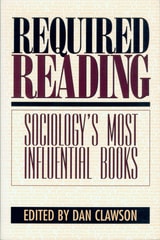
cover of Required Reading: Sociology's Most Influential Books

Required Reading

Sociology's Most Influential Books

Dan Clawson

University of Massachusetts Press, 1998

When the editors of Contemporary Sociology selected the ten most influential books of the past twenty-five years and published new essays on their importance, the feature sparked enthusiasm, debate, and controversy. This volume responds to and extends that discussion by expanding the list to seventeen books, incorporating a piece on the bestsellers of sociology, and adding four essays on the "most influential" controversy itself. Although the list centers on sociology, only half of the books were written by sociologists.

The charge to the reviewers was not to make a case for a book, but rather to analyze the character and extent of its influence. Because these works are already recognized as milestones in their fields, and because the reviewers are prominent figures who themselves often played central roles in the dramas surrounding these titles, the reviews are as noteworthy for their critical edge as for their celebration of the books' contributions. The result is a thought-provoking volume that engages many of the key intellectual issues of our time.
[more]
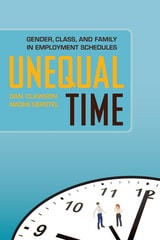
cover of Unequal Time: Gender, Class, and Family in Employment Schedules

Unequal Time

Gender, Class, and Family in Employment Schedules

Dan Clawson is professor of sociology at the University of Massachusetts, Amherst. Naomi Gerstel is a distinguished university professor of sociology at the University of Massachusetts, Amherst.

Russell Sage Foundation, 2014

Life is unpredictable. Control over one’s time is a crucial resource for managing that unpredictability, keeping a job, and raising a family. But the ability to control one’s time, much like one’s income, is determined to a significant degree by both gender and class. In Unequal Time, sociologists Dan Clawson and Naomi Gerstel explore the ways in which social inequalities permeate the workplace, shaping employees’ capacities to determine both their work schedules and home lives, and exacerbating differences between men and women, and the economically privileged and disadvantaged. Unequal Time investigates the interconnected schedules of four occupations in the health sector—professional-class doctors and nurses, and working-class EMTs and nursing assistants. While doctors and EMTs are predominantly men, nurses and nursing assistants are overwhelmingly women. In all four occupations, workers routinely confront schedule uncertainty, or unexpected events that interrupt, reduce, or extend work hours. Yet, Clawson and Gerstel show that members of these four occupations experience the effects of schedule uncertainty in very distinct ways, depending on both gender and class. But doctors, who are professional-class and largely male, have significant control over their schedules and tend to work long hours because they earn respect from their peers for doing so. By contrast, nursing assistants, who are primarily female and working-class, work demanding hours because they are most likely to be penalized for taking time off, no matter how valid the reasons. Unequal Time also shows that the degree of control that workers hold over their schedules can either reinforce or challenge conventional gender roles. Male doctors frequently work overtime and rely heavily on their wives and domestic workers to care for their families. Female nurses are more likely to handle the bulk of their family responsibilities, and use the control they have over their work schedules in order to dedicate more time to home life. Surprisingly, Clawson and Gerstel find that in the working class occupations, workers frequently undermine traditional gender roles, with male EMTs taking significant time from work for child care and women nursing assistants working extra hours to financially support their children and other relatives. Employers often underscore these disparities by allowing their upper-tier workers (doctors and nurses) the flexibility that enables their gender roles at home, including, for example, reshaping their workplaces in order to accommodate female nurses’ family obligations. Low-wage workers, on the other hand, are pressured to put their jobs before the unpredictable events they might face outside of work. Though we tend to consider personal and work scheduling an individual affair, Clawson and Gerstel present a provocative new case that time in the workplace also collective. A valuable resource for workers’ advocates and policymakers alike, Unequal Time exposes how social inequalities reverberate through a web of interconnected professional relationships and schedules, significantly shaping the lives of workers and their families.
[more]