Results by title
5 books match the query 'Climate justice'
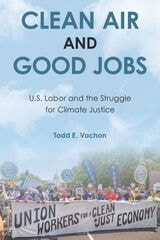
Clean Air and Good Jobs
U.S. Labor and the Struggle for Climate JusticeTodd E. Vachon
Temple University Press, 2023
The labor–climate movement in the U.S. laid the groundwork for the Green New Deal by building a base within labor for supporting climate protection as a vehicle for good jobs. But as we confront the climate crisis and seek environmental justice, a “jobs vs. environment” discourse often pits workers against climate activists. How can we make a “just transition” moving away from fossil fuels, while also compensating for the human cost when jobs are lost or displaced?
In his timely book, Clean Air and Good Jobs, Todd Vachon examines the labor–climate movement and demonstrates what can be envisioned and accomplished when climate justice is on labor’s agenda and unions work together with other social movements to formulate bold solutions to the climate crisis. Vachon profiles the workers and union leaders who have been waging a slow, but steadily growing revolution within their unions to make labor as a whole an active and progressive champion for both workers and the environment.
Clean Air and Good Jobs examines the “movement within the movement” offering useful solutions to the dual crises of climate and inequality.
Climate Justice and Public Health
Realities, Responses, and Reimaginings for a Better FutureEdited by Rajini Srikanth and Linda Thompson
University of Massachusetts Press, 2024
When climate disasters like hurricanes, heatwaves, and tsunamis strike, they reveal the inequities of our social, political, and economic structures. They also lay bare the negative impacts of these structures on the health and safety of all people, and particularly socioeconomically vulnerable groups. With original contributions from scholars from a wide range of diverse fields—including environmental studies, public health, legal studies, urban planning, literary studies, and nursing—Climate Justice and Public Health examines this nexus of climate change, which has become impossible to ignore in the twenty-first century.
Expanding the climate and health equity discussions to populations all over the globe, the contributors in this volume address an impressive and broad range of topics that include Indigenous health and cultural practices, mental and emotional health, senior health, and impacts on African American communities. Collectively, they present radical new ways of confronting these issues and propose holistic solutions.
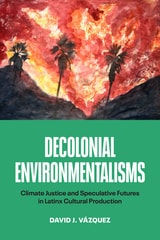
Decolonial Environmentalisms
Climate Justice and Speculative Futures in Latinx Cultural ProductionDavid J. Vázquez
University of Texas Press, 2025
A critical examination of the environmental movement and the Latinx voices that are shifting how to think about a future shaped by climate change.
In Decolonial Environmentalisms, David Vázquez argues that the mainstream environmental movement is implicated in racial capitalism, not least through its ignorance of environmental justice as it pertains to Latinx people. Through close readings of eco-minded novels, films, visual art, and short stories by Chicanx, Puerto Rican, Dominican, Cuban American, Peruvian, and Central American culture makers, Vázquez surfaces diverse Latinx visions for an equitable and sustainable humanity.
In the creations of Helena María Viramontes, Ester Hernández, Salvador Plascencia, the printmaking collective Dominican York Proyecto GRAFICA, and others, Vázquez locates a bracing critique of racist elisions and assumptions in hegemonic environmentalist thought. At the same time, he shows that the roles of Latinx people in the exploitation of the US West and the ruin of Indigenous communities are ripe for self-examination, in hopes of sparking reform. Indeed, Decolonial Environmentalisms is a work of guarded optimism, finding glimmers of possibility even in dystopic science fiction. The overlooked experiences of Latinx people, Vázquez suggests, can inspire environmental movements capable of transformative advocacy.
Governing the End
The Making of Climate Change Loss and DamageLisa Vanhala
University of Chicago Press, 2025
A searing account of how the international community is trying—and failing—to address the worst effects of climate change and the differential burdens borne by rich and poor countries.
Climate change is increasingly accepted as a global emergency creating irrevocable losses for the planet. Yet, each country experiences these losses differently, and reaching even inadequate political agreements is fraught with contestation. Governing the End untangles the complex relationship between deteriorating environmental conditions, high politics, and everyday diplomatic practices, focusing on the United Nations’ agreement to address “loss and damage” and subsequent battles over implementation.
Lisa Vanhala looks at the differing assumptions and strategic framings that poor and rich countries bring to bear and asks why some norms emerge and diffuse while others fail to do so. Governing the End is based on ethnographic observation of eight years of UN meetings and negotiations and more than one hundred and fifty interviews with diplomats, policymakers, UN secretariat staff, experts, and activists. It explores explicit political contestation, as well as the more clandestine politics that have stymied implementation and substantially reduced the scope of compensation to poor countries. In doing so, Governing the End elucidates the successes and failures of international climate governance, revealing the importance of how ideas are constructed and then institutionally embodied.
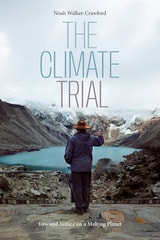
The Climate Trial
Law and Justice on a Melting PlanetNoah Walker-Crawford
Duke University Press, 2026