Results by title
5 books match the query 'Clinic'
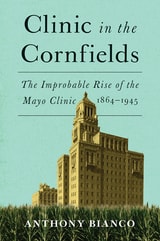
Clinic in the Cornfields
The Improbable Rise of the Mayo Clinic, 1864-1945Anthony Bianco
University of Minnesota Press, 2027
From a remote prairie outpost to a global medical empire—the definitive early history of the Mayo Clinic
Founded by William Worrall Mayo more than 160 years ago, the Mayo Clinic, now considered one of the world’s preeminent medical institutions, was established in the small town of Rochester, Minnesota. The Clinic’s founding in the hinterlands might have been serendipitous, but through unprecedented access to the institution’s archives, Anthony Bianco shows how its remote location was essential to the success of what has always been a powerfully idiosyncratic institution. Tracing the highs and lows of Mayo Clinic’s early years, Bianco reveals how it shaped Rochester into what a New York Times reporter dubbed in 1928 “the only clinic city in America”—and transformed the practice and culture of medicine worldwide.
At a confluence of character, industry, location, and timing, the Mayo Clinic invented a revolutionary model of clinical care: multispecialty group practice. This approach was so innovative that it was condemned by America’s medical establishment as a treasonous manifestation of socialism. In this definitive history, Bianco chronicles how an institution founded on operating room excellence achieved astonishing medical breakthroughs: the Clinic was instrumental in first introducing insulin as a diabetes treatment following World War I and later performed the clinical trials that catalyzed mass distribution of penicillin during World War II. By establishing itself as a leader in aviation medicine, the Mayo Clinic engineered oxygen masks, g-suits, and other life-saving devices while also staffing Army field hospitals deployed around the world.
Alongside these remarkable advancements, an appalling institutional paradox is also uncovered by Bianco’s analysis. Throughout this era, the Clinic violated its own professed code of conduct by systemically discriminating against Black people, Jews, and non–Northern European immigrants and by participating in Minnesota’s state program mandating the sterilization of citizens deemed “unfit.”
The first of a two-volume history recounting Mayo’s growth and behind-the-scenes stories, Clinic in the Cornfields draws on sources ranging from the Mayo brothers’ personal papers to internal operational records, creating a riveting narrative inextricably linked to the birth of modern medicine.
Retail e-book files for this title are screen-reader friendly with images accompanied by short alt text and/or extended descriptions.

Doctor Jim
A Community, a Commune, and a Clinic in the Oregon WoodsJim Shames
Oregon State University Press, 2027
In 1973 Jim Shames, a young doctor questioning life in a country divided by the Vietnam War, learned of a counterculture community in Southern Oregon interested in establishing its own medical clinic. A recent graduate from medical school, with limited hands-on experience as a doctor, Jim found the promise and opportunity of a community in the woods, far from the turmoil of the times, appealing. In a leap of faith, he joined the back-to-the-earth movement and became a country doctor.
In the impoverished Illinois River Valley of Southern Oregon, Shames moved to Takilma and the Mystic Mountain commune. There Shames found a home, family, and fulfilling work at the Takilma People’s Clinic. It was a different world, offering an alternative journey and self-reflection. Surrounded by uninhibited friendliness, joy, and music, Doctor Jim cared for the patients of the community. Collectively the clinic treated rattlesnake bites, gunshot wounds, obstetrical complications, meningitis, cancer, and more for the residents of Southern Oregon.
Doctor Jim offers a window into communal life and the challenges of healthcare in rural Oregon. Shames highlights the struggles and rewards to be found in simple daily activities with like-minded souls sharing emotional and physical work. In reflecting on his unique medical career, Shames teaches that healing is about the intimate interaction between the patient and the doctor rather than medications or procedures. What started as an experiment evolved into a medical practice caring for a broader community beyond its counterculture brethren.
Making Room in the Clinic
Nurse Practitioners and the Evolution of Modern Health CareFairman, Julie
Rutgers University Press, 2009

Rebirth of the Clinic
Places and Agents in Contemporary Health CareCindy Patton
University of Minnesota Press, 2010
Combining theory, history, and ethnography, the contributors to this volume ground today's clinic in a larger scheme of power relations, identifying the cultural, political, and economic pressures that frame clinical relationships, including the instrumentalist definition of health, actuarial-based medical practices, and patient self-help movements, which simultaneously hem in and create the conditions under which agents creatively change ideas of illness and treatment.
From threatened community health centers in poor African American locales to innovative nursing practices among the marginally housed citizens of Canada's poorest urban neighborhood, this volume addresses not just the who, what, where, and how of place-specific clinical practices, but also sets these local experiences against a theoretical backdrop that links them to the power of modern medicine in shaping fundamental life experiences.
Revising the Clinic
Vision and Representation in Victorian Medical Narrative and the NovelMeegan Kennedy
The Ohio State University Press, 2010
Critics have examined how novelists borrow from other genres—newspapers, legal cases, autobiographies. Medical writing likewise enriches the novel’s uniquely flexible and wide-ranging presentation of Victorian culture. In turn, the novel shapes medical narrative even as clinical science idealizes methodological rigor. Revising the Clinic shows how the wealth of scientific material in mainstream Victorian periodicals creates a productive literary “commons” where novelists and physicians can encounter each others’ strategies for seeing and stating. Novelists adapt physicians’ techniques to nonmedical scenes, and physicians echo the sentimental or sensational novel to gain sympathy or rhetorical force when medical knowledge falters.
Kennedy traces the development of the Victorian novel and the case history from eighteenth-century curious observation and curious sights through nineteenth-century clinical observation, mechanical observation, and speculation, to Freud’s labyrinthine mapping and speculative insight. These make new sense, read within the literary tradition of the case history. The lens of Kennedy’s argument clarifies and illuminates the preoccupation with genre and visuality that is common to Victorian medicine and the novel.