Results by title
11 books match the query 'Clinton, Bill'
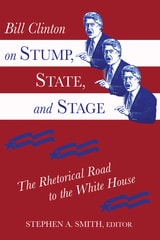
Bill Clinton on Stump, State, and Stage
The Rhetorical Road to the White HouseStephen A. Smith
University of Arkansas Press, 1994
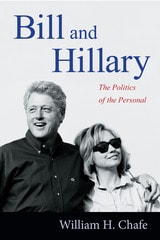
Bill and Hillary
The Politics of the PersonalWilliam H. Chafe
Duke University Press, 2012
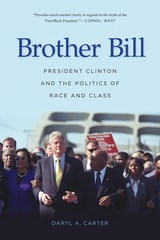
Brother Bill
President Clinton and the Politics of Race and ClassDaryl A Carter
University of Arkansas Press, 2016
“This book is a fascinating analysis of race and class in the age of President Bill Clinton. It provides much-needed clarity in regards to the myth of the ‘First Black President.’ It contributes much to our understanding of the history that informs our present moment!”
—Cornel West
As President Barack Obama was sworn into office on January 20, 2009, the United States was abuzz with talk of the first African American president. At this historic moment, one man standing on the inaugural platform, seemingly a relic of the past, had actually been called by the moniker the “first black president” for years.
President William Jefferson Clinton had long enjoyed the support of African Americans during his political career, but the man from Hope also had a complex and tenuous relationship with this faction of his political base. Clinton stood at the nexus of intense political battles between conservatives’ demands for a return to the past and African Americans’ demands for change and fuller equality. He also struggled with the class dynamics dividing the American electorate, especially African Americans. Those with financial means seized newfound opportunities to go to college, enter the professions, pursue entrepreneurial ambitions, and engage in mainstream politics, while those without financial means were essentially left behind. The former became key to Clinton’s political success as he skillfully negotiated the African American class structure while at the same time maintaining the support of white Americans. The results were tremendously positive for some African Americans. For others, the Clinton presidency was devastating.
Brother Bill examines President Clinton’s political relationship with African Americans and illuminates the nuances of race and class at the end of the twentieth century, an era of technological, political, and social upheaval.
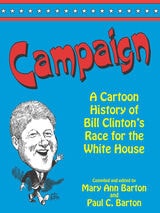
Campaign
A Cartoon History of Bill Clinton's Race for the White HouseMary Ann Barton
University of Arkansas Press, 1993
For many people, in the United States and abroad, the dramas of the campaign created the character of Clinton. From the Gennifer Flowers debacle to Clinton’s
resurrection at the Democratic National Convention and the triumph of the election win, the incisive cartoons in this collection capture Clinton’s emerging image in a way that no written word can. The forty-five contributing artists use these cartoons to depict the breathtaking and colorful events that only a presidential campaign can produce and offer hours of entertainment for any reader.
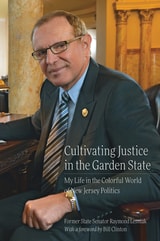
Cultivating Justice in the Garden State
My Life in the Colorful World of New Jersey PoliticsRaymond Lesniak
Rutgers University Press, 2022
He recounts the many causes he championed in his forty years as a state legislator, from the landmark Environmental Cleanup Responsibility Act to bills concerning animal protections, marriage equality, women’s reproductive rights, and the abolition of the death penalty. He also delves into his experiences on the national stage as a key advisor for Bill Clinton and Al Gore’s presidential campaigns. With refreshing candor, Lesniak describes both his greatest achievements and his moments of failure, including his unsuccessful 2017 gubernatorial run.
Cultivating Justice in the Garden State is both a gripping American success story and a must-read for anyone seeking to understand the inner workings of our political system. It offers an insider’s perspective on the past fifty years of New Jersey politics, while presenting a compelling message about what leaders and citizens can do to improve the state’s future.
Separate Societies
Poverty and Inequality in U.S. CitiesAuthored by William W. Goldsmith and Edward J. Blakely with a foreword by President Bill Clinton
Temple University Press, 2010
“Economic and political forces no longer combat poverty—they generate poverty!" exclaim William Goldsmith and Edward Blakely in their report on the plight of American's urban poor. In this revised and updated edition of their 1992 book Separate Societies,the authors present a compelling examination of the damaging divisions that isolate poor city minority residents from the middle-class suburban majority. They pay special attention to how the needs of the permanently poor have been unmet through the alternating years of promises and neglect, and propose a progressive turn away from 30 years of conservative policies.
Separate Societies vividly documents how the urban working class has been pushed out of industrial jobs through global economic restructuring, and how the Wall Street meltdown has aggravated underemployment, depleted public services, and sharpened racial and class inequalities.
The authors insist that the current U.S. approach puts Americans out of work and lowers the standard of living for all. As such, Goldsmith and Blakely urge the Obama administration to create better urban policy and foster better metropolitan management to effectively and efficiently promote equality.
The Boy from Altheimer
From the Depression to the BoardroomWilliam H. Bowen
University of Arkansas Press, 2006
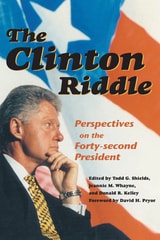
The Clinton Riddle
Perspectives on the Forty-second PresidentTodd G. Shields
University of Arkansas Press, 2004
The Clinton Wars
The Constitution, Congress, and War PowersRyan C. Hendrickson
Vanderbilt University Press, 2002
Ryan Hendrickson examines the behavior of the Clinton administration and Congress in dealing with the range of American military operations that occurred during the Clinton presidency. He uses a case-study approach, laying out the foreign background and domestic political controversies in separate chapters on Somalia, Haiti, Bosnia, Kosovo, and Iraq. Of special interest after the World Trade Center attacks is the chapter "Terrorism: Usama Bin Laden."
The author analyzes a number of factors that influence the domestic decision-making process. We see the president relying on congressional consultation and approval during periods of political or personal weakness, and, conversely, in better times we see a president with a freer hand. Also influential is the ability of the public to comprehend and support the reasons for a particular action, with troops in Bosnia requiring more explanation than cruise missiles over Baghdad. Consideration is given to the relevance and effectiveness of the War Powers Resolution of 1973, a Watergate-era attempt by Congress to restore what it perceived to be its legitimate constitutional role in the decision to use force abroad.
The Clintons of Arkansas
An Introduction by Those Who Know Them BestErnest Dumas
University of Arkansas Press, 1993
The Psychological Assessment of Political Leaders
With Profiles of Saddam Hussein and Bill ClintonJerrold M. Post, Editor
University of Michigan Press, 2005
In an age when world affairs are powerfully driven by personality, politics require an understanding of what motivates political leaders such as Hussein, Bush, Blair, and bin Laden. Through exacting case studies and the careful sifting of evidence, Jerrold Post and his team of contributors lay out an effective system of at-a-distance evaluation. Observations from political psychology, psycholinguistics and a range of other disciplines join forces to produce comprehensive political and psychological profiles, and a deeper understanding of the volatile influences of personality on global affairs.
Even in this age of free-flowing global information, capital, and people, sovereign states and boundaries remain the hallmark of the international order -- a fact which is especially clear from the events of September 11th and the War on Terrorism.
Jerrold M. Post, M.D., is Professor of Psychiatry, Political Psychology, and International Affairs, and Director of the Political Psychology Program at George Washington University. He is the founder of the CIA's Center for the Analysis of Personality and Political Behavior.