Results by title
5 books match the query 'Clocks'
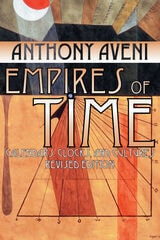
Empires of Time
Calendars, Clocks, and Cultures, Revised EditionAnthony Aveni
University Press of Colorado, 2002
—The Sciences
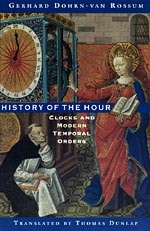
History of the Hour
Clocks and Modern Temporal OrdersGerhard Dohrn-van Rossum
University of Chicago Press, 1996
"In tracing the evolution of time consciousness with scholarship and skill . . . Dohrn-van Rossum evokes the many ways that the small moments of life have come to be reckoned with the passage of time."—Dava Sobel, Civilization
"Dohrn-van Rossum paints a highly nuanced picture of time's conquest of modern life."—Steven Lagerfeld, Wilson Quarterly
"This book is definitive in showing the clock's pervasive influence over European society."—Virginia Quarterly Review
"[A] delightful, excellently translated history."—Choice
"Dohrn-van Rossum has produced a persuasive and brilliantly documented new understanding of how modern time-consciousness arose."—Owen Gingerich, Nature
In the Absence of Clocks
Jacob Shores-Arguello
Southern Illinois University Press, 2012
In the fascinating collection of poems, In the Absence of Clocks, poet Jacob Shores-Arguello takes readers on an illuminating voyage through Ukrainian life. Set during the turmoil of the 2004 Orange Revolution, when the country trembled in the wake of political corruption and public outrage, Shores-Arguello’s lyrics of a revolution provide a glimpse into a world at once foreign and familiar.
Throughout the collection are the iconic images and myriad juxtapositions of Ukrainian life. wolves howling in the snow and bakers pounding early-morning loaves of bread; farmlands and cities alike rocked by political transformation; gypsies and protesters; opulent images of Byzantium and the concrete ghosts of Chernobyl—all meet here at the crossroads of East and West, democracy and communism, reality and mythology. As the narrator travels across the Ukraine, he does much more than cross the distances between Horlivka and Odessa or Kiev and the Black Sea. As the tides of change swirl around him, they mirror his own search for a cultural identity and history.
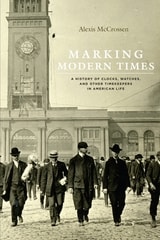
Marking Modern Times
A History of Clocks, Watches, and Other Timekeepers in American LifeAlexis McCrossen
University of Chicago Press, 2013
In Marking Modern Times, Alexis McCrossen relates how the American preoccupation with time led people from across social classes to acquire watches and clocks. While noting the difficulties in regulating and synchronizing so many timepieces, McCrossen expands our understanding of the development of modern time discipline, delving into the ways we have standardized time and describing how timekeepers have served as political, social, and cultural tools in a society that doesn’t merely value time but regards access to time as a natural-born right, a privilege of being an American.
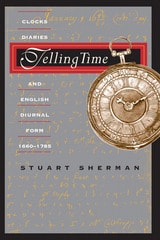
Telling Time
Clocks, Diaries, and English Diurnal Form, 1660-1785Stuart Sherman
University of Chicago Press, 1997
Through brilliant readings of Samuel Pepys's diary, Joseph Addison and Richard Steele's daily Spectator, the travel writings of Samuel Johnson and James Boswell, and the novels of Daniel Defoe and Frances Burney, Sherman traces the development of a new way of counting time in prose—the diurnal structure of consecutively dated installments—within the cultural context of the daily institutions which gave it form and motion. Telling Time is not only a major accomplishment for seventeenth- and eighteenth-century literary studies, but it also makes important contributions to current discourse in cultural studies.