Results by title
2 books match the query 'Clovis Site'
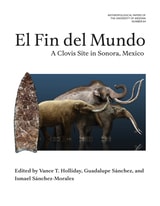
El Fin del Mundo
A Clovis Site in Sonora, MexicoVance T. Holliday, Guadalupe Sánchez, and Ismael Sánchez-Morales
University of Arizona Press, 2024
In a remote desert corner of Sonora, Mexico, the site of El Fin del Mundo offers the first recorded evidence of Paleoindian interactions with gomphotheres, an extinct species related to elephants. The Clovis occupation of North America is the oldest generally accepted and well-documented archaeological assemblage on the continent. This site in Sonora, Mexico, is the northernmost dated late Pleistocene gomphothere and the youngest in North America. It is the first documented intact buried Clovis site outside of the United States, the first in situ Paleoindian site in northwestern Mexico, and the first documented evidence of Clovis gomphothere hunting in North America. The site also includes an associated upland Clovis campsite. This volume also describes a paleontological bone bed below the Clovis level, which includes a rare association of mastodon, mammoth, and gomphothere.
El Fin del Mundo presents and synthesizes the archaeological, geological, paleontological, and paleoenvironmental records of an important Clovis site.
Contributors
Joaquín Arroyo-Cabrales
Jordan Bright
James K. Feathers
Edmund P. Gaines
Thanairi Gamez
Gregory W. L. Hodgins
Vance T. Holliday
Susan M. Mentzer
Carmen Isela Ortega-Rosas
Manuel R. Palacios-Fest
Guadalupe Sánchez
Ismael Sánchez-Morales
Kayla B. Worthey
Kristen Wroth
[more]
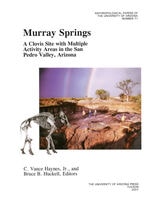
Murray Springs
A Clovis Site with Multiple Activity Areas in the San Pedro Valley, ArizonaEdited by C. Vance Haynes, Jr., and Bruce B. Huckell
University of Arizona Press, 2007
The Murray Springs Site in the upper San Pedro River Valley of southeast Arizona is one of the most significant Clovis sites ever found. It contained a multiple bison kill, a mammoth kill, and possibly a horse kill in a deeply stratified sedimentary context. Scattered across the buried occupation surface with the bones of late Pleistocene animals were several thousand stone tools and waste flakes from their manufacture and repair. Because of the unique occurrence of an algal black mat that buried the Clovis-age surface immediately after abandonment, the distributional integrity of the artifacts and debitage clusters is exceptional for Paleoindian sites. Excavation of the Clovis hunters’ camp 50 to 150 meters south of the kills revealed artifactual evidence typical of hunting camp activity, including hide working and weapons repair. Impact flakes conjoining with Clovis points clearly tied the camp to the bison kill. The unique nature of the site and this comprehensive study of the excavated material constitute one of the most important contributions to our knowledge of Paleoindian hunters in the New World.
[more]