Results by title
15 books match the query 'Coaching'
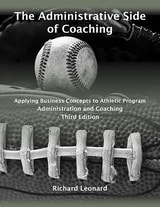
Administrative Side of Coaching
Third EditionRichard Leonard
FiT Publishing, 2017
Creating an efficient and effective athletic program is no small feat. Coaches and athletic program administrators face daily challenges regarding matters such as budgeting, marketing, travel administration, and risk management. This textbook provides an in-depth discussion of these and other specialized topics in coaching administration—making it the perfect fit for undergraduate and graduate courses.
Building upon on the foundational material of the previous editions, author Dr. Richard Leonard offers an overview of coaching administration with greater focus on the practical application. This updated third edition also includes new chapter organization, contemporary support references, and bonus administrative tips.
The Administrative Side of Coaching: Applying Business Concepts to Athletic Program Administration and Coaching, 3rd Edition, guides undergraduate and graduate students, as well as coaches and program administrators, through the conceptual and tangible operational decisions and tasks necessary to create and manage a viable athletic program.

Almost Heaven
How Bobby Bowden's Ten Years at West Virginia University Helped Him Become One of the Winningest Coaches in College Football HistoryJohn Antonik
West Virginia University Press, 2025
Sports journalist John Antonik covers Bowden’s entire WVU tenure from 1966–75 and the circumstances, issues, difficulties, and obstacles that he had to overcome that were unique to this period in Mountaineer sports history. Additionally, Almost Heaven examines what transpired on WVU’s campus and in its athletic programs as well as nationally during the Vietnam War, campus protests, desegregation, and the complexities of the shifting NCAA landscape. Antonik paints a vivid picture of how Bowden’s time at WVU enriched him personally and professionally while putting athletics on a path toward the much greater successes that it enjoyed in the 1980s when Don Nehlen arrived. By the time he left Morgantown in the winter of 1976, following the Mountaineers’ 13–10 Peach Bowl victory over North Carolina State, which culminated in an outstanding 9–3 season, he was a far wiser and much better-prepared football coach. Those difficult lessons that Bowden learned at West Virginia led him down a path to greatness at Florida State.
Almost Heaven draws from an impressive array of primary sources, including newspaper articles; football team rosters; internal documents on recruiting; and interviews with former players, assistants, staffers, sports reporters, Bowden’s sons Tommy and Terry, and Bowden himself, prior to his passing in 2021. The year 2025 represents the 50th anniversary of his final season coaching the Mountaineers, and many of his players are now entering their golden years, making this the optimal time to tell this story.

An Athletic Director’s Story and the Future of College Sports in America
Robert E. Mulcahy
Rutgers University Press, 2020
His words and actions were prominent during a nationally-reported incident involving student athletes. When the Rutgers Women’s Basketball team players were slandered by racist remarks from a popular radio talk show host, Mulcahy met it head on. With the coach and players, he set an inspiring example for defending character and values.
Though Mr. Mulcahy left Rutgers in 2009, his memoir reflects continued devotion to intercollegiate athletics and student athletes. His insights for addressing several leading issues confronting Division I sports today offer guidelines for present and future athletic directors to follow.

Between the Ears
How to Think Like a ChampionGreg Hatcher
Parkhurst Brothers, Inc., 2006

Coaching for the Inner Edge
Practical Sport Psychology for Coaches, Second EditionRobin S. Vealey
FiT Publishing, 2021
Coaches are continually searching for ways to gain the edge over their opponents. They work tirelessly to get their athletes in top physical condition, to develop their physical skills, and to implement successful routines and strategies for their teams. This physical training develops the athlete’s outer edge—the peak physical performance advantage over their opponents. But as most coaches realize, athletes also need an inner edge to perform successfully. This Inner Edge is the advantage that athletes cultivate within themselves by honing their mental skills, by learning to manage their energy in pressure situations and to focus effectively, despite distractions and obstacles.
This much anticipated second edition is a must read for anyone interested in improving sport performance. Dr. Vealey distills and applies the proven methods, updated techniques, and her own experience into a practical, engaging resource for coaches, trainers, and consultants. Drawing from the preeminent research literature of master coaches, innovative sport psychologists, and from her own practical experiences as a college basketball player, coach, sport psychology researcher and consultant, Dr Vealey defines how to develop the Inner Edge in athletes.

Coaching in the Library
A Management Strategy for Achieving ExcellenceRuth F. Metz
American Library Association, 2010
Coaching in the Library
A Management Strategy for Achieving ExcellenceAmerican Library Association, 2001
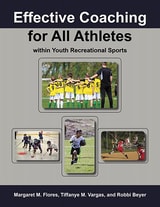
Effective Coaching for All Athletes within Youth Recreational Sports
Margaret M. Flores
FiT Publishing, 2017
Within any given team, young athletes have varied skills that range from novice to competent. Providing the same coaching activities for everyone will result in frustration for some athletes because they do not possess certain prerequisite skills, and others because they have reached mastery and become bored. Effective Coaching offers a foundational structure and methods for teaching effective skills that athletes of varied levels of mastery need to work as a team. These easy-to-use, practical tools reduce athlete frustration and help create an environment that encourages mastery as well as fun for all, including the coach.
Topics discussed include effective organization, design of practice environments, communication with families, efficient and feasible progress monitoring, and discussion of common youth sport programs (e.g., soccer, t-ball, indoor hockey, basketball, flag football, lacrosse, and volleyball), as well as accessible coaching for teams that may include young athletes with learning disabilities, behavioral disabilities, attention deficit hyperactivity disorder, as well as athletes without disabilities. This book is written for youth sport coaches, and individuals who volunteer their time to teach young athletes the fundamentals of a given sport.
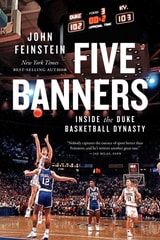
Five Banners
Inside the Duke Basketball DynastyJohn Feinstein
Duke University Press, 2024
In Five Banners, Feinstein tells the inside history of Coach K’s forty-two-year career at Duke and its five NCAA championships, from the first, against Kansas in 1991, to the most recent, in 2015 against Wisconsin. With unparalleled access to Coach K, the team, and its staff, Feinstein takes readers on a mesmerizing ride into the locker room and onto the court. Full of intimate details, personal memories, and previously untold on- and off-court stories, it is a book that only Feinstein could write.
Feinstein explores a basketball legacy that begins with his days as an undergrad Duke Chronicle reporter covering coaches Bucky Waters and Neill McGeachy (who went 10-16 in one year as head coach), includes the “drought years” of the 1980s and the glory of the teams of the 1990s, and moves into the present day with Jon Scheyer’s succession. Drawing on new interviews, Feinstein highlights the voices of Grant Hill, Nolan Smith, Christian Laettner, Tommy Amaker, and Bobby Hurley, who each bring new insights on the championship years.
Throughout, Feinstein unveils the momentous force of college basketball as a game of intense relationships and intimate conversations. Candid, revelatory, and engrossing, Five Banners is an essential book for all Duke fans and anyone who loves the college game.
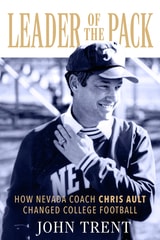
Leader of the Pack
How Nevada Coach Chris Ault Changed College FootballJohn Trent
University of Nevada Press, 2027
Nevada Wolf Pack football coach Chris Ault is unlike any other college football coach in history. He spent his entire coaching career, from 1976 to 2012, at the University of Nevada, Reno, where he elevated a football program with very little notoriety onto the national stage, winning 234 games and earning a place in the College Football Hall of Fame. Ault’s innovative “Pistol” offense, established in the 2004–2005 season, revolutionized college football and ushered in its modern high-scoring offensive style.
Yet perhaps beyond the offensive genius Ault brought to the college game, he was also a masterful showman. He built interest in a previously moribund program with publicity stunts like inviting military tanks into Mackay Stadium and having them blast non-live rounds into the sky whenever the Wolf Pack scored a touchdown. He wrote victory songs for the Wolf Pack to sing in the locker room following every win. His teams marched through downtown Reno in military formation while wearing full game uniforms. He delivered stirring halftime speeches that led to improbable comebacks, including the single greatest football comeback in NCAA history. He found common personal ground with young Wolf Pack athletes and developed talent like Colin Kaepernick, who developed into one of the greatest college quarterbacks the sport had ever seen.
Through his unconventional coaching methods, his fervent belief that the University of Nevada, Reno, was the finest institution of higher learning in the land, and his innate, creative, and intuitive understanding of how a winning football program can unite people, Ault brought the people of Northern Nevada together in a way that no one has replicated since. Chris Ault was the rare college football coach who came to campus as a starting quarterback, stayed throughout his career as a coach, and left a mark that will never be equaled.

Living in the Sweet Spot
Preparing for Performance in Sport and LifeAmy L. Baltzell
FiT Publishing, 2011
Living in the Sweet Spot: Preparing for Performance in Sport and Life inspires readers to prepare for life’s big performances. The author integrates the principles of positive psychology and sport psychology, relating techniques to strengthen daily fulfillment to get the most out of the experience when those big moments take place. The issues performers face when under pressure come to life through examples from top athletes, musicians, and the author's experiences as an Olympian and America's Cup sailor. Every chapter contains practical, effective, reflective exercises that help readers rise to the challenge of performing their best when it counts.
“What I learned in this book is that if you focus on the positives and what actually brings you joy, it will change your perspective, and maybe most importantly, give you more energy. Everyone, not just athletes, can benefit from reading Living in the Sweet Spot—we can learn how to accept ourselves, our endeavors, our sport, or our profession.”
— from the foreword by Phil Simms, Super Bowl XXI MVP
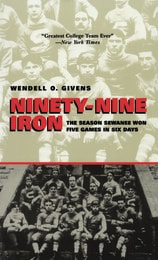
Ninety-Nine Iron
The Season Sewanee Won Five Games in Six DaysWendell Givens
University of Alabama Press, 2003
The fascinating story of the 1899 Sewanee football team’s remarkable, unassailable winning streak.
Ninety-Nine Iron is the story of the 1899 Sewanee football team. The University of the South, as it is formally called, is a small Episcopal college on Mounteagle Mountain in southeastern Tennessee. It is a respected academic institution not known for its athletic programs. But in that final year of the 19th century the Sewanee football team, led by captain “Diddy” Seibels, produced a record that is legendary.
In six days, on a grueling 2,500-mile train trip, the team defeated Texas, Texas A&M, Tulane, Louisiana State University, and Ole Miss—all much larger schools than Sewanee. In addition to this marathon of victory, the 21 members of the Sewanee Iron Men won all 12 of their regular games, and of their 12 opponents, only Auburn managed to score at all against them. Ten of these 12 victories were against Southern Intercollegiate Athletic Association opponents, which put Sewanee in the record books for most conference games played and most won in a season.
In Ninety-Nine Iron, Wendell Givens provides a play-by-play account of that remarkable season. He includes an overview of campus life at Sewanee and profiles of the players, the team’s coach (Billy Suter), the manager (Luke Lea), and the trainer (Cal Burrows). In the five years he researched the work, Givens conducted interviews with Seibels and visited the five cities in which the Iron Men had played—Austin, Houston, New Orleans, Baton Rouge, and Memphis. Givens has written a vivid account of a sports achievement not likely to be seen again.
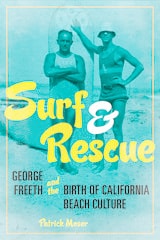
Surf and Rescue
George Freeth and the Birth of California Beach CulturePatrick Moser
University of Illinois Press, 2022
A compelling merger of biography and sports history, Surf and Rescue brings to light the forgotten figure whose novel way of seeing the beach sparked the imaginations of people around the world.
The Art of Accompanying and Coaching
Kurt Adler
University of Minnesota Press, 1965
The Art of Accompanying and Coaching was first published in 1965. Minnesota Archive Editions uses digital technology to make long-unavailable books once again accessible, and are published unaltered from the original University of Minnesota Press editions.
Kurt Adler, former conductor and chorus master of the Metropolitan Opera, provides a comprehensive guide to musical accompanying and coaching, based in his extensive experience, which will be helpful, if not indispensable, to music teachers, students, coaches, accompanists, orchestral and choral conductors, and performing vocal and instrumental artists.
The first part of the book gives the historical and technical background of the subject and explains in detail the mechanics of string instruments, piano, celeste, organ, harmonium, and voice. The next section offers a thorough guide to the singing diction of five languages— Italian, Latin, French, German, and English. The author continues with a discussion of the elements of musical style, describing, with the use of ample musical illustrations, tempo, rhythm, dynamics, phrasing and articulation, and ornamentation. This section closes with an analysis of the German lied style and the French art song style.
Mr. Adler goes on to synthesize the various elements of accompanying and coaching. He stresses the importance of psychological and spiritual rapport between accompanists and artist and shows ways of achieving this. He explains the differences and similarities among opera, oratorio, and song coaching. In a section on program arranging, he offers advice about planning concerts of various kinds, citing examples of programs given by outstanding artists. He writes about particular aspects of accompanying — self accompanying, the difference between piano accompanying and soloistic piano playing, and accompanying for singers, instrumentalists, and dancers. In conclusion, he describes the qualities of an ideal accompanist and the rewards derived from excellence in performance.
University and college music departments, schools of music, choral groups, voice teachers, singers, pianists, and other musicians will find the book of inestimable value, either as a text or as a reference work. It will be especially helpful to pianists who aspire to become accompanists.
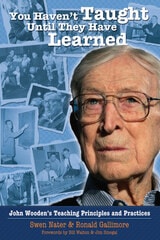
You Haven't Taught Until They Have Learned
Swen Nater
FiT Publishing, 2010
Not only was John Wooden a great basketball coach, he was a master teacher. In fact, he was a great coach because he was a master teacher. What Wooden has learned from others in the classroom and perfected on the practice court are fundamental principles of effective teaching, which are conveyed in You Haven’t Taught Until They Have Learned: John Wooden’s Teaching Principles and Practices. Co-author Swen Nater, one of Wooden’s former players at UCLA, provides insightful first-hand accounts on the many life lessons he learned from Wooden that he has applied to his life since becoming a teacher himself. Wooden’s principles conveyed by Nater and co-author Ronald Gallimore in this book can be studied and applied by teachers, coaches, parents, and anyone else who is responsible for, works with, or supervises others.
In this revised version of the book, the authors include an afterword, in which specific examples and anecdotes are provided of how You Haven’t Taught Until They Have Learned has impacted people in the teaching, coaching, and business industries.