Results by title
6 books match the query 'Coal trade'

Company Towns
Industry Power and the Historical Foundations of Public MistrustElizabeth Mitchell Elder
University of Chicago Press, 2026
Reveals the deep, historical roots of public distrust in former mining areas in the US, shedding new light on the corrosive feedback loops that persist today.
In Company Towns, Elizabeth Mitchell Elder examines the long-lasting political legacies of mining-company dominance in the Midwest and Appalachia. While the economic consequences of deindustrialization are well-known, Elder shifts the focus to a more insidious problem: the political dysfunction that took root long before the mines shut down.
Drawing on historical and administrative data, Elder shows that the coal industry hindered the growth of local government capacity in the places where it was dominant. Mining companies also engaged in outright corruption to shape local governments, practices which local elites then carried forward. When mining companies withdrew, they left behind not just economic decline, but local governments ill-equipped to govern.
These patterns have had enduring consequences for public life. Elder shows how these historical experiences have fueled a broader cynicism toward government, in which citizens expect little from public institutions and doubt the usefulness of elections. Company Towns underscores the consequences of corporate dominance for state capacity, public opinion, and democratic accountability today.
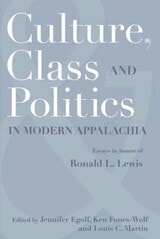
Culture, Class, and Politics in Modern Appalachia
Essays in Honor of Ronald L. LewisEdited by Jennifer Egolf, Ken Fones-Wolf, and Louis C. Martin
West Virginia University Press, 2009
Culture, Class, and Politics in Modern Appalachia takes stock of the field of Appalachian studies as it explores issues still at the center of its scholarship: culture, industrialization, the labor movement, and twentieth-century economic and political failure and their social impact. A new generation of scholars continues the work of Appalachian studies’ pioneers, exploring the diversity and complexity of the region and its people. Labor migrations from around the world transformed the region during its critical period of economic growth. Collective struggles over occupational health and safety, the environment, equal rights, and civil rights challenged longstanding stereotypes. Investigations of political and economic power and the role of social actors and social movements in Appalachian history add to the foundational work that demonstrates a dynamic and diverse region.
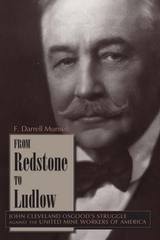
From Redstone to Ludlow
John Cleveland Osgood's Struggle against the United Mine Workers of AmericaF. Darrell Munsell
University Press of Colorado, 2009
From Redstone to Ludlow depicts the bipolarity of his approach to the threat of unionism. The "Redstone experiment," a model industrial village designed to improve the lives of workers through social programs, showed Osgood's efforts to attain his anti-union goals through compassion. Conversely, the Ludlow tent colony and the events that transpired there, marked by armed gunmen and machine guns paid for by Osgood, illustrate his willingness to resort to violence and intimidation for the same purpose. A leading participant in the transformation of the West, Osgood helped to shape the character of the Gilded Age. Today, the beautiful village of Redstone and a granite memorial at Ludlow are reminders of Osgood's complex role in the clash between labor and management during the most violent industrial struggle in American history.

JOHN PEALE BISHOP
A BIOGRAPHYELIZABETH C. SPINDLER
West Virginia University Press, 1980
The Making of Federal Coal Policy
Robert H. Nelson
Duke University Press, 1983
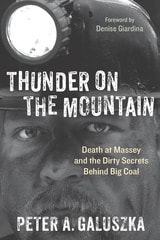
Thunder on the Mountain
Death at Massey and the Dirty Secrets behind Big CoalPeter A. Galuszka
West Virginia University Press, 2014
With a foreword by Denise Giardina
On April 5, 2010, an explosion ripped through Massey Energy’s Upper Big Branch Mine, killing twenty-nine coal miners. This tragedy was the deadliest mine disaster in the United States in forty years—a disaster that never should have happened. These deaths were rooted in the cynical corporate culture of Massey and its notorious former CEO Don Blankenship, and were part of an endless cycle of poverty, exploitation, and environmental abuse that has dominated the Appalachian coalfields since coal was first discovered there. And the cycle continues unabated as coal companies bury the most insidious dangers deep underground, all in search of higher profits, and hide the true costs from regulators, unions, and investors alike. But the disaster at Upper Big Branch goes beyond the coalfields of West Virginia. It casts a global shadow, calling into bitter question why coal miners in the United States are sacrificed to erect cities on the other side of the world, why the coal wars have been allowed to rage, polarizing the country, and how the world’s voracious appetite for energy is satisfied at such horrendous cost.
With Thunder on the Mountain, Peter A. Galuszka pieces together the true story of greed and negligence behind the tragedy at the Upper Big Branch Mine, and in doing so he has created a devastating portrait of an entire industry that exposes the coal-black motivations that led to the death of twenty-nine miners and fuel the ongoing war for the world’s energy future.
This paperback edition contains a foreword by Denise Giardinia that provides an update on Massey Energy and Donald Blankenship, Chairman and CEO of Massey Energy Company during the UBB disaster, and recounts her own experiences with Massey Energy and the United Mine Workers Association in the 1980s. This edition also includes a notes section and a bibliography.