Results by title
9 books match the query 'Coasts'

A Guide to Oregon South Coast History
Traveling the Jedediah Smith TrailNathan Douthit
Oregon State University Press, 1999

A Moveable Shore
The Fate of the Connecticut CoastPeter C. Patton and James M. Kent
Duke University Press, 1992
Beginning with the hurricane of 1938, the biggest natural disaster to strike Connecticut since its settlement by Europeans, the authors demonstrate the continuing pattern of development of coastal land prone to flooding and high winds. Although the Connecticut coast faces Long Island and Block Island sounds, it is subject to the same natural hazards, land-use risks, and regulations as opean ocean shorelines. Global climatic events--glaciation, global warming, and rising sea levels--influence the shape and composition of the Connecticut shoreline, as do small-scale forces such as wind, waves, and tides.
Patton and Kent seek to instill a respect for the force of natural events and provide a guide for lessening the dangers of construction and development. A practical question-and-answer chapter explains what homeowners need to know to meet land-use regulations along the coast. In a state where the entire population lives within 100 miles of the coast, this important book will serve as a citizens’ guide to living with the Connecticut shore and will be of interest to coastal residents, developers, geologists, policymakers, and vacationers.
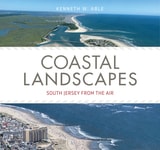
Coastal Landscapes
South Jersey from the AirKenneth W. Able
Rutgers University Press, 2023
Based on numerous aerial images from helicopter and drone flights between 2015 and 2021, this book provides extensive photographs and maps of the New Jersey coast, from the Pine Barrens to the ocean beaches. The text associated with each exceptional image describes it in detail, including its location, ecological setting, and relative position within the larger landscape. Author Kenneth Able, director of the Rutgers University Marine Field Station for over thirty years, has thoroughly ground-truthed each image by observations made through kayaks, boats, and wading through marshes. Calling upon his decades of expertise, Able paints a compelling portrait of coastal New Jersey’s stunning natural features, resources, history, and possible futures in an era of rising sea levels.
Impermanence
Life and Loss on Superior's South Shoreleaf
University of Minnesota Press, 2024
A personal journey through the ever-changing natural and cultural history of Lake Superior’s South Shore
Lake Superior’s South Shore is as malleable as it is enduring, its red sandstone cliffs, clay bluffs, and golden sand beaches reshaped by winds and water from season to season—and sometimes from one hour to the next. Generations of people have inhabited the South Shore, harvesting the forests and fish, mining copper, altering the land for pleasure and profit, for better or worse. In Impermanence, author Sue Leaf explores the natural and human histories that make the South Shore what it is, from the gritty port city of Superior, Wisconsin, to the shipping locks at Sault Ste. Marie, Michigan.
For Leaf, what began as a bicycling adventure on the coast of Lake Superior in 1977 turned into a lifelong connection with the area, and her experience, not least as owner of a rustic cabin on a rapidly eroding lakeside cliff, imbues these essays with a passionate sense of place and an abiding curiosity about its past and precarious future. As waves slowly consume the shoreline where her family has spent countless summers, Leaf is forced to confront the complexity of loving a place that all too quickly is being reclaimed by the great lake.
Impermanence is a journey through the South Shore’s story, from the early days of the Anishinaabe and fur traders through the heyday of commercial fishing, lumber camps, and copper mining on the Keweenaw Peninsula to the awakening of the Northland to the perils and consequences of plundering its natural splendor. Noting the geological, ecological, and cultural features of each stop on her tour along the South Shore, Leaf writes about the restoration of the heavily touristed Apostle Islands National Lakeshore to its pristine conditions, even as Lake Superior maintains its allure for ice fishers, kayakers, and long-distance swimmers. She describes efforts to protect the endangered piping plover and to preserve the diverse sand dunes on the Michigan coast, and she observes the slough that supports rare intact wild rice beds central to Anishinaabe culture.
Part memoir, part travelogue, part natural and cultural history, Leaf’s love letter to Lake Superior’s South Shore is an invitation to see this liminal world in all its seasons and guises, to appreciate its ageless, ever-changing wonders and intimate charms.
Living with the Chesapeake Bay and Virginia's Ocean Shores
Larry G. Ward, Peter S. Rosen, William J. Neal. Orrin H. Pilkey Jr., Orrin H. Pilkey Sr., Gary L. Anderson, and Stephen J. Howie
Duke University Press, 1989
Living with the Louisiana Shore
Joseph T. Kelley, Alice R. Kelley, Orrin Pilkey Sr., and Albert Clark
Duke University Press, 1984
But the most striking feature of Louisiana's coastline is rapidly accelerating change, which means (1) some coastal parishes may literally disappear by the year 2000; (2) the loss of marshland will damage the prolific seafood industry; (3) a retreating coastline could cost the state hundreds of millions of dollars in tax revenues from offshore oil facilities; (4) present and potential shoreline residents will face many new problems and possibilities.
The Atlas of Coasts and Oceans
Ecosystems, Threatened Resources, Marine ConservationDon Hinrichsen
University of Chicago Press, 2011
Oceans drive the world’s climate, nurture marine ecosystems full of aquatic life, and provide shipping lanes that have defined the global economy for centuries. And few realize that half of the world’s population lives in a coastal region within easy reach of one. Yet human activities such as commercial fishing, coastal real estate development, and industrial pollution have taken their toll on the seas. The first book of its kind, The Atlas of Coasts and Oceans documents the fraught relationship between humans and the earth’s largest bodies of water—and outlines the conservation steps needed to protect the marine environment for generations to come.
The Atlas offers a fascinating and often sobering account of how urbanization, climate change, offshore oil drilling, shipping routes, global tourism, and maritime conflict have had a profound impact on the world’s oceans and coasts. Combining text and images in visually engaging, thematically organized map spreads, this volume addresses the ecological, environmental, and economic importance of marine phenomena such as coral reefs, eroding shorelines, hurricanes, and fish populations—and how development threatens to destroy the ultimate source of all life on the “blue planet.” Lavishly illustrated with global and regional maps, from the Arabian Gulf to the Great Barrier Reef, from the Black Sea to the Mediterranean, and all the other major global waterways, The Atlas of Coasts and Oceans will be the definitive companion to any study of its subject for years to come.
The Human Shore
Seacoasts in HistoryJohn R. Gillis
University of Chicago Press, 2012
Since before recorded history, people have congregated near water. But as growing populations around the globe continue to flow toward the coasts on an unprecedented scale and climate change raises water levels, our relationship to the sea has begun to take on new and potentially catastrophic dimensions. The latest generation of coastal dwellers lives largely in ignorance of the history of those who came before them, the natural environment, and the need to live sustainably on the world’s shores. Humanity has forgotten how to live with the oceans.
Vanishing Sands
Losing Beaches to MiningOrrin H. Pilkey, Norma J. Longo, William J. Neal, Nelson G. Rangel-Buitrago, Keith C. Pilkey, and Hannah L. Hayes
Duke University Press, 2022