Results by title
5 books match the query 'Coca industry'
Beyond Indigeneity
Coca Growing and the Emergence of a New Middle Class in BoliviaAlessandra Pellegrini Calderón
University of Arizona Press, 2016
In Bolivia, the discourse on indigenous peoples intensified in the last few decades, culminating in the election of Evo Morales as president in 2005. Indigenous people are portrayed by the Morales government as modest, communitarian, humble, poor, anticapitalist, and economically marginalized. In his 2006 inaugural speech, Morales famously described indigenous people as “the moral reserve of humanity.” His rhetoric has reached all levels of society—most notably the new political constitution of 2009. This constitution initiated a new regime of considerable ethnic character by defining thirty-six indigenous nations and languages.
Beyond Indigeneity offers new analysis into indigenous identity and social mobility that changes the discourse in Latin American social anthropology. Author Alessandra Pellegrini Calderón points out that Morales’s presidency has led to heightened publicity of coca issues and an intensification of indigeneity discourse, echoing a global trend of increased recognition of indigenous peoples’ claims. The “living well” attitude (vivir bien) enshrined in the new political constitution is generally represented as an indigenous way of life, one based on harmony and reciprocity, in sharp contrast to the capitalist logic of “living better” that is based on accumulation and expansion.
In this ethnography, Pellegrini explores the positioning of coca growers in Bolivia and their reluctance to embrace the politics of indigeneity by rejecting the “indigenous peoples’ slot,” even while they emerge as a new middle class. By staying in a space between ethnic categories and also between social classes, the coca growers break with the traditional model of social mobility in Latin America and create new forms of political positioning that challenge the dominant culturalist framework about indigeneity and peasants.
[more]
Coca Yes, Cocaine No
How Bolivia's Coca Growers Reshaped DemocracyThomas Grisaffi
Duke University Press, 2019
In Coca Yes, Cocaine No Thomas Grisaffi traces the political ascent and transformation of the Movement toward Socialism (MAS) from an agricultural union of coca growers into Bolivia's ruling party. When Evo Morales—leader of the MAS—became Bolivia's president in 2006, coca growers celebrated his election and the possibility of scaling up their form of grassroots democracy to the national level. Drawing on a decade of ethnographic fieldwork with coca union leaders, peasant farmers, drug traffickers, and politicians, Grisaffi outlines the tension that Morales faced between the realities of international politics and his constituents, who, even if their coca is grown for ritual or medicinal purposes, are implicated in the cocaine trade and criminalized under the U.S.-led drug war. Grisaffi shows how Morales's failure to meet his constituents' demands demonstrates that the full realization of alternative democratic models at the local or national level is constrained or enabled by global political and economic circumstances.
[more]
Cocaine
From Coca Fields to the StreetsEnrique Desmond Arias and Thomas Grisaffi, editors
Duke University Press, 2021
The contributors to Cocaine analyze the contemporary production, transit, and consumption of cocaine throughout the Americas and the illicit economy's entanglement with local communities. Based on in-depth interviews and archival research, these essays examine how government agents, acting both within and outside the law, and criminal actors seek to manage the flow of illicit drugs to both maintain order and earn profits. Whether discussing the moral economy of coca cultivation in Bolivia, criminal organizations and drug traffickers in Mexico, or the routes cocaine takes as it travels into and through Guatemala, the contributors demonstrate how entire ways of life are built around cocaine commodification. They consider how the authority of state actors is coupled with the self-regulating practices of drug producers, traffickers, and dealers, complicating notions of governance and of the relationships between economic and moral economies. The collection also outlines a more progressive drug policy that acknowledges the important role drugs play in the lives of those at the urban and rural margins.
Contributors. Enrique Desmond Arias, Lilian Bobea, Philippe Bourgois, Anthony W. Fontes, Robert Gay, Paul Gootenberg, Romain Le Cour Grandmaison, Thomas Grisaffi, Laurie Kain Hart, Annette Idler, George Karandinos, Fernando Montero, Dennis Rodgers, Taniele Rui, Cyrus Veeser, Autumn Zellers-León
Contributors. Enrique Desmond Arias, Lilian Bobea, Philippe Bourgois, Anthony W. Fontes, Robert Gay, Paul Gootenberg, Romain Le Cour Grandmaison, Thomas Grisaffi, Laurie Kain Hart, Annette Idler, George Karandinos, Fernando Montero, Dennis Rodgers, Taniele Rui, Cyrus Veeser, Autumn Zellers-León
[more]
Conflicts over Coca Fields in Sixteenth-Century Perú
María Rostworowski de Diez Canseco
University of Michigan Press, 1988
Many archaeologists and ethnohistorians use historic documents to help interpret prehistoric archaeological sequences. A sixteenth-century Spanish document called Justicia 413 has been instrumental in helping researchers understand conflict among the prehistoric polities of coastal Peru. Volume 4 of the subseries Studies in Latin American Ethnohistory & Archaeology.
[more]
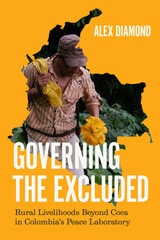
Governing the Excluded
Rural Livelihoods Beyond Coca in Colombia's Peace LaboratoryAlex Diamond
University of Chicago Press, 2026
An on-the-ground description of Colombia’s peace process as lived by the rural populations most affected by it.
The Colombian village of Briceño might, at first glimpse, look like many communities in the rural Global South. Many of the people living there rely on small-scale farming, even as a newly constructed hydroelectric dam threatens traditional livelihoods. Yet after decades where Briceño suffered from a bloody conflict, the village has more recently become central to the nation’s hopes for peace. In Governing the Excluded, sociologist Alex Diamond shares a closer look at Briceño and offers unique insight not only into the contemporary Colombian state but to how people across the Global South are struggling to maintain rural livelihoods amid economic dispossession.
Governing the Excluded describes a landmark peace process between the Colombian government and the radical FARC guerrillas from the perspective of Colombian farmers, drawing links between economic transformation, drug economies, and armed conflict. Exclusion from global markets for traditional crops like coffee first pushed farmers to grow coca, the raw material for cocaine. This ushered in an era of violent conflict for control of the illicit economy, while farmers continued to be priced out of legal markets. In exchange for peace and state protection, farmers ultimately agreed to sacrifice profitable coca. But with its disappearance, they now find themselves dependent on the state: for machinery to maintain the roads they need to get legal harvests to market, municipal jobs that are the only decent work available, and for public resources to subsidize food crops with razor-thin profit margins. Ongoing economic struggles in the legal sector make the state’s newfound authority tenuous, as some villagers replant coca, abandon the village for uncertain urban futures, or join a rearmed guerrilla group.
Informed by deep ethnographic research and firsthand stories from Briceño residents, Governing the Excluded shows that when it comes to the forces driving dispossession—be they international corporate megaprojects, global food prices, or national initiatives to replace coca cultivation—state authority goes only so far as its ability to sustain local livelihoods.
[more]