Results by title
10 books match the query 'Cognitive grammar'
Anaphora and Conceptual Structure
Karen van Hoek
University of Chicago Press, 1997
Integrating the results of previous work, Van Hoek develops a model in which some nominals function as "conceptual reference points" that dominate over stretches defined by the semantic relations among elements. When a full noun is in the domain of a reference point, coreference is ruled out, since the speaker would be sending contradictory messages about the salience of the noun's referent.
With profound implications for the nature of syntax, this book will interest theoretical linguists of all persuasions.
Aristote et le lexique de l'espace
Claude Vandeloise
CSLI, 2001
Automaton Theories of Human Sentence Comprehension
John T. Hale
CSLI, 2014
Empirical and Experimental Methods in Cognitive/Functional Research
Edited by Sally Rice and John Newman
CSLI, 2010
Empirical and Experimental Methods in Cognitive/Functional Research consists of selected papers from the seventh meeting of the Conceptual Structure, Discourse, and Language Conference, held at the University of Alberta in October 2004. The papers fall into five main categories, reflecting the cognitive and functional orientation of the conference: reciprocity between lexis and syntax, semantic factors affecting form patterning, grammaticalization of basic verbs, form/meaning pairings in discourse, and experimental investigations of language/mind and language/use interactions. In addition, a plenary paper by Nick Evans on complex events, propositional overlay, and the special status of reciprocal clauses is included.
Language and Human Understanding
David Braine
Catholic University of America Press, 2014
Language from a Cognitive Perspective
Grammar, Usage, and ProcessingEdited by Emily M. Bender and Jennifer E. Arnold
CSLI, 2011
This book is a collection of papers on language processing, usage, and grammar, written to commemorate the career of Thomas Wasow on the occasion of his sixty-fifth birthday. Wasow has been professor of linguistics and philosophy at Stanford University since 1973, and is affiliated with the Symbolic Systems Program. He has made significant contributions to the study of English syntax, psycholinguistics, and philosophy of linguistics.
Language, Culture, and Mind
Edited by Michel Achard and Suzanne Kemmer
CSLI, 2003

Scribal Memory and Word Selection
Text Criticism of the Hebrew BibleRaymond F. Person Jr.
SBL Press, 2023
What were ancient scribes doing when they copied a manuscript of a literary work? This question is especially problematic when we realize that ancient scribes preserved different versions of the same literary texts. In Scribal Memory and Word Selection: Text Criticism of the Hebrew Bible, Raymond F. Person Jr. draws from studies of how words are selected in everyday conversation to illustrate that the same word-selection mechanisms were at work in scribal memory. Using examples from manuscripts of the Hebrew Bible, Person provides new ways of understanding the cognitive-linguistic mechanisms at work during the composition/transmission of texts. Person reveals that, while our modern perspective may consider textual variants to be different literary texts, from the perspective of the ancient scribes and their audiences, these variants could still be understood as the same literary text.
The Neural Mind
How Brains ThinkGeorge Lakoff and Srini Narayanan
University of Chicago Press, 2025
What is an idea, and where does it come from? We experience thought as if it were abstract, but every thought is actually a physical thing, carried out by the neural systems of our brains. Thought does not occur neuron-by-neuron; it happens when neurons come together to form circuits and when simple circuits combine to form complex ones. Thoughts, then, derive their structures from the circuitry we also use for vision, touch, and hearing. This circuitry is what allows simple thoughts to come together into complex concepts, making meaning, creating metaphors, and framing our social and political ideas.
With The Neural Mind, George Lakoff, a pioneering cognitive linguist, and computer scientist Srini Narayanan deftly combine insights from cognitive science, computational modeling, and linguistics to show how thoughts arise from the neural circuitry that runs throughout our bodies. They answer key questions about the ways we make meaning: How does neural circuitry create the conceptual “frames” through which we understand our social lives? What kind of neural circuitry characterizes metaphorical thought, in which ideas are understood in terms of other ideas with similar structures? Lively and accessible, the book shows convincingly that the “metaphors we live by”—to use Lakoff’s famous phrase—aren’t abstractions but deeply embodied neural constructs.
The Neural Mind is the first book of its kind, bringing together the ideas of multiple disciplines to offer a unified, accessible theory of thought. A field-defining work, Lakoff and Narayanan’s book will be of interest not just to linguists and cognitive scientists but also to psychologists, philosophers, anthropologists, journalists, sociologists, and political scientists—and anyone who wants to understand how we really think.
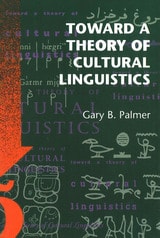
Toward a Theory of Cultural Linguistics
By Gary B. Palmer
University of Texas Press, 1996
Imagery, broadly defined as all that people may construe in cognitive models pertaining to vision, hearing, touch, taste, smell, and feeling states, precedes and shapes human language. In this pathfinding book, Gary B. Palmer restores imagery to a central place in studies of language and culture by bringing together the insights of cognitive linguistics and anthropology to form a new theory of cultural linguistics.
Palmer begins by showing how cognitive grammar complements the traditional anthropological approaches of Boasian linguistics, ethnosemantics, and the ethnography of speaking. He then applies his cultural theory to a wealth of case studies, including Bedouin lamentations, spatial organization in Coeur d'Alene place names and anatomical terms, Kuna narrative sequence, honorifics in Japanese sales language, the domain of ancestral spirits in Proto-Bantu noun-classifiers, Chinese counterfactuals, the non-arbitrariness of Spanish verb forms, and perspective schemas in English discourse.
This pioneering approach suggests innovative solutions to old problems in anthropology and new directions for research. It will be important reading for everyone interested in anthropology, linguistics, cognitive science, and philosophy.