Results by title
11 books match the query 'Collaborationists'
A Jewish Kapo in Auschwitz
History, Memory, and the Politics of SurvivalTuvia Friling
Brandeis University Press, 2014
Civil Obedience
Complicity and Complacency in Chile since PinochetMichael J. Lazzara
University of Wisconsin Press, 2020
Michael J. Lazzara boldly argues that today's Chile is a product of both complicity and complacency. Combining historical analysis with deft literary, political, and cultural critique, he scrutinizes the post-Pinochet rationalizations made by politicians, artists, intellectuals, bystanders, former revolutionaries-turned-neoliberals, and common citizens. He looks beyond victims and perpetrators to unveil the ambiguous, ethically vexed realms of memory and experience that authoritarian regimes inevitably generate.

From Racism to Genocide
Anthropology in the Third ReichGretchen E. Schafft
University of Illinois Press, 2007
In paperback for the first time, From Racism to Genocide is an explosive, richly detailed account of how Nazi anthropologists justified racism, developed practical applications of racist theory, and eventually participated in every phase of the Holocaust.
Using original sources and previously unpublished documentation, Gretchen E. Schafft shows the total range of anti-human activity from within the confines of a particular discipline. Based on seven years of archival research in the United States and abroad, the work includes many original photos and documents, most of which have never before been published. It uses primary data and original texts whenever possible, including correspondence written by perpetrators. The book also reveals that the United States was not merely a bystander in this research, but instead contributed professional and financial support to early racial research that continued through the first five years of Hitler’s regime.
My Father's War
A True Story of Nazism and Treasonby Bjørn Westlie, translated by Dean Krouk
University of Wisconsin Press, 2023
With an insightful introduction from translator Dean Krouk, My Father’s War is a contemporary classic of war literature. Committed to genuine understanding without falling into undue sympathizing, this sober and reflective book presents an eye-opening, moving, intense, and necessary account of the allure of fascism in a world at war—and its personal costs.
Not the Germans Alone
A Son's Search for the Truth of VichyIsaac Levendel
Northwestern University Press, 2000
On the eve of D-Day, Isaac Levendel's mother left her hiding place on a farm in southern France and never returned. After 40 years of silence and torment, he returned to France in 1990 determined to find out what had happened. This is the story of how, with perseverance, luck, and official help, he gained access to secret wartime documents laying bare the details of French collaboration-and the truth about his mother's fate.
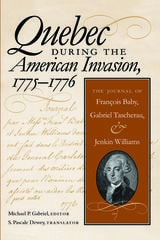
Quebec During the American Invasion, 1775-1776
The Journal of Francois Baby, Gabriel Taschereau, and Jenkin WilliamsMichael P. Gabriel
Michigan State University Press, 2005
Available for the first time in English, the 1776 journal of François Baby, Gabriel Taschereau, and Jenkin Williams provides an insight into the failure to incite rebellion in Quebec by American revolutionaries. While other sources have shown how British soldiers and civilians and the French-Canadian gentry (the seigneurs) responded to the American invasion of 1775–1776, this journal focuses on French-Canadian peasants (les habitants) who made up the vast majority of the population; in other words, the journal helps explain why Quebec did not become the "fourteenth colony."
After American forces were expelled from Quebec in early 1776, the British governor, Sir Guy Carleton, sent three trusted envoys to discover who had collaborated with the rebels from the south. They traveled to fifty-six parishes and missions in the Quebec and Trois Rivières district, discharging disloyal militia officers and replacing them with faithful subjects. They prepared a report on each parish, revealing actions taken to support the Americans or the king. Baby and his colleagues documented a wide range of responses. Some habitants enlisted with the Americans; others supplied them with food, firewood, and transportation. Some habitants refused to cooperate with the king’s soldiers. In some parishes, women were the Americans’ most zealous supporters. Overall, the Baby Journal clearly reveals that the habitants played an important, but often overlooked, role in the American invasion.
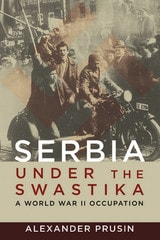
Serbia under the Swastika
A World War II OccupationAlexander Prusin
University of Illinois Press, 2017
Deftly merging political and social history, Serbia under the Swastika looks at the interactions between Germany’s occupation policies, the various forces of resistance and collaboration, and the civilian population. Alexander Prusin reveals a German occupying force at war with itself. Pragmatists intent on maintaining a sedate Serbia increasingly gave way to Nazified agencies obsessed with implementing the expansionist racial vision of the Third Reich. As Prusin shows, the increasing reliance on terror catalyzed conflict between the nationalist Chetniks, communist Partisans, and the collaborationist government. Prusin unwraps the winding system of expediency that at times led the factions to support one-another against the Germans--even as they fought a ferocious internecine civil war to determine the future of Yugoslavia.
Comprehensive and judicious, Serbia under the Swastika is a rare English-language foray into the still-fraught history of Serbia in World War II.
The Aftermath of War
Jean-Paul Sartre
Seagull Books, 2008
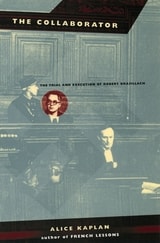
The Collaborator
The Trial and Execution of Robert BrasillachAlice Kaplan
University of Chicago Press, 2000
Was Brasillach in fact guilty of treason? Was he condemned for his denunciations of the resistance, or singled out as a suspected homosexual? Was it right that he was executed when others, who were directly responsible for the murder of thousands, were set free? Kaplan's meticulous reconstruction of Brasillach's life and trial skirts none of these ethical subtleties: a detective story, a cautionary tale, and a meditation on the disturbing workings of justice and memory, The Collaborator will stand as the definitive account of Brasillach's crime and punishment.
A National Book Award Finalist
A National Book Critics Circle Award Finalist
"A well-researched and vivid account."—John Weightman, New York Review of Books
"A gripping reconstruction of [Brasillach's] trial."—The New Yorker
"Readers of this disturbing book will want to find moral touchstones of their own. They're going to need them. This is one of the few works on Nazism that forces us to experience how complex the situation really was, and answers won't come easily."—Daniel Blue, San Francisco Chronicle Book Review
"The Collaborator is one of the best-written, most absorbing pieces of literary history in years."—David A. Bell, New York Times Book Review
"Alice Kaplan's clear-headed study of the case of Robert Brasillach in France has a good deal of current-day relevance. . . . Kaplan's fine book . . . shows that the passage of time illuminates different understandings, and she leaves it to us to reflect on which understanding is better."—Richard Bernstein, The New York Times
The Expectation of Justice
France, 1944–1946Megan Koreman
Duke University Press, 2000
As the first social history of the “après -Libération” period from the perspective of ordinary people, Koreman’s study reveals how citizens of these towns expected legal, social, and honorary justice—such as punishment for collaborators, fair food distribution, and formal commemoration of patriots, both living and dead. Although the French expected the Resistance’s Provisional Government to act according to local understandings of justice, its policies often violated local sensibilities by instead pursuing national considerations. Koreman assesses both the citizens’ eventual disillusionment and the social costs of the “Resistencialist myth” propagated by the de Gaulle government in an effort to hold together the fragmented postwar nation. She also suggests that the local demands for justice created by World War II were stifled by the Cold War, since many people in France feared that open opposition to the government would lead to a Communist takeover. This pattern of nationally instituted denial and suppression made it difficult for citizens to deal effectively with memories of wartime suffering and collaborationist betrayal. Now, with the end of the Cold War, says Koreman, memories of postwar injustices are resurfacing, and there is renewed interest in witnessing just and deserved closure.
This social history of memory and reconstruction will engage those interested in history, war and peace issues, contemporary Europe, and the twentieth century.
The Hunt for Nazi Spies
Fighting Espionage in Vichy FranceSimon Kitson
University of Chicago Press, 2007
Simon Kitson informs this remarkable story with findings from his investigation—the first by any historian—of thousands of Vichy documents seized in turn by the Nazis and the Soviets and returned to France only in the 1990s. His pioneering detective work uncovers a puzzling paradox: a French government that was hunting down left-wing activists and supporters of Charles de Gaulle’s Free French forces was also working to undermine the influence of German spies who were pursuing the same Gaullists and resisters. In light of this apparent contradiction, Kitson does not deny that Vichy France was committed to assisting the Nazi cause, but illuminates the complex agendas that characterized the collaboration and shows how it was possible to be both anti-German and anti-Gaullist.
Combining nuanced conclusions with dramatic accounts of the lives of spies on both sides, The Hunt for Nazi Spies adds an important new dimension to our understanding of the French predicament under German occupation and the shadowy world of World War II espionage.